Christian Social Issues Research Survey
62% of Non-Evangelicals Say "Church Encourages Discrimination and Hate"
[Asia Economy Reporter Kim Hyunjung] There is little difference in political orientation between Protestant Christians and non-Protestants in Korea, but significant differences in their stances on abortion (pregnancy termination) and same-sex marriage have been revealed.
The Korea Christian Social Issues Research Institute announced on the 12th the results of an online survey conducted last November by G&Com Research targeting Protestant Christians and non-Protestants nationwide aged 19 and older.
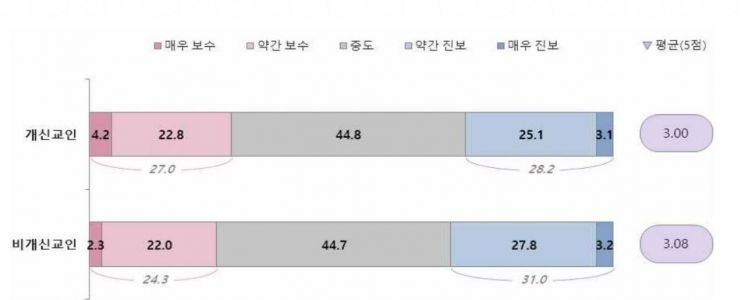 Subjective political orientations of Protestant and non-Protestant individuals.
 [Photo by Yonhap News]
First, regarding subjective political orientation, there was no significant difference between Protestants and non-Protestants. Among Protestants, 27.0% identified as conservative, 44.8% as moderate, and 28.2% as progressive. Among non-Protestants, 24.3% identified as conservative, 44.7% as moderate, and 31.0% as progressive.
When asked whether tactical nuclear weapons are necessary for the military security of the Korean Peninsula, 74.1% of Protestants and 76.1% of non-Protestants answered "necessary," while those who said "not necessary" were 25.9% and 23.9%, respectively. Responses regarding political interest, the sunshine policy toward North Korea, and the direction of social welfare policies were also similar between the two groups.
The topics showing the most stark differences between Protestants and non-Protestants were abortion and same-sex marriage. When asked which is more important between "women's right to choose" and "the fetus's life" regarding abortion, both groups mostly answered that women's right to choose is more important. However, among Protestants, 59.4% said "women's right to choose is important," whereas 76.8% of non-Protestants answered likewise.
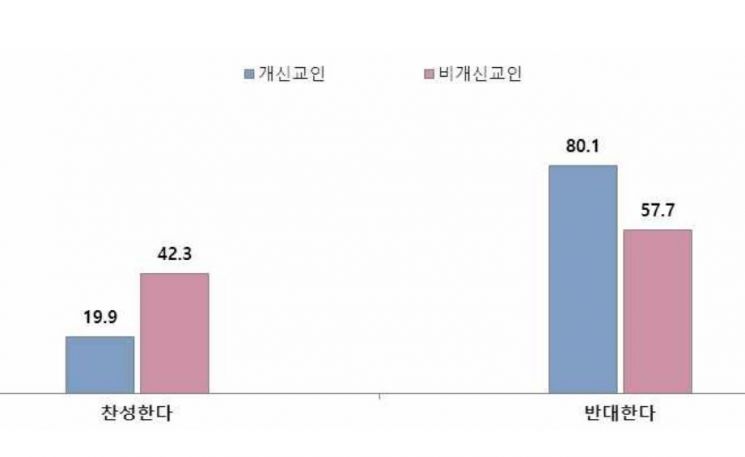
Regarding same-sex marriage, 80.1% of Protestants opposed it and 19.9% supported it, while among non-Protestants, 57.7% opposed and 42.3% supported it, showing that Protestants hold a much stronger opposition to same-sex marriage. In both groups, men showed relatively higher opposition rates, and younger age groups showed higher support rates. Additionally, among both Protestants and followers of other religions, longer years of religious practice and higher importance placed on religion correlated with higher opposition rates.
To gauge the degree of discomfort toward others, respondents were asked, "If OOO sits next to me on the subway, I would feel uncomfortable," with examples including homeless people, sexual minorities, people with disabilities (autistic tendencies, intellectual disabilities), foreign workers, the opposite sex, and elderly people over 70. Both groups most avoided "homeless people" (Protestants 79.7%, non-Protestants 80.4%). There was little difference between the two groups regarding other categories, but
the tendency to avoid sexual minorities was higher among Protestants (39.9%) than non-Protestants (31.9%). More than 60% of Protestants reported having heard sermons stating "homosexuality is a sin," and among them, 67.9% agreed with those sermons.
When asked whether Protestant churches incite discrimination and hatred, 47.0% of Protestants answered "no," while 62.2% of non-Protestants answered "yes," showing a significant difference in views. Among Protestants, only 30.5% answered "yes," less than half of the non-Protestants.
The survey included 1,000 Protestants and 1,000 non-Protestants, conducted with proportional allocation by region, gender, and age. Among non-Protestants, 21.7% were Buddhist, 14.2% Catholic, 1.2% other religions, and 62.9% non-religious. The sampling error, assuming random sampling, is ±3.1 percentage points at a 95% confidence level.
© The Asia Business Daily(www.asiae.co.kr). All rights reserved.


















