Supporting Vitality Recovery and Rejump for Middle-Aged and Older Adults through Humanities and Leisure Culture
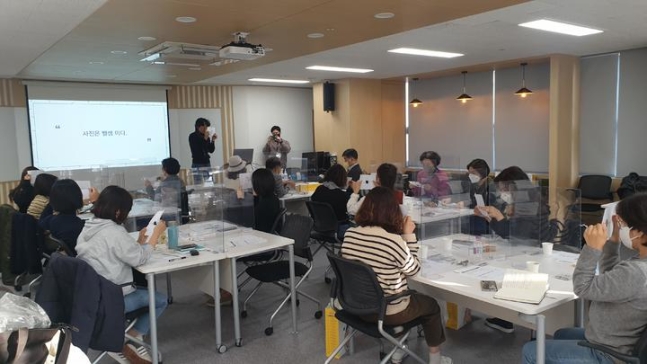 'Middle-aged and Senior Youth Culture Space' established at the Middle-aged Tomorrow Center.
 [Photo courtesy of the Ministry of Culture, Sports and Tourism]
[Asia Economy Reporter Kim Heeyoon] The government is creating 'Youth Culture Spaces' at 17 Middle-aged Tomorrow Centers nationwide.
On the 12th, the Ministry of Culture, Sports and Tourism and the Ministry of Employment and Labor announced that during the first half of this year, they will establish 'Middle-aged Youth Culture Spaces' at 17 Middle-aged Tomorrow Centers (formerly Middle-aged Job Hope Centers) nationwide and provide integrated humanities, leisure culture programs, and employment support services.
The Middle-aged Tomorrow Centers are employment support institutions under the Ministry of Employment and Labor that provide comprehensive employment services such as life career planning, job transition and reemployment support, and region- and industry-specialized services for workers aged 40 and above, including retirees and those expected to retire.
The Ministry of Culture, Sports and Tourism and the Ministry of Employment and Labor have included the national agenda project 'Middle-aged Youth Culture Spaces' in this year's new budget to address the difficulty middle-aged people face in enjoying cultural life due to time and economic reasons as they plan the latter half of their lives in an aging society. The Ministry of Culture, Sports and Tourism is investing 1.7 billion KRW (for programs), and the Ministry of Employment and Labor is investing 180 million KRW (for space creation).
Previously, since the second half of last year, the two ministries have been jointly preparing the project by creating 'Middle-aged Youth Culture Spaces' within the Seoul and Busan Middle-aged Tomorrow Centers. From October to November last year, they operated pilot programs together with public institutions such as the Korea Publication Culture Industry Promotion Agency and the Labor-Management Development Foundation, receiving great responses from the middle-aged participants.
A participant in her 50s, A, who took the 'Expressing with Words and Images' course at the Seoul Center during the pilot program, said, "After participating in the program, I was able to look back on my past life, and my vague fear of doing something different from what I have done so far has somewhat diminished."
B, a participant in his 60s who joined the 'How to Age Gracefully and Smartly' program at the Busan Center, said, "It was really good to be able to receive life career planning services and cultural programs simultaneously with peers. They say it is the era of a second life after retirement, and this helped me greatly in planning a new life after retirement."
The Ministry of Culture, Sports and Tourism and the Ministry of Employment and Labor have prepared an operational plan for the 'Middle-aged Youth Culture Spaces' considering the life cycle characteristics of middle-aged people through pilot program operations and expert research from institutions such as the Korea Culture and Tourism Institute.
The 'Middle-aged Youth Culture Spaces' will be operated as hub spaces providing cultural and employment services for the middle-aged. Basic spaces such as lecture rooms, learning spaces, club rooms, community spaces, and cultural cafes will be established.
Additionally, programs reflecting the characteristics and demands of the middle-aged, such as ▲ self-development through reading, writing, and learning ▲ enjoyment of humanities and leisure culture ▲ identity exploration, self-esteem recovery, psychological healing, relationship improvement, life planning, and humanities competency enhancement by occupation, will be operated in various formats including lectures, experiences, explorations, seminars, mentoring, counseling, and club support.
For those interested, cultural programs will also support active participation by the socially experienced middle-aged by providing opportunities to participate as instructors or mentors in humanities projects, as well as social contribution activities such as volunteering for local communities.
The linkage between cultural programs and employment support services will also be strengthened. Employment support service users at the Middle-aged Tomorrow Centers will be offered humanities and leisure culture programs, or those who participate in cultural programs will be consecutively provided with employment support services, enabling complex scheduling and customized services tailored to user needs.
Jung Hyangmi, Director of Cultural Policy at the Ministry of Culture, Sports and Tourism, said, "This project is part of President Yoon Suk-yeol’s pledge and was prepared for the middle-aged who are entering the second act of life after retirement. We hope that middle-aged people, who lacked time or opportunities to properly reflect on themselves and their surroundings while focusing only on moving forward in their youth, will prepare for a more exciting second life through various humanities, arts, and cultural programs."
Ha Hyungso, Director of the Integrated Employment Policy Bureau at the Ministry of Employment and Labor, said, "Facing a super-aged society, the Ministry of Employment and Labor and the Ministry of Culture, Sports and Tourism have launched a collaborative project utilizing each ministry’s resources and strengths targeting the middle-aged. It is even more meaningful that the Middle-aged Tomorrow Centers can serve as stepping stones for planning the latter half of life by providing integrated employment support and humanities and leisure culture services."
© The Asia Business Daily(www.asiae.co.kr). All rights reserved.
![Clutching a Stolen Dior Bag, Saying "I Hate Being Poor but Real"... The Grotesque Con of a "Human Knockoff" [Slate]](https://cwcontent.asiae.co.kr/asiaresize/183/2026021902243444107_1771435474.jpg)
















