Ministry of Health and Welfare to Include Measures to Relax Medical Aid Support Obligation Criteria in the '3rd Three-Year Basic Plan for Medical Aid'
Strengthening Coverage for Low-Income Groups and Researching Financial Demand Estimates
[Asia Economy Reporter Lee Gwan-joo] Attention is focused on whether the support obligation criteria, which remain only in medical benefits among the Basic Livelihood Security System, can be relaxed. The support obligation criteria have been pointed out as a factor that raises the threshold for medical benefits and creates blind spots in welfare.
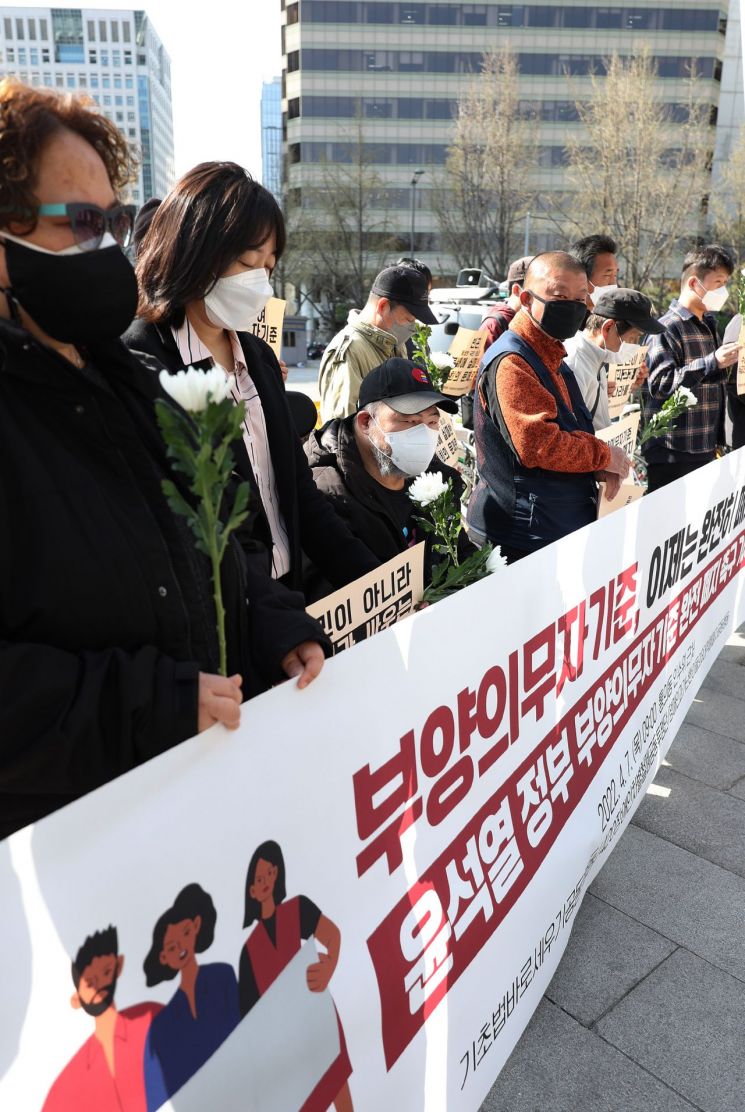 A civic group is holding a press conference urging the complete abolition of the support obligation criteria under the National Basic Livelihood Security System.
 [Image source=Yonhap News]
According to the Ministry of Health and Welfare on the 13th, the ministry recently commissioned a research project to establish the ‘3rd Three-Year Basic Plan for Medical Benefits,’ beginning to draw the main outline of medical benefit policies to be applied over the three years from 2024 to 2026. Through this research, the ministry plans to analyze the achievements and limitations of the previous 2nd Basic Plan and derive key areas for the mid- to long-term development of medical benefits, core policy goals, detailed tasks, and specific implementation measures for system improvement.
In particular, this study is expected to prepare a phased plan to relax the support obligation criteria for medical benefits. The support obligation criteria exclude individuals from the Basic Livelihood Security System if they have parents, children, or spouses with income or assets above a certain level. However, as the number of non-beneficiary poor increased due to support obligors who had no intention to support, the government sequentially abolished the support obligation criteria for housing and education benefits, and also abolished the support obligation criteria for livelihood benefits in October 2021, except for high-income (annual 100 million KRW) and high-asset (over 900 million KRW) support obligors.
The problem is that the criteria remain unchanged for medical benefits, causing a ‘reversal phenomenon’ where people receive livelihood benefits but not medical benefits. According to data submitted to Justice Party lawmaker Kang Eun-mi by the Ministry of Health and Welfare, 24,157 people who applied for medical benefits between 2021 and 2022 were rejected due to the support obligation criteria, with their average monthly income being only 440,000 KRW. This is lower than the average monthly income of 690,000 KRW for 6,891 people who were rejected from livelihood benefits due to the support obligation criteria. Over the past five years (2017 to June 2022), the rejection rate for medical benefits reached 43% (94,249 out of 217,903 applicants). In response to calls for abolishing the support obligation criteria for medical benefits, the ministry stated in this year’s work report that it would include improvement measures for the medical benefits support obligation criteria in the basic plan.
Along with this, the Ministry of Health and Welfare plans to conduct research in various areas such as strengthening medical coverage for low-income groups, measures to improve recipients’ health, enhancing the rationality of medical benefits system operation, and expanding and solidifying pilot projects for home medical benefits, to be included in this medical benefits basic plan. The ministry will analyze factors that have influenced the increase in medical benefits finances so far and conduct mid- to long-term projections of medical benefits financial requirements reflecting future demographic factors and policy environment changes. The ministry stated, “Based on the performance evaluation of the medical benefits system over the past three years, we will promote the establishment of a comprehensive development plan for medical benefits considering future policy environment changes.”
© The Asia Business Daily(www.asiae.co.kr). All rights reserved.
![User Who Sold Erroneously Deposited Bitcoins to Repay Debt and Fund Entertainment... What Did the Supreme Court Decide in 2021? [Legal Issue Check]](https://cwcontent.asiae.co.kr/asiaresize/183/2026020910431234020_1770601391.png)
















