Announcement of National Health Insurance Medical Treatment Status
3.6% Increase in Patients Over 5 Years
Avoid Drinking and Smoking, Engage in Proper Exercise

[Asia Economy Reporter Lee Gwan-joo] The number of patients suffering from 'intracerebral hemorrhage,' a condition where blood vessels in the brain suddenly rupture and blood accumulates, has increased over the past five years. Notably, the majority of these patients are elderly individuals aged 60 and above. Since high blood pressure is a major cause, efforts to manage blood pressure regularly are necessary.
On the 12th, the National Health Insurance Service (NHIS) announced the status of health insurance treatment for 'intracerebral hemorrhage' from 2017 to 2021 using health insurance treatment data.
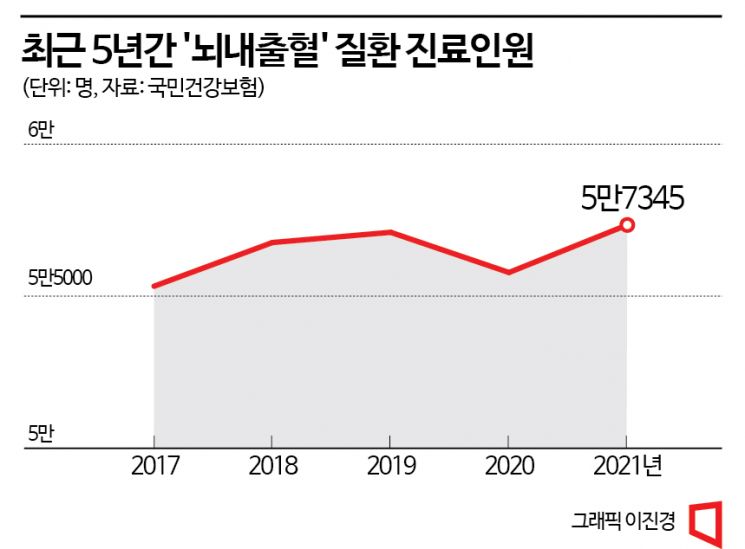
According to the NHIS, the number of patients treated for intracerebral hemorrhage increased by 3.6%, from 55,330 in 2017 to 57,345 in 2021, with an average annual growth rate of 0.9%. By gender, as of 2021, there were 31,546 men and 25,799 women, with men outnumbering women.
By age group, those in their 60s accounted for the largest share of total patients at 16,309 (28.4%). This was followed by those in their 70s with 13,371 (23.3%), 50s with 10,756 (18.8%), and those aged 80 and above with 9,887 (17.2%). Professor Lee Yun-ho of the Department of Neurosurgery at NHIS Ilsan Hospital explained, "After the age of 50, the number of patients with underlying conditions such as hypertension, diabetes, and hyperlipidemia, which cause arteriosclerosis that hardens and weakens blood vessels making them prone to rupture, increases, leading to a sharp rise in cerebral hemorrhage."
Additionally, the number of intracerebral hemorrhage patients per 100,000 people was 112. By age group per 100,000 people, those aged 80 and above had the highest rate at 519. Particularly, the total health insurance medical expenses for intracerebral hemorrhage patients increased by 43.3% over five years, from 407 billion KRW in 2017 to 583.1 billion KRW in 2021. The medical expenses per patient also rose by 38.3%, from 7.36 million KRW to 10.17 million KRW during the same period.
The primary cause of intracerebral hemorrhage is hypertension, which weakens small arteries and causes them to rupture. Major symptoms include hemiplegia, where one side of the body suddenly becomes paralyzed; dysarthria, characterized by slurred speech; aphasia, where patients speak inappropriately and cannot understand others; and diplopia, or double vision. Compared to cerebral infarction, intracerebral hemorrhage often involves an extremely severe headache that patients have never experienced before.
To prevent intracerebral hemorrhage, it is advised to avoid alcohol and smoking, consume sufficient vegetables and fish regularly, and engage in appropriate exercise for at least 30 minutes daily. Maintaining a healthy weight and waist circumference, and regularly monitoring blood pressure, blood sugar, and cholesterol levels are also recommended. If diagnosed with diabetes or hyperlipidemia, consistent treatment is necessary.
Professor Lee emphasized, "Intracerebral hemorrhage has a high risk of rebleeding, and the mortality rate significantly increases if rebleeding occurs." He added, "Since the mortality rate is highest within 1 to 2 days after the onset of cerebral hemorrhage, it is crucial to recognize the symptoms promptly, ensure rapid hospital transfer, and provide early treatment."
© The Asia Business Daily(www.asiae.co.kr). All rights reserved.
![Clutching a Stolen Dior Bag, Saying "I Hate Being Poor but Real"... The Grotesque Con of a "Human Knockoff" [Slate]](https://cwcontent.asiae.co.kr/asiaresize/183/2026021902243444107_1771435474.jpg)

















