First Release of ShadowCam Photos by NASA on Danuri
Vivid Tracks of Rocks Rolling on the Moon's Surface Captured
Posted on Arizona State University ShadowCam Operation Website
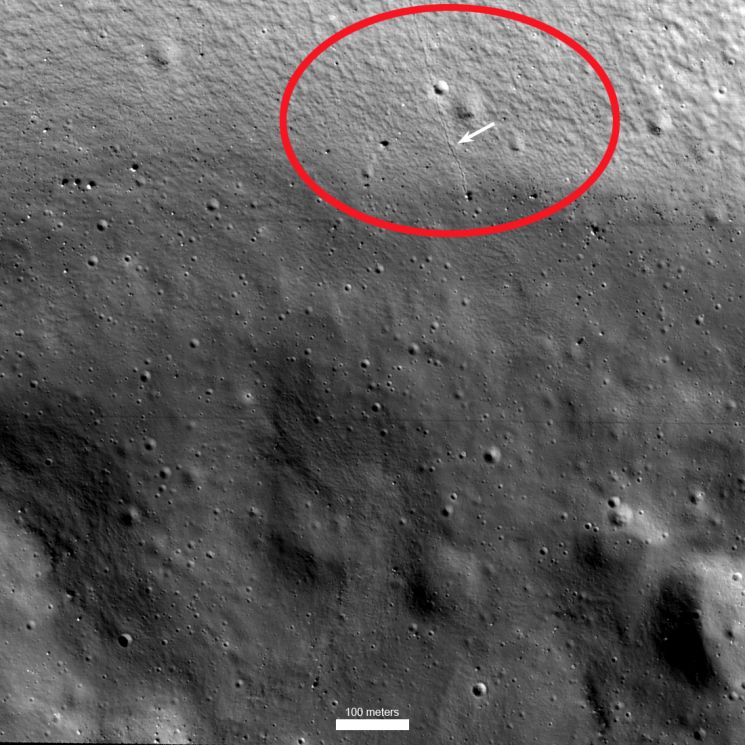 The permanently shadowed region on the Moon captured by the ShadowCam, developed by NASA and Arizona State University and mounted on Korea's lunar probe Danuri. Photo by Arizona State University website
[Asia Economy Reporter Kim Bong-su] "You can vividly see even the tracks of rocks rolling on the lunar surface."
The first photos taken by the 'ShadowCam,' developed by NASA and mounted on South Korea's lunar orbiter 'Danuri,' have been released.
The Korea Aerospace Research Institute (KARI) announced on the 12th that such photos were posted on the ShadowCam website operated by Arizona State University, the institution that developed the payload. The photos capture the permanently shadowed region inside Shackleton Crater, approximately 20 km wide, located at the Moon's south pole. Shackleton Crater is one of the candidate sites for manned landings under NASA's Artemis program, and NASA has been closely investigating this area using the Lunar Reconnaissance Orbiter (LRO). Arizona State University explained that the images provide detailed views of the permanently shadowed region of the Moon, showing features never seen before, such as the precise paths of 5-meter diameter rocks rolling down the steep crater slopes.
The ShadowCam mounted on Danuri is a special camera developed by NASA in collaboration with Arizona State University to analyze the presence of water in the permanently shadowed regions within craters at the lunar poles. It is designed to be over 200 times more sensitive to light compared to the Narrow Angle Camera (NAC) installed on NASA's LRO lunar orbiter launched in 2009, enabling it to capture images of permanently shadowed areas of the Moon that were previously unphotographable. Observations of these permanently shadowed regions, where water is expected to exist, will be used to select candidate sites for manned Artemis landings planned after 2025.
© The Asia Business Daily(www.asiae.co.kr). All rights reserved.
![Clutching a Stolen Dior Bag, Saying "I Hate Being Poor but Real"... The Grotesque Con of a "Human Knockoff" [Slate]](https://cwcontent.asiae.co.kr/asiaresize/183/2026021902243444107_1771435474.jpg)
















