Analysis Suggests Low Possibility of Mass Production for Micro LED
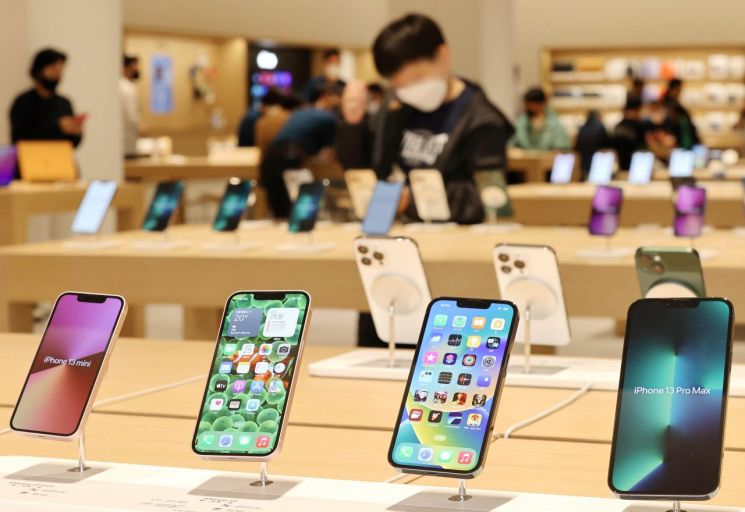
[Asia Economy Reporter Park Sun-mi] Apple is changing the display of its highest-spec Apple Watch model (Ultra) from the existing organic light-emitting diode (OLED) to micro light-emitting diode (LED) and is considering in-house production. Concerns are growing over the impact on Korean companies that have supplied displays to Apple.
On the 12th, Bloomberg reported that Apple plans to equip its new Apple Watch models with self-developed micro LED displays starting in 2024. Compared to OLED, micro LED has a significantly disadvantageous cost structure, which would greatly increase smartphone prices even if applied only to mobile devices. However, its advantages include bright screen implementation with excellent outdoor visibility, product reliability, and low power consumption.
Bloomberg predicted that if Apple installs self-designed displays, the Korean display industry will inevitably be hit, as LG Display and Samsung Display depend on Apple for 36% and 6.6% of their sales, respectively. Apple has been focusing on micro LED development since acquiring the startup LuxVue in 2014 with the goal of developing core components in-house.
Industry insiders say Apple is likely to first apply its self-developed micro LED display to the Apple Watch Ultra model and then possibly expand its application to other Apple products such as the iPhone and iPad. Especially for the iPhone 14, Samsung Display supplies about 70% of the displays and LG Display about 20%, so if Apple equips iPhones with self-developed displays in the future, the impact on the Korean display industry will inevitably increase. As market concerns grow, LG Display’s stock price, listed on the stock market, fell nearly 3% the previous day and was down about 1% again in the morning session.
However, some note that although Apple owns small- and medium-sized display production lines, its production capacity (capa) is small and the focus is still on technology research and development (R&D) rather than production, so it will take time before mass production in-house is realized. While Apple reducing its dependence on K-Display through in-house display production is unfavorable for Korean companies, Apple’s current conditions do not allow for rapid progress.
KB Securities analyst Kim Dong-won explained, "Samsung Display is currently focused only on producing OLED panels for the iPhone, and production of OLED panels for the Apple Watch has been halted since this year, so there is no immediate impact. Also, the micro LED Apple hopes to install in the Apple Watch is a display suitable for small mobile devices under 2 inches like watches, so for the next several years, Apple’s dependence on Korean companies including Samsung Display for display panel procurement is expected to remain at least 60% or higher."
Korean display companies also view the possibility of Apple immediately starting micro LED in-house production as low. Especially since it takes at least two years or more to secure mass production technology, set up facilities, and begin production at factories, the realistic chance of Apple equipping new Apple Watch models with self-developed micro LED displays starting in 2024 is slim. An industry official said, "In particular, Apple has never had experience producing components or finished products in-house," adding, "It is seen as an effort to secure fundamental technology rather than a likelihood of directly producing micro LED and applying it to Apple products."
© The Asia Business Daily(www.asiae.co.kr). All rights reserved.
![Clutching a Stolen Dior Bag, Saying "I Hate Being Poor but Real"... The Grotesque Con of a "Human Knockoff" [Slate]](https://cwcontent.asiae.co.kr/asiaresize/183/2026021902243444107_1771435474.jpg)











