One Year Since the Enforcement of the Serious Accident Punishment Act, 'CEO' Investigation and Punishment at the Center
Practical Response Measures from Prevention to Investigation and Recurrence Prevention Included
[Asia Economy Reporter Donghoon Jeong] Since the enforcement of the Serious Accidents Punishment Act, a report has been released containing companies' legal compliance measures and response plans in the event of accidents, based on investigative authorities' judgments on serious accidents.
On the 12th, the Korea Chamber of Commerce and Industry (KCCI) announced the report titled "Step-by-Step Response Measures for Serious Industrial Accidents," which analyzes investigative authorities' judgments on serious accidents that occurred after the law's enforcement, aiming to broaden member companies' understanding of the Serious Accidents Punishment Act, prevent serious accidents, and assist in legal compliance.
The report includes ▲ Current status of serious industrial accidents and investigation trends ▲ Responses during the stages of serious accident prevention and legal compliance ▲ Responses when serious accidents occur ▲ Measures to prevent recurrence of serious accidents ▲ Suggestions for legislative improvements.
A KCCI official explained, "Although the Serious Accidents Punishment Act is stipulated to protect workers' lives and bodies through the prevention of serious accidents, in industrial sites it functions as a law for strong punishment of CEOs. Despite one year having passed since the law's enforcement, companies continue to express frustration due to the law's ambiguity, so we have prepared response measures through legal firm consultations."
Among the 211 serious industrial accidents that occurred after the law's enforcement, 163 cases are currently under investigation, and 31 cases have been prosecuted for violating the Serious Accidents Punishment Act. Analyzing investigation cases, KCCI found that the application target of the Act is clearly the CEO.
According to the report, investigative authorities tend to actively investigate the CEO as the duty fulfillment subject, even if there is a Chief Safety Officer (CSO). It was advised that appointing a CSO is viewed as an attempt to protect the CEO during investigations, so if a CSO is appointed, it is important that the CSO exercises actual authority. Furthermore, in investigations of serious accidents involving subcontractors, authorities actively investigate the legal violations of the primary contractor's CEO.
Investigative authorities also tend to assess whether the obligation to ensure safety and health has been fulfilled, focusing on risk assessments. In particular, if issues pointed out in the risk assessment were not improved and an accident occurred, it would be difficult to avoid punishment.
Moreover, whether the company reviewed and improved risks reported by workers and reported them to the CEO is considered an important factor in determining legal violations. It was emphasized that when a serious accident occurs, documents showing workers' opinions must be submitted, so related evidence should be prepared.
A KCCI official stressed, "When a serious accident occurs, investigations and punishments basically target the CEO. When near-miss accidents or minor accidents, which are precursors to serious accidents, occur, workers' opinions must be heard, on-site investigations conducted, and improvements made to prevent escalation to serious accidents."
The report pointed out that establishing a safety and health management system to prevent serious accidents is not a waste of budget but an indispensable element in running a company, and companies must faithfully fulfill their safety and health obligations. To this end, it presented five key points for serious accident prevention and legal compliance. First, securing a safety and health budget and building a safety and health organization with that budget.
Second, granting appropriate authority to members of the safety and health organization and establishing procedures to evaluate their performance. It was emphasized that if members are not given budget authority or are not evaluated, it may be judged as failure to fulfill safety and health obligations, so caution is needed.
Third, the most important point is establishing procedures to identify and improve harmful and risky factors through risk assessments, conducting inspections, and taking measures. Since the establishment of criminal liability in investigations tends to focus on whether risk assessments were conducted and their evaluation items, thorough risk assessments are crucial. The government’s announced "Serious Accident Reduction Roadmap" also plans to amend the Industrial Safety and Health Act to establish risk assessment as a core means of preventing and preventing recurrence of serious accidents, expanding its application from companies with 300 or more employees to workplaces with 5 or more employees.
Fourth, establishing procedures to hear workers' opinions and implementing improvement measures. If the hearing procedure is not followed or appropriate measures are not taken after hearing and a serious accident occurs, the possibility of criminal punishment is high.
Fifth, in cases of subcontracting, outsourcing, or consignment, evaluating the safety and health capabilities of partner companies and reflecting this in contract decisions was urged. Many recent cases where CEOs of primary contractors were prosecuted for serious accidents involving subcontractor workers were due to the lack of standards and procedures for judging compliance with safety and health measures by subcontractors.
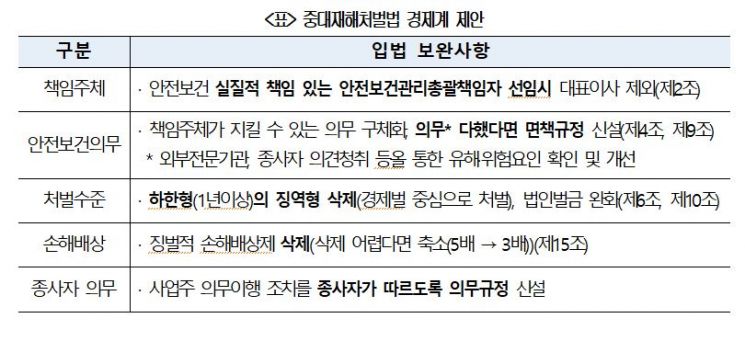
The report suggested that legislative supplementation is necessary to align with the original purpose of accident prevention, as fatal accidents have not decreased even after the enforcement of the Serious Accidents Punishment Act.
Regarding responsibility, it stated that if a Chief Safety Officer (CSO) with practical overall responsibility for safety and health management is appointed, this should be recognized. Since it is practically impossible for the CEO to manage all matters related to workplace operations, it is more effective for a CSO with expertise in safety and health to be in charge and fulfill the obligation to ensure safety and health, thereby protecting workers' lives and health.
It also argued that the obligation to ensure safety and health should be clarified. If harmful and risky factors are identified and improved through external professional institutions and workers' opinion hearings, the obligation should be considered fulfilled. Since the Act applies to companies of various industries and sizes, but contains many abstract provisions such as "necessary measures and budget," "faithful performance of duties," and "obligations under safety and health-related laws," companies cannot predict or judge compliance.
Meanwhile, KCCI will hold an online briefing session on the report announced today for member companies on the 17th. A lawyer from the law firm Sejong, who provided legal advice during the report's preparation, will be invited as a speaker to explain detailed step-by-step responses to serious accidents and answer companies' questions in real time.
Yuilho, head of the Employment and Labor Policy Team at KCCI, said, "Although companies have made efforts to fulfill obligations under the Serious Accidents Punishment Act, serious accidents have not decreased, and voices from the field calling for amendments aligned with the prevention purpose are growing. Especially since workplaces with fewer than 50 employees, which have weak legal compliance capabilities, will be subject to the law starting next year, legislative supplementation must be made within this year."
© The Asia Business Daily(www.asiae.co.kr). All rights reserved.
![Clutching a Stolen Dior Bag, Saying "I Hate Being Poor but Real"... The Grotesque Con of a "Human Knockoff" [Slate]](https://cwcontent.asiae.co.kr/asiaresize/183/2026021902243444107_1771435474.jpg)
















