Jogye Order Announces This Year's Plan
Considering Abolishing Temple Admission Fees from May
Focusing on Training Monastics and Monk Welfare
Preparing to Establish Meditation Center and Programs
[Asia Economy Reporter Seomideum] The controversial issue of charging admission fees for cultural heritage at temples is expected to be resolved soon. The Jogye Order of Korean Buddhism has announced that it will ultimately abolish the admission fees.
Jinwoo Sunim, the Chief Executive of the Jogye Order of Korean Buddhism, stated at a New Year's press conference held on the morning of the 11th at the Korean Buddhist History and Culture Memorial Hall in Jongno-gu, Seoul, “This year, government budget has been allocated to support cultural heritage admission fees. We will conduct a survey (research project) until April, and from May, we are considering abolishing the admission fees as a public service.”
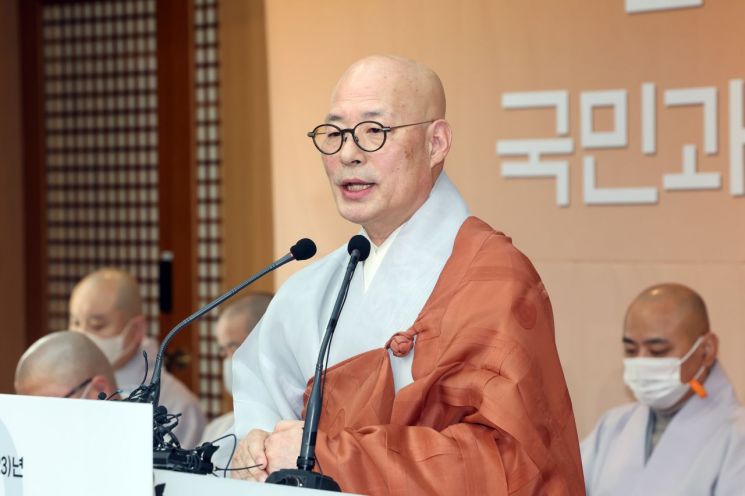 Jinwoo Sunim, the Chief Executive of the Jogye Order, is holding a New Year's press conference on the 11th at the Korean Buddhist History and Culture Memorial Hall in Jongno-gu, Seoul. [Image source=Yonhap News]
The government-related budget amounts to 41.9 billion KRW. The amended Cultural Heritage Protection Act, which allows the state to support the cost of waived admission fees, is set to take effect on May 4 this year. According to Jinwoo Sunim, a government-commissioned research project is currently underway, and based on this, consultations with the authorities will proceed.
Jinwoo Sunim explained, “Currently, admission fees are collected at about 70 temples nationwide. Monks have been collecting admission fees to preserve national cultural heritage that should be managed by the state, but the order and the government are working together to resolve public inconvenience.”
Efforts will also be made to support those entering monastic life. Jinwoo Sunim emphasized, “To liberate all sentient beings from suffering, there must be practitioners and teachers. Monastics are essential.” He added, “We plan to establish appropriate welfare and practice environments. In particular, we intend to actively promote military propagation and propagation to elementary and secondary school students targeting young people.” According to the Jogye Order, this year welfare will be strengthened in areas such as national pension, medical expenses, housing, care, medical treatment, and daily living for monks. Especially in medical care, there are plans to establish and operate a specialized nursing hospital for monks.
Work will also be carried out to upright the Ma-ae Buddha carved into the rock in Yeolam Valley, Namsan, Gyeongju, which was found fallen forward while still attached to the ground. Jinwoo Sunim cited this as a key task for this year, stating, “Various sectors are responding to the order’s proposal, and technical reviews by related institutions are nearing completion. If the public’s interest continues, within a few years the rock-carved Buddha will smile brightly toward the world.”
Regarding the 41.7 billion KRW compensation to be received after winning a lawsuit claiming the loss of land owned by Bongeunsa Temple in the Gangnam area of Seoul due to past document forgery by public officials, he said nothing has been finalized yet but added, “We plan to use it well for propagation.”
He also mentioned the development of meditation programs. Jinwoo Sunim said, “In fact, temples nationwide can be considered meditation centers,” but added, “Currently, land and construction plans are being concretely promoted in downtown Seoul. Discussions are ongoing with local government heads in Jeju Island, Jeolla Province, and Gyeongbuk Province.” He continued, “We are designing meditation programs with leading domestic meditation experts and aim to create a world-class Seon (Zen) meditation program.”
He plans to devote efforts to helping neighbors in need as well. Jinwoo Sunim said, “Although South Korea has reached an advanced level materially and economically, there is still a severe wealth gap and many marginalized groups. The spirit of Jata-bul-i (self and others are not two), which cares for the poor and marginalized neighbors, is the foundation for willingly sharing suffering to overcome times of hardship. The Jogye Order of Korean Buddhism will join various paths to resolve social issues.”
© The Asia Business Daily(www.asiae.co.kr). All rights reserved.
![Clutching a Stolen Dior Bag, Saying "I Hate Being Poor but Real"... The Grotesque Con of a "Human Knockoff" [Slate]](https://cwcontent.asiae.co.kr/asiaresize/183/2026021902243444107_1771435474.jpg)
















