[Asia Economy Reporter Byeon Seon-jin] Despite the COVID-19 outbreak situation in China, the decline in the winter outbreak in South Korea is clear. If this trend continues, there is hope that the government's expected indoor mask mandate lift by the end of this month could take place, but there are additional variables to consider.
According to the Central Disease Control Headquarters (CDCH) on the 12th, the average daily number of confirmed cases in the first week of January (1st to 7th) was 59,239, confirming a decrease in new cases for two consecutive weeks. The peak of the winter outbreak, which started in the 30,000 range at the end of October, was likely in the third week of last month (18th to 24th, with a daily average of 67,314), when daily cases reached the high 80,000s. The infection reproduction number (Rt), an outbreak indicator, dropped below 1 to 0.95 for the first time in 12 weeks. This means that after three months of sustained outbreak, the current outbreak is being suppressed.
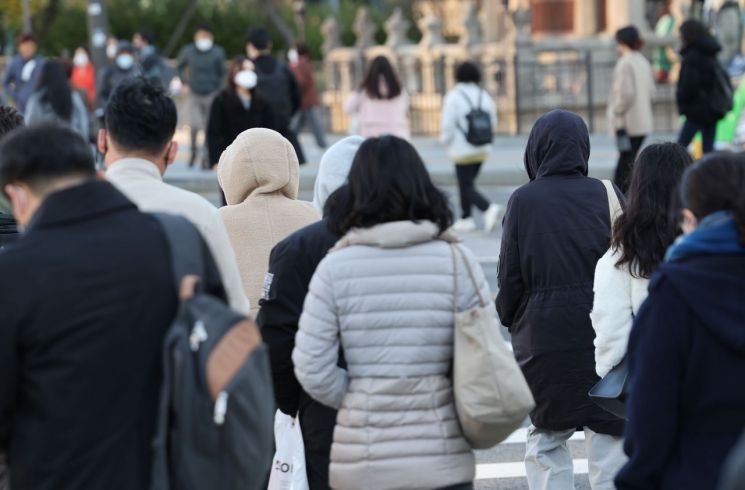
The scale of this 7th outbreak is less than half of the government's projection of up to 200,000 daily confirmed cases after December.
Professor Jeong Jae-hoon of Gachon University’s Department of Preventive Medicine analyzed, “Because the overall immunity level of the public has increased after experiencing the previous summer outbreak, this outbreak did not show a pattern of rapidly rising and falling but rather a gradual increase,” adding, “Currently, it can be said that the situation is stable, having peaked and now declining.”
The decisive difference between this outbreak and the previous summer outbreak: 'Variants'
The major difference between this winter outbreak and the summer outbreak is the variety of variants. The previous outbreak was a ‘single variant’ form, with the Omicron subvariant BA.5 accounting for 99.0% detection rate (first week of September last year). In contrast, this outbreak has shown a ‘variant Warring States period’ pattern, with BA.5 (34.4%) gradually losing strength while BN.1 (32.4%), BQ.1·BQ.1.1 (12.1%), BA.2.75 (10.0%), BF.7 (6.0%), and other diverse variants competing for dominance. Recently, XBB.1.5 (0.2%), known among local scientists in the U.S. as having the highest immune evasion ability and rapidly spreading there, was detected 17 times cumulatively since the 8th of last month.
Yoo Cheon-kwon, head of the CDCH Diagnostic Analysis Team, said, “Even if BA.5 decreases and BN.1 increases domestically during the winter outbreak, the impact on confirmed and severe cases is not significant, and effective treatments are available,” adding, “In the U.S., where XBB.1.5 is spreading, confirmed cases increased, but due to the effectiveness of natural infection and vaccination, there was no significant change in the occurrence of severe cases.”
Will indoor mask mandate discussions be possible next week?
Among the four indicators the government presented last month as conditions for lifting the indoor mask mandate ? ▲weekly patient cases decreasing for two consecutive weeks ▲weekly new severe cases decreasing and weekly fatality rate below 0.10% ▲availability of more than 50% of intensive care beds mobilizable within four weeks ▲additional winter vaccination rates of 50% for the elderly and 60% for infection-vulnerable facilities ? two indicators (patient cases and bed availability) have been met, making mask mandate review possible.
However, the fact that severe cases, which appear with a 2-3 week lag from the scale of confirmed cases, are still on the rise remains a concern. The average daily number of severe cases was 444 in the first week of December last year, but it increased for four consecutive weeks, reaching nearly 600 (597) in the first week of January.
Jeong Ki-seok, head of the COVID-19 Special Response Team and member of the National Infectious Disease Crisis Response Advisory Committee, said at a regular briefing on the 9th, “If severe cases increase, 50% of those numbers result in death,” adding, “We need to see a decline in the severe case indicator before we can start discussions on adjusting the indoor mask mandate at next week’s National Infectious Disease Crisis Response Advisory Committee meeting.” The advisory committee, composed of infectious disease experts and others, advises the Central Disaster and Safety Countermeasures Headquarters to ensure that quarantine policies are scientific and efficient. The advisory committee meeting is scheduled for the 17th.
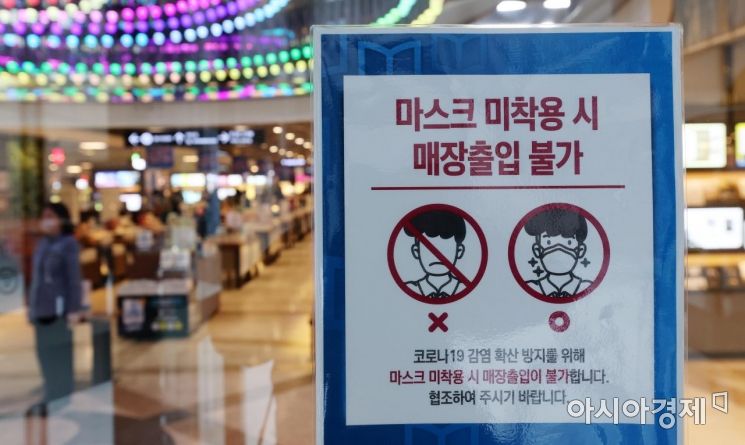 A notice regarding mask-wearing is posted at a bookstore in downtown Seoul. Photo by Hyunmin Kim kimhyun81@
The government’s position is that “in addition to the four indicators for lifting the indoor mask mandate, overseas situations and new variants must also be reviewed” (Minister of Health and Welfare Cho Kyu-hong). From the 2nd to the 7th, six days after enhanced quarantine measures against China were implemented, the positivity rate among arrivals from China was 19.6% (1,100 confirmed cases out of 5,617 arrivals). One in five travelers tested positive, indicating that the COVID-19 outbreak situation in China remains serious, and although no new variants imported from China have been detected yet, additional monitoring is necessary.
© The Asia Business Daily(www.asiae.co.kr). All rights reserved.
![Clutching a Stolen Dior Bag, Saying "I Hate Being Poor but Real"... The Grotesque Con of a "Human Knockoff" [Slate]](https://cwcontent.asiae.co.kr/asiaresize/183/2026021902243444107_1771435474.jpg)

















