[Asia Economy Reporter Ryu Tae-min] Two months ago, at the Seoul Western District Court’s real estate auction site, a 30.1㎡ (exclusive area) A Villa first-floor unit located in Gusan-dong, Eunpyeong-gu, which was up for auction, found a new owner. It was nine months since it first appeared as an auction item in February last year. It had been passed over seven times due to no bidders. Finally, at the 8th auction, it was sold for 21% of the appraised value of 103 million KRW, at 21.6 million KRW. However, it turned out that the successful bidder was Jeon, a tenant currently residing in the villa. Since no one wanted to buy the so-called ‘empty shell jeonse’ property, the tenant took the initiative to purchase the house themselves.
As the housing market continues to slump, even the court auction market has frozen, leading to an increase in ‘empty shell jeonse’ victims directly winning auctions. With no bidders, tenants have no way to recover their jeonse deposits, forcing them to reluctantly bid themselves.
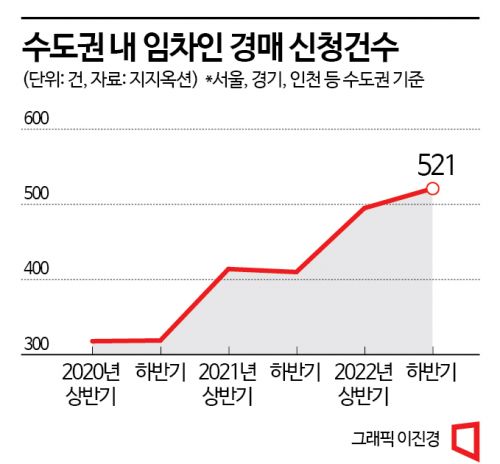
According to Gigi Auction, a court auction specialist company, the number of cases in the second half of last year in the Seoul metropolitan area (Seoul, Gyeonggi, Incheon) where tenants filed auctions against landlords totaled 521. This is an increase of over 100 cases each year compared to 319 cases in the second half of 2020 and 410 cases in the second half of 2021.
The increase in cases where tenants directly apply for auctions is due to the growing number of landlords unable to return jeonse deposits. Even after the contract period expired, tenants could not get their deposits back, so they directly applied for forced auctions.
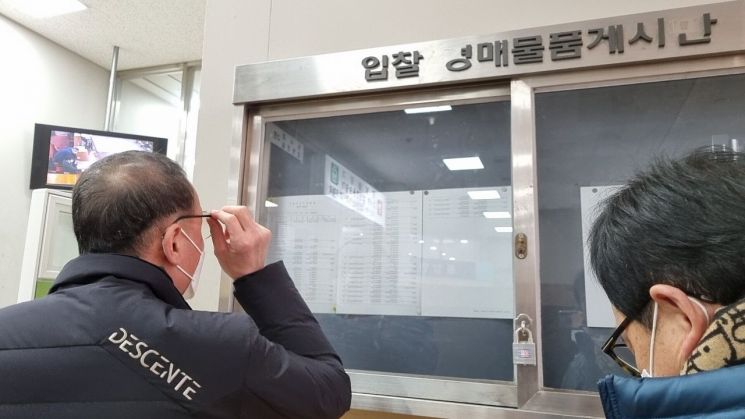
Auction Market ‘Frozen Solid’... Winning Prices Also ‘Plummet’
The problem is that as the auction market freezes, properties are not selling. In December last year, the winning bid rate for villas in Seoul was 11.1%. The winning bid rate refers to the ratio of properties with successful bidders among those put up for auction. For example, a winning bid rate of 11.1% means only about 1 out of 10 auctioned properties found a new owner. The villa winning bid rates in Incheon and Gyeonggi in December last year were also low at 25.0% and 22.9%, respectively.
The apartment market is also in a deep freeze. The winning bid rate for Seoul apartments in December last year was 17.9%, with most properties failing to sell. Incheon and Gyeonggi also saw low rates of 23.1% and 25.0%, respectively, with most properties remaining unsold.
As repeated failures to sell occur, the minimum price, which serves as the basis for the winning bid price, decreases. In Seoul, each time a property fails to sell once, the minimum price is reduced by 20% of the previous minimum price. For example, if a property with an appraised value of 1 billion KRW fails to sell at the first auction, the minimum auction price for the second auction starts at 800 million KRW. If it fails again at the second auction, the minimum price for the third auction becomes 640 million KRW, which is 20% less than 800 million KRW.
In other metropolitan areas like Incheon and Gyeonggi, the reduction rate is even steeper at 30% per failed auction. If a property with an appraised value of 1 billion KRW fails three times, the minimum price plummets to 340 million KRW.
As the winning bid price falls due to repeated failures, the jeonse deposit tenants can recover also decreases. Tenants can only recover their deposits after deducting auction-related costs and taxes such as local taxes from the winning bid amount. With the winning bid price sharply dropping, tenants’ anxiety grows.
Tenants Reluctantly Jump into Auctions
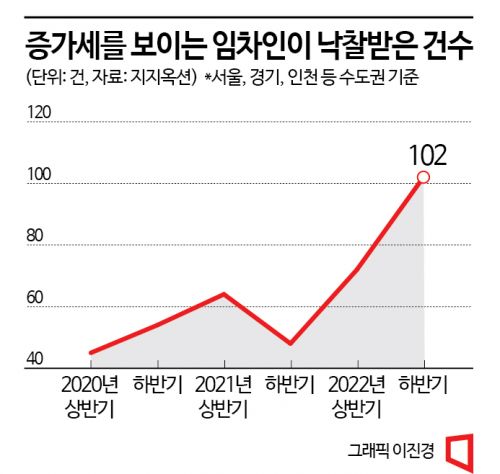
Recently, the number of tenants directly entering auctions has been increasing. According to Gigi Auction, in the metropolitan area, the number of cases in the second half of last year where tenants directly won auctions for homes they lived in was 102. This is more than double the 48 cases in the same period the previous year. For the entire last year, the total was 174 cases, an increase of more than 1.5 times compared to 112 cases in the previous year and 99 cases in 2020. Especially by region, as of the second half of last year, Seoul accounted for more than 60% with 62 cases.
Those who suffered large-scale jeonse frauds by so-called ‘Villa Kings’ or ‘Construction Kings’ are in even more difficult situations. Most of these properties have mortgages registered, so tenants lack even the legal right to oppose. With repeated failures to sell, tenants not only fail to recover any jeonse deposit but also face eviction from their homes.
For example, a 49.7㎡ (exclusive area) B apartment on the 10th floor in Sungui-dong, Michuhol-gu, Incheon, was won by tenant Park in the third auction last December for 137 million KRW. A 67.1㎡ C Villa unit on the 5th floor in Juan-dong, Michuhol-gu, was also won by tenant Kim in the second auction for 185 million KRW. They were victims of jeonse fraud by a construction businessman known as the ‘Construction King’ in Michuhol-gu, and after their homes failed to sell once or twice, they directly bid themselves.
When tenants directly enter auctions, the winning bid amount can be offset against the deposit. This means the winning bid amount is reduced by the amount of the deposit the tenant can recover. For example, if the winning bid is 150 million KRW and the tenant’s recoverable jeonse deposit is 50 million KRW, the tenant only needs to pay the remaining 100 million KRW.
However, it should be noted that the amount eligible for offset is not the total unpaid jeonse deposit but the amount the tenant will recover after the auction. For example, even if a tenant is owed 50 million KRW in jeonse deposit but only recovers 30 million KRW due to the distribution order of the winning bid amount, only 30 million KRW can be offset.
© The Asia Business Daily(www.asiae.co.kr). All rights reserved.
![Clutching a Stolen Dior Bag, Saying "I Hate Being Poor but Real"... The Grotesque Con of a "Human Knockoff" [Slate]](https://cwcontent.asiae.co.kr/asiaresize/183/2026021902243444107_1771435474.jpg)













