Statistics Korea Reports and Finalizes '2023 Major Work Plan' to Ministry of Economy and Finance
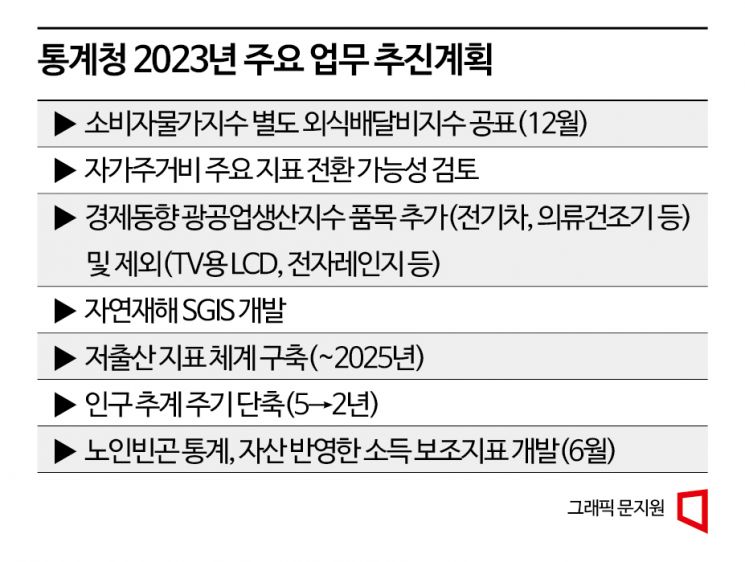
[Asia Economy Sejong=Reporter Kim Hyewon] Starting this December, the Food Delivery Cost Index will be published separately from the Consumer Price Index (CPI). This is to distinguish the proportion of in-store food prices and delivery fees when dining costs rise or fall. By 2025, a final decision will be made on whether to convert the owner-occupied housing cost, currently a supplementary indicator of the CPI, into a main indicator.
Items such as electric vehicles and clothes dryers will be added to the composition of the Industrial Production Index in economic trend statistics, while items with decreased domestic production like TV LCDs and microwave ovens will be excluded.
In response to the population crisis, the projection cycle will be shortened from 5 years to 2 years, and an indicator system capable of diagnosing the current state and causes of low birth rates will be established around 2025.
To examine "whether the elderly population in Korea is truly impoverished," elderly poverty statistics will develop an income supplementary indicator reflecting assets by June. A second survey by household members will be conducted in March for virtual asset statistics, which had a first pilot survey targeting household heads.
On the 11th, Han Hoon, Commissioner of Statistics Korea, reported and finalized the "2023 Major Work Plan of Statistics Korea" containing these details to Deputy Prime Minister and Minister of Economy and Finance Choo Kyung-ho.
Revision of Price Indices, Separate Publication of Food Delivery Cost Index... Review of Owner-Occupied Housing Cost as Main Indicator
The CPI statistical system will be revised to reflect recent changes in consumer spending patterns. The item-specific weights composing the CPI will be updated from the 2020 base to the 2022 base and the results will be published in December.
By conducting simultaneous surveys of in-store and delivery prices for dining establishments, the current status of food delivery costs will be identified, and the Food Delivery Cost Index will be published separately from the CPI in December. This is because it takes one year to secure a time series.
In response to demands for improving the method of calculating owner-occupied housing costs in the CPI, the possibility of converting it into a main indicator will be reviewed. However, after a process of public consultation, the final decision is expected around 2025. Commissioner Han explained, "If the owner-occupied housing cost, currently a supplementary indicator, is included as a main indicator in the CPI, its share will significantly increase to 27.8% of the total," adding, "This could cause the CPI to fluctuate greatly depending on housing cost changes." He further noted, "Since many parts are linked to consumer price indicators such as pensions, thorough review including foreign cases is necessary."
Economic trend statistics will also be partially revised. Representative items and weights for the Industrial Production Index will be updated from the 2015 base to the 2020 base and published starting in March. To increase the utilization of regional data, the number of representative items for Sejong City will be significantly increased from 54 to 81, and the publication scope will be expanded from the total index to the middle classification level.
A Natural Disaster Statistical Geographic Information Service (SGIS) will be developed. This system integrates natural disaster information with spatial statistics to assist in pre- and post-analysis of vulnerable groups' damage, such as residents of semi-basement or old houses and the elderly population, when disasters occur.
The Nowcast Portal, a big data-based rapid indicator platform, will add new indicators such as consumer dining expenditures using delivery apps, road traffic volume, and subscription service expenditures to the existing eight indicators including credit card usage and online job openings, with services starting in December.
Collaboration with telecommunications companies and credit card companies will expand analyses of regional tourism characteristics and lifestyle patterns.

Support for National Issues such as Low Birth Rate Indicators and Migrant Statistics... Commissioner Han: "Upgrading Statistics Korea to a Department Will Help Strengthen Data Hub Functions"
Statistics Korea will establish a low birth rate indicator system to support government policies addressing the population crisis. Indicators will be developed year-round to diagnose the current state and causes of low birth rates, and after research projects and consistency checks, an indicator system will be established by 2025. The indicators will be categorized into low birth rate status, causes, and responses, with domains and subdomains organized accordingly.
The population projection cycle will be shortened from 5 years to 2 years to provide future population projections (nationwide and by city/province) reflecting rapidly changing population structures. This year, nationwide future population projections (2022?2027) will be published, and next year, city/province-level projections will be released.
Statistics on multicultural children, naturalized citizens, foreigners, North Korean defectors, and their children aged 24 and under with migration backgrounds will be provided in November based on the Population and Housing Census.
In economic activity population survey statistics, the elderly category will be subdivided from "70 years and older" into "70?74 years" and "75 years and older," and a new employment status survey including platform workers and various labor types will be conducted starting in July.
To enhance the perceived accuracy of elderly poverty statistics, an income supplementary indicator reflecting assets will be developed by June, and additional use of administrative data (private pension income) will be pursued by September. Commissioner Han said, "We will consider including imputed housing income (the net value of housing services provided by owner-occupied homes) and housing/farmland pensions," adding, "There are academic opinions questioning the high elderly poverty rate in Korea among OECD countries and whether owner-occupiers can be considered impoverished, aiming to provide information that better reflects reality."
The population and enterprise statistical registries will be advanced by adding items. Additionally, pension statistics linked to each ministry's pension data based on the statistical registries will be developed by October to help understand pension subscription and receipt status by individual and household characteristics. Combining statistical registries with private credit data, an in-depth analysis of household debt characteristics for all households in Korea will be conducted.
Regarding virtual assets, following the first pilot survey last year, a second survey by household members will be conducted in March to more accurately grasp ownership status. Review of the virtual asset statistics compilation method will also begin in August.
Furthermore, to produce and share timely data related to regional economies, a regional income statistics rapid report will be developed by 2024 with the goal of publication in 2025.
Commissioner Han emphasized, "This year, Statistics Korea will do its best to support evidence-based policies and ultimately improve the quality of life for the people through citizen-centered innovation in statistics production, utilization, and services."
Regarding the organizational reform movement to upgrade Statistics Korea to a department, he said, "If the status of Statistics Korea is elevated, it will be efficient in strengthening data hub functions," adding, "Currently, the Statistics Act is under the Ministry of Economy and Finance, but if upgraded to a department, active revisions to the Statistics Act and other matters will be possible."
© The Asia Business Daily(www.asiae.co.kr). All rights reserved.
![Clutching a Stolen Dior Bag, Saying "I Hate Being Poor but Real"... The Grotesque Con of a "Human Knockoff" [Slate]](https://cwcontent.asiae.co.kr/asiaresize/183/2026021902243444107_1771435474.jpg)

















