[Asia Economy Yang Nak-gyu, Military Specialist Reporter] South Korea and the United States will conduct an extended deterrence measure operation exercise (TTX) next month, assuming a scenario of North Korea's nuclear use. While previous TTXs conducted by the two countries aimed at crisis management on the Korean Peninsula, from now on they intend to prioritize responding to the North Korean nuclear crisis. The tabletop exercise (TTX) is also translated as a war game or discussion exercise, and as the term "tabletop" suggests, it is a type of simulated training where military units do not actually mobilize in the field.
On the 21st, the Ministry of National Defense stated in this year's government New Year work report, "South Korea and the United States will conduct a TTX in the U.S. next month and expand the frequency and intensity of deployment of U.S. strategic assets on the Korean Peninsula to achieve the effect of permanent deployment." To this end, they plan to revise the Korea-U.S. Tailored Deterrence Strategy (TDS) within this year.
In November last year, at the 54th Security Consultative Meeting (SCM) held in the U.S. attended by the defense ministers of both countries, South Korea and the U.S. agreed to discuss joint planning and joint exercises for nuclear force operations. The two governments intend to strengthen cooperation to deter North Korea's nuclear and missile threats as North Korea continues unprecedented levels of military provocations and demonstrates its determination to strengthen its nuclear capabilities.
Joint planning means South Korea's participation in U.S. nuclear policy, strategy, operational plans, and rapid deterrence and response measures. It can be seen as officially reflecting South Korea's opinions in U.S. nuclear decision-making. Joint exercises refer to realistically training scenarios where the U.S. nuclear delivery strategic assets are supported by allied conventional means.
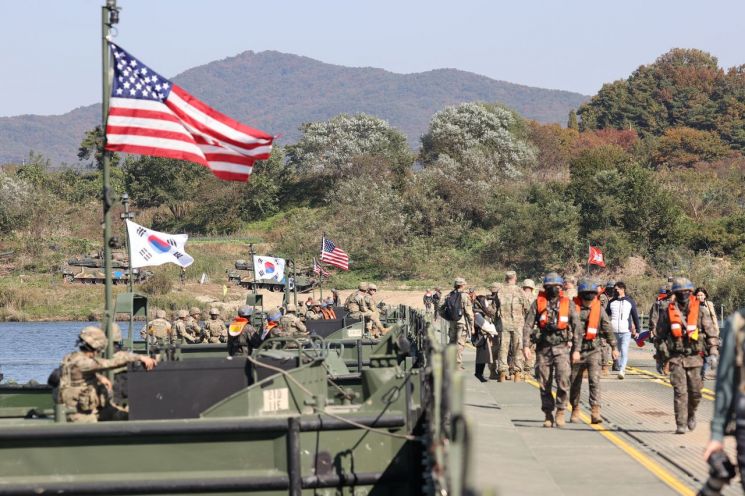
As part of the joint exercises, South Korea and the U.S. will conduct the combined exercise Freedom Shield (FS) from March 13 to 25. Previously, the exercise was conducted in two parts: Part 1 (defense), followed by a 2-3 day break, then Part 2 (offense). From this year, it will be conducted as a continuous exercise, making it the longest-ever 11-day exercise.
First TTX Based on North Korean Nuclear Use Scenario Conducted, FS Combined Exercise to be Longest Ever
The Moon Jae-in administration had reduced live field exercises to battalion-level exercises in each military branch due to COVID-19 and inter-Korean relations. In this year's FS combined exercise, a four-star general of the Republic of Korea Army will command the future combined command and complete the Full Operational Capability (FOC) evaluation, which is the second stage of the three-stage operational capability assessment for the transfer of wartime operational control.
In addition, the scale and types of outdoor live field exercises linked to the Korea-U.S. combined exercises will be expanded. Starting with the Ssangryong combined amphibious landing exercise involving the Korea-U.S. Marine Corps, combined science-based combat training, combined attack helicopter firing exercises, and combined maritime patrol operations will be conducted.
Also, the Ministry of National Defense announced plans to jointly hold the "Korea-UN Member States Defense Ministers Meeting" with the U.S. Through this, the Ministry explained it will consolidate international community support and cooperation for North Korea policy.
However, some speculate that this might officially mark the start of discussions on the status and role of the United Nations Command (UNC) after the transfer of wartime operational control (OPCON).
Currently, the Commander of U.S. Forces Korea concurrently serves as the Commander of the Korea-U.S. Combined Forces Command (exercising OPCON) and the Commander of the United Nations Command (managing the armistice regime). The U.S. general is essentially wearing three "hats." After the OPCON transfer, the future combined command led by the Republic of Korea Army will lead operations, but how much cooperation the UNC, which receives troops and equipment from UN member states, will provide is a key issue. The U.S. may have a fundamental reluctance to place various strategic assets it deploys in contingencies on the Korean Peninsula under South Korean command. This means they will not allow free operation of U.S. strategic assets.
A military official said, "We will strive to ensure that our position is reflected in the U.S. nuclear use decision-making process by holding more than three Korea-U.S. defense minister meetings this year."
© The Asia Business Daily(www.asiae.co.kr). All rights reserved.

















