Economic and Management Experts Express Concerns Over Persistent Low Growth
Economic Conditions and Growth Rate Show 'Chilly Outlook'

[Asia Economy Reporter Jeong Dong-hoon] Domestic economic and management experts described this year's domestic and international economic situation as "Down the rabbit hole in Alice in Wonderland." This means being drawn into a strange country where existing methods and strategies no longer work.
According to a survey conducted by the Korea Chamber of Commerce and Industry on the 11th targeting 85 economic and management experts (university professors, public and private research institute researchers) on the '2023 Economic Keywords and Corporate Environment Outlook,' this year is expected to be an economic situation of 'Down the rabbit hole.'
Experts chose keywords such as ‘Abyss,’ ‘Flickering candlelight in the wind,’ ‘Steep mountains,’ and ‘Surrounded on all sides’ to describe this year’s economy, expressing concerns that our economy will fall into a dark and chaotic situation like Alice falling down the rabbit hole in the fairy tale Alice in Wonderland. This expression is borrowed from Lewis Carroll’s 1865 novel Alice in Wonderland. Just as Alice follows a watch-carrying rabbit down the rabbit hole into a strange land, it represents a situation of confusion and labyrinth.
Keywords such as ‘Feeling one’s way in the dark’ (searching by groping in the dark), ‘Many hands make light work’ (many people working together can move mountains), and ‘Economic and social resilience’ were also presented as opinions on the direction we should take in response.
Concerns that this year will be the first year of entrenched low growth... Domestic and international economic conditions and growth rate outlook 'chilly'
In fact, 76.2% agreed with the opinion that this year will be ‘the first year of entrenched low growth.’
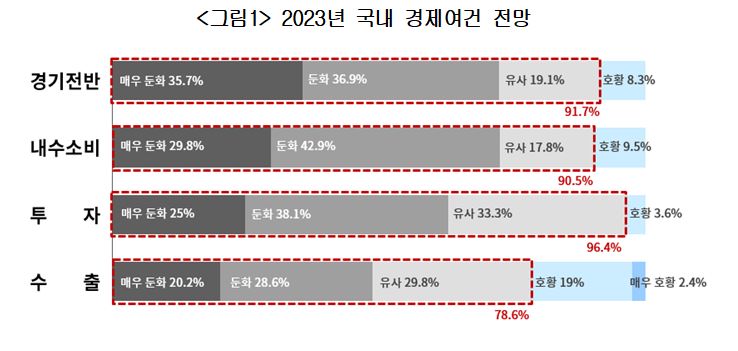
Regarding this year’s consumption and investment outlook, 90.5% and 96.4% respectively responded that they would be ‘similar to last year or slow down.’ For exports, 78.6% expected ‘similar to last year or slowdown.’
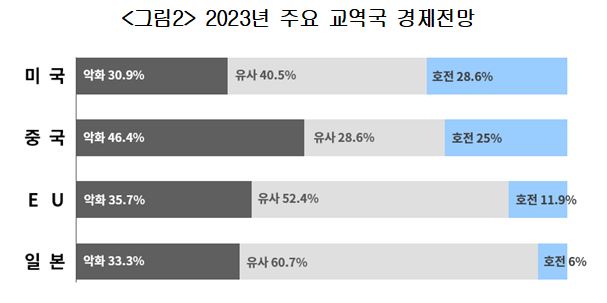
The world economic growth rate forecast also fell short of major institutions’ projections. Experts predicted this year’s global economic growth rate at about 2.22%, slightly below the forecasts of major institutions. Economic outlooks for major trading partners were also sluggish. The proportion of respondents who answered that the U.S. and China economies would be ‘similar to last year or worsen’ were 71.4% and 75%, respectively.
The economic risks facing our economy in the new year were most frequently cited as ‘high interest rate situation’ (24.5%) and ‘continued high inflation and raw material prices’ (20.3%). Following were ‘export slowdown and prolonged trade deficit’ (16.8%), ‘domestic demand recession’ (15%), and ‘geopolitical risks (U.S.-China conflict, war, etc.)’ (13.8%).
When asked about the most important factors to consider in deciding future interest rate policies, the largest number of experts (39.3%) chose ‘U.S. interest rate levels.’ Those who answered ‘economic conditions’ accounted for 23.8%, followed by ‘debt situation’ (21.4%) and ‘domestic inflation levels’ (15.5%).
Future growth industries? Battery 21%, Bio 19%, Mobility 17%
As the industries that will lead Korea after semiconductors, battery (21.2%), bio (18.8%), mobility (16.5%), and artificial intelligence (10.6%) were suggested. The response that next-generation semiconductors will continue to lead our economy was 5.9%.
As for the economic policy areas the government should focus on this year, ‘fostering future strategic industries’ (25%) was the most frequently chosen. ‘Stabilizing funds and financial markets’ (23.8%), ‘economic security and economic diplomacy’ (11.9%), ‘export expansion’ (9.5%), and ‘industrial and corporate restructuring’ (8.3%) followed. Stabilizing funds and financial markets was seen as an urgent short-term task, while fostering future strategic industries was identified as an urgent long-term task.
Last year’s Korean economy grade was ‘B’... Evaluated as ‘holding up well under difficult circumstances’ but concerns about ‘weakened fundamentals’ also exist
When asked to evaluate the Korean economy in 2022, 44.1% of experts responded ‘well,’ followed by ‘poor’ (41.7%), ‘very poor’ (8.3%), and ‘very well’ (5.9%). The highest proportion responded with a grade of ‘B’ (29.8%).
Despite difficult domestic and external conditions, the evaluation was that our economy held up well. Professor Cho Sung-hoon of Yonsei University’s Department of Economics said, “Entering the post-COVID era, consumption did not drop significantly, and having a well-balanced industrial base including semiconductors, automobiles, and petrochemicals were factors for relative resilience,” adding, “It is necessary to diversify national competitiveness by strengthening the competitiveness of key industries while promoting more diverse industries such as bio, defense, and eco-friendly energy.”
Concerns about weakened economic fundamentals also existed. Hwang Kyung-in, a research fellow at the Korea Institute for Industrial Economics and Trade, said, “There are concerns about the deterioration of our economy’s fundamentals, such as the reversal to a trade deficit, accumulation of household debt, and weakening fiscal soundness,” adding, “Especially recently, as major countries actively pursue industrial and trade policies based on domestic-first principles such as the IRA, it is necessary for us to expand policy support to strengthen fundamentals, including regulatory improvements, next-generation technology development support, and workforce training.”
All experts responded ‘social conflicts are serious’ (100%)... Most serious conflict identified as ‘political conflict’ (58%)
When asked about the overall level of conflict in our society, all respondents answered that the conflict level is ‘serious.’
Kang Seok-gu, head of the Korea Chamber of Commerce and Industry’s Research Division, said, “This year is a year to manage major economic indicators stably in response to economic uncertainties while achieving results in key reform tasks such as labor, regulation, and education,” adding, “Since key reform tasks are important policies supporting future sustainable growth, they must be pursued without wavering, but it will not be easy in the current situation where social conflicts are serious.”
Kang emphasized, “Ultimately, the key is cooperation between the government and the National Assembly,” and added, “Through cooperation, major policies must be promptly established and implemented to resolve public distrust in politics and enhance the dynamism of our economy.”
© The Asia Business Daily(www.asiae.co.kr). All rights reserved.
![Clutching a Stolen Dior Bag, Saying "I Hate Being Poor but Real"... The Grotesque Con of a "Human Knockoff" [Slate]](https://cwcontent.asiae.co.kr/asiaresize/183/2026021902243444107_1771435474.jpg)


















