Okryongsa Site and Over 10,000 Camellia Trees Converted into Festival Operation
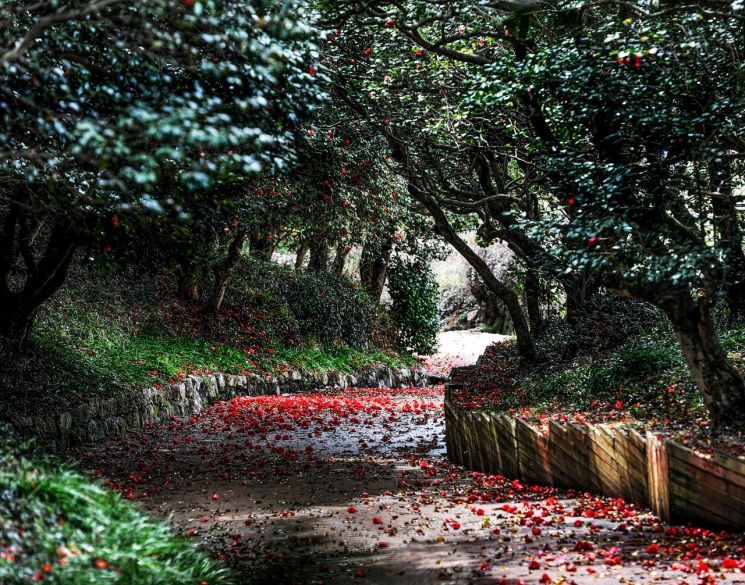
[Asia Economy Honam Reporting Headquarters, Reporter Heo Seon-sik] The "Okryongsa Camellia Forest," selected as Jeollanam-do's top forest for February, is a space where the aesthetics of emptiness and fullness are realized through the site of Okryongsa Temple and the densely packed 10,000 camellia trees.
Okryongsa Temple was a temple located south of Baekgye Mountain, a branch of Baegun Mountain, where Seongak Guksa Doseon stayed for 35 years (864?898), training disciples and eventually passing away.
The Camellia Forest is said to have been created when Doseon, who emphasized Bibo Pungsu (a form of geomancy that complements deficiencies), renovated Okryongsa to suppress the fire energy (hwagi) around the temple and to invigorate the earth's energy.
Although Okryongsa was destroyed by fire in 1878 and only a few foundation stones remain, the camellia trees, boasting an age of over 100 years, bloom dark red camellia flowers every year, continuing a thousand-year history.
In particular, it has been designated and protected as a Natural Monument (No. 489) in recognition of its academic value as a pristine southern temple forest and its beautiful scenery.
Even in the cold and dry winter, the Okryongsa Camellia Forest retains a deep green color full of moisture, conveying a strong vitality and liveliness.
Although expecting flowers in the winter camellia forest, which peaks in March, is unrealistic, the winter forest, which nurtures the red camellias to bloom in spring, is filled with energy (gi) and life.
Jung Gu-young, Director of Tourism, said, "The Okryongsa Camellia Forest, recognized as Jeollanam-do's top forest, is a land chosen by the geomancy master Seongak Guksa Doseon, a space where stillness and the buzz of life coexist in harmonious movement."
He added, "Although it is still difficult to see the bright red camellias, the subtle elegance of the ancient trees nurturing red life and the footsteps of tourists trying to read the forest's history never cease. We hope visitors to the Okryongsa Camellia Forest, where energy and life flow, will continue the vibrant Year of the Rabbit."
Meanwhile, the city plans to upgrade the cultural events centered around the Okryongsa Camellia Forest held annually at the end of March into a high-quality festival that satisfies citizens and tourists starting this year.
© The Asia Business Daily(www.asiae.co.kr). All rights reserved.

















