March 11: "Election Law Revision Must Be Completed Within March"
Constitutional Amendment Discussions Also Intensify
Advisory Committee Under Speaker Followed by Launch of Constitutional Amendment Special Committee
[Asia Economy Reporter Oh Ju-yeon] Ahead of the 2024 general elections, National Assembly Speaker Kim Jin-pyo, who brought the issue of reforming the 'large multi-member constituency system' to the forefront alongside President Yoon Seok-yeol, has raised the anchor for political reform by introducing constitutional amendment discussions following the electoral district reform. With the inauguration of an advisory committee directly under the Speaker and the upcoming establishment of a 'Constitutional Amendment Special Committee,' attention is focused on whether discussions on electoral system reform will accelerate.
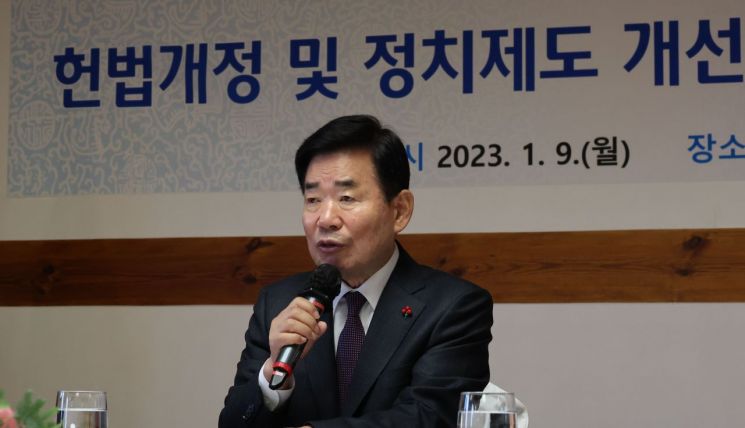
On the 11th, Speaker Kim Jin-pyo held a New Year's press conference at the National Assembly and stated, "Let's complete the revision of the election law by March."
To apply the recently heated electoral district reform plan in the political sphere starting from the general elections in April next year, the election law must be amended by April 10, one year in advance. Although only three months remain until the deadline, difficulties are expected as opinions differ not only between the ruling and opposition parties but also among individual lawmakers based on their interests regarding the change from the current single-member constituency system, which elects one person per district, to a large multi-member constituency system electing two or more members. However, Speaker Kim emphasized his determination to process the election law revision within the deadline, stating, "We must comprehensively overhaul the winner-takes-all electoral system and political relations laws."
He explained, "The upcoming general election should be a major turning point to end factional and fandom politics. There are exactly three months left until the legal deadline for the 22nd general election district delineation," adding, "The law stipulates that the number of district representatives and electoral districts must be finalized by April 10 at the latest."
He also criticized the fact that the electoral districts were finalized only a month before the 20th and 21st general elections, emphasizing, "If it is set by law, it must be observed no matter what, even if the sky splits in two," showing strong will for the election law revision.
Speaker Kim is expected to accelerate the election law revision by publicizing the issue.
First, after receiving expert advice on the electoral system from the National Assembly's Political Reform Special Committee (Jeonggae Special Committee), multiple amendment proposals will be drafted and then referred to the full committee of the National Assembly for intensive deliberation and resolution. Speaker Kim stated, "The full committee will hold focused discussions at least twice a week, and through public opinion surveys and live broadcasts on National Assembly TV, we can actively involve the public," emphasizing that he will approach the election law debate based on the three principles of 'focused discussion, public participation, and swift decision-making.'
Alongside the election law revision, discussions on constitutional amendment will also be launched in earnest. On the 9th, the 'Constitutional Amendment Advisory Committee' directly under the Speaker was inaugurated, which is expected to accelerate related discussions. Later, plans are to establish the 'National Assembly Constitutional Amendment Special Committee (Constitutional Amendment Special Committee)' through bipartisan agreement. Speaker Kim expressed hope, saying, "Once the Constitutional Amendment Special Committee is launched, a 'Public Opinion Committee' will be formed under it to actively begin a public participation-type constitutional amendment process."
The core of the constitutional amendment proposal is the restructuring of the existing power system, including the 'four-year renewable presidential term.' The four-year renewable term has been discussed since the 19th presidential election. The current winner-takes-all structure, which concentrates power in the presidency, has been criticized for causing many problems.
Speaker Kim proposed, "Let's start a 'national integration-type constitutional amendment discussion' to change the current political system, designed on a winner-takes-all basis, into a cooperative political system." He explained that powers concentrated in the executive branch will be dispersed to strengthen the legislative power of the National Assembly. He detailed, "It is necessary to realize the National Assembly's review rights over treaties and budgets and to transfer the Board of Audit and Inspection's accounting audit authority to the National Assembly," listing specific issues. Speaker Kim also said he would revise the 'Constitutional Amendment Procedure Act' to publicly explain the constitutional amendment schedule to the public.
Speaker Kim emphasized, "I consider the role of National Assembly Speaker as the last position in my political career," and added, "I will take setting our politics right as the mission of my 20-year political life."
© The Asia Business Daily(www.asiae.co.kr). All rights reserved.
![Clutching a Stolen Dior Bag, Saying "I Hate Being Poor but Real"... The Grotesque Con of a "Human Knockoff" [Slate]](https://cwcontent.asiae.co.kr/asiaresize/183/2026021902243444107_1771435474.jpg)
















