SKT, LG U+, KT and Others Achieve Successive 'Open RAN' Tests
Reducing Telecom Infrastructure Costs...Key Technology for the '6G Era'
US Deputy Secretary of Commerce Visiting Korea Discusses Open RAN Technology Cooperation with Domestic Telecom Industry

[Asia Economy Reporter Kang Nahum] Joint Open Radio Access Network (Open RAN) technology development achievements between domestic telecom companies and global corporations have begun to emerge. News of the commercialization of virtualized base stations and successful equipment interoperability tests is coming out one after another.
Open RAN is a technology that separates the hardware and software of mobile communication equipment such as base stations and standardizes the interface between devices so that equipment from different manufacturers can interoperate. Simply put, it means that any communication equipment from different manufacturers can be used interchangeably. Since Open RAN is considered a core technology transitioning from 5G (5th generation) to 6G, it is evaluated as a step closer to the 6G era.
Commercialization of 'Open RAN' is Near
On the 10th, SK Telecom, together with Nokia, installed the country's first cloud-based Open RAN virtualized base station in a commercial network and confirmed stable 5G service speed and coverage performance through field tests.
SK Telecom and Nokia have continuously collaborated on Open RAN base station research, including developing a cloud-based virtualized base station linked with 5G 64 TRx (embedded antenna) equipment early last year. This time, they demonstrated 5G performance by installing it in a commercial network for the first time in Korea. SK Telecom also succeeded in developing and verifying an intelligent base station controller (Radio Access Network Intelligent Controller, RIC) capable of automatic traffic optimization. A company official stated, "We developed technology to distribute traffic between base stations and optimize packet delay times according to service types and applied it to the intelligent base station controller." They added, "After application, we confirmed an improvement in 5G service quality."
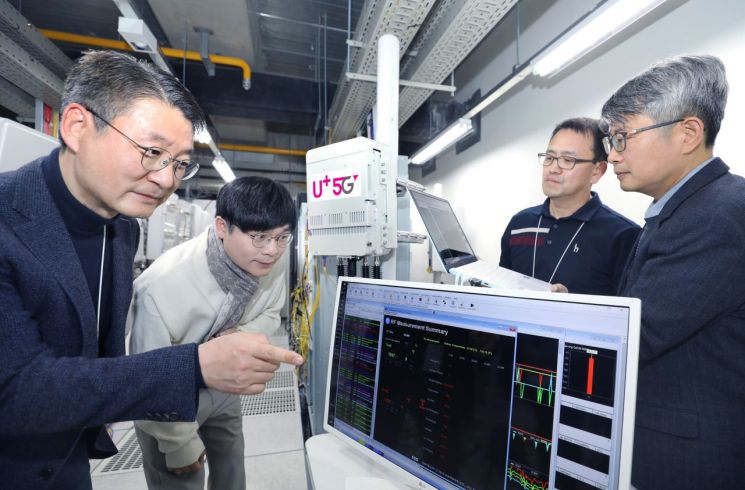
Earlier, LG Uplus also succeeded in interworking O-DU (Distributed Unit) and O-RU (Radio Unit) equipment based on Open RAN international standard specifications in collaboration with Nokia and domestic telecom equipment manufacturer Samji Electronics. O-DU and O-RU are Open RAN global standard-based base station equipment that constitute Open RAN.
For the interoperability demonstration, LG Uplus configured a test network at the Magok office in Gangseo-gu, Seoul, using Nokia's O-DU equipment and Samji Electronics' O-RU equipment. Nokia's global research center was responsible for the development work to interconnect the two companies' equipment.
In the demonstration, it was confirmed that Nokia's O-DU and Samji Electronics' O-RU equipment, based on standards set by the O-RAN Alliance, also interoperate with commercial core equipment. An LG Uplus official evaluated, "With this successful equipment interworking, LG Uplus has secured a total Open RAN solution."
KT also early established an Open RAN testbed at its Convergence Technology Institute and succeeded in base station equipment interoperability tests with Japanese telecom company NTT Docomo and ICT equipment and service company Fujitsu. In August last year, the Open RAN interoperability specification proposed by KT was approved as an international standard at the O-RAN Alliance meeting.
Why Open RAN?
Open RAN is considered a core technology ushering in the 6G era. It especially broadens telecom equipment choices and reduces the cost of building communication infrastructure. When equipment from multiple companies can be used together, it is easier to procure parts. This accelerates the speed of base station construction. Industry insiders explain that this helps operate 5G and 6G mobile communication services, which require densely installed base stations due to relatively short radio wave reach distances.
As seen in collaborations between domestic telecom companies and global corporations, global Open RAN deployment is a worldwide trend. The United States is the most proactive in Open RAN deployment. American telecom company Verizon plans to use Open RAN equipment in its services within this year. The U.S. government has also encouraged allies such as Korea and Japan to adopt Open RAN.
In May last year, following the Korea-U.S. summit held in Korea, President Yoon Suk-yeol and U.S. President Joe Biden stated in a joint communiqu?, "Recognizing the importance of communication security and operator diversity, we pledge to cooperate to develop open, transparent, and secure 5G and 6G network equipment and architectures using Open RAN approaches domestically and internationally."
Jose Fernandez, U.S. Deputy Secretary of State for Economic Affairs, who is visiting Korea, is also known to be scheduled to discuss Open RAN technology cooperation plans with domestic telecom industry officials on the 11th.
© The Asia Business Daily(www.asiae.co.kr). All rights reserved.
![Clutching a Stolen Dior Bag, Saying "I Hate Being Poor but Real"... The Grotesque Con of a "Human Knockoff" [Slate]](https://cwcontent.asiae.co.kr/asiaresize/183/2026021902243444107_1771435474.jpg)

















