2021 Year 64.5%, Down 0.8%P from Previous Year
Coverage Rate for High Medical Expense Severe Diseases Rises
Government "Strengthens Non-Covered Service Management"... Medical Community Protests
[Asia Economy Reporter Lee Gwan-ju] The 2021 National Health Insurance coverage rate has decreased by nearly 1 percentage point compared to the previous year. The main reason is a significant drop in the coverage rate at primary care institutions at the clinic level due to an increase in non-reimbursable services. The government plans to enhance the effectiveness of managing non-reimbursable services at the clinic level based on this, but clashes are expected to be inevitable given strong opposition from the medical community.
2021 Health Insurance Coverage Rate at 64.5%... Decline Led by Clinic Level
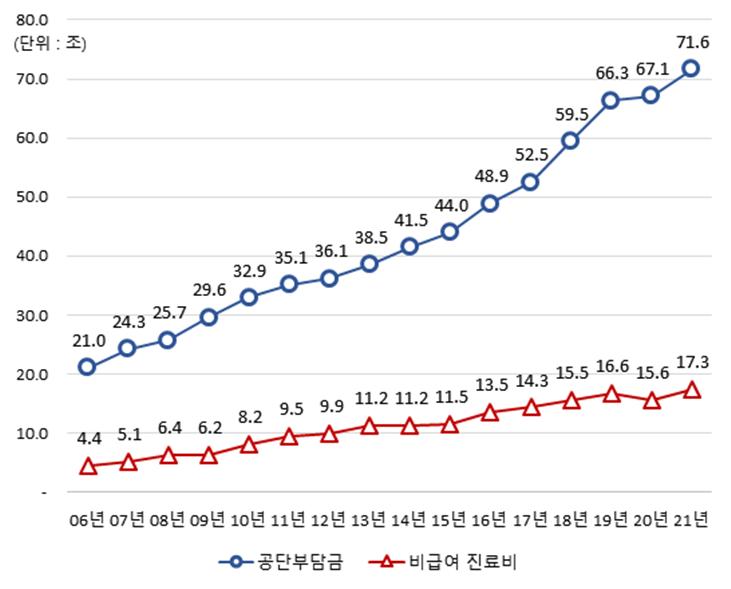
According to the analysis of the '2021 Health Insurance Patient Medical Expense Survey' announced by the National Health Insurance Service on the 10th, the health insurance coverage rate was 64.5%, down 0.8 percentage points from the previous year. Conversely, the burden rate of non-reimbursable services increased by 0.4 percentage points to 15.6% during the same period. The total medical expenses for health insurance patients in 2021, including non-reimbursable services, are estimated at approximately 111.1 trillion KRW, with insurer payments at 71.6 trillion KRW, statutory out-of-pocket payments at 22.1 trillion KRW, and non-reimbursable medical expenses at 17.3 trillion KRW.
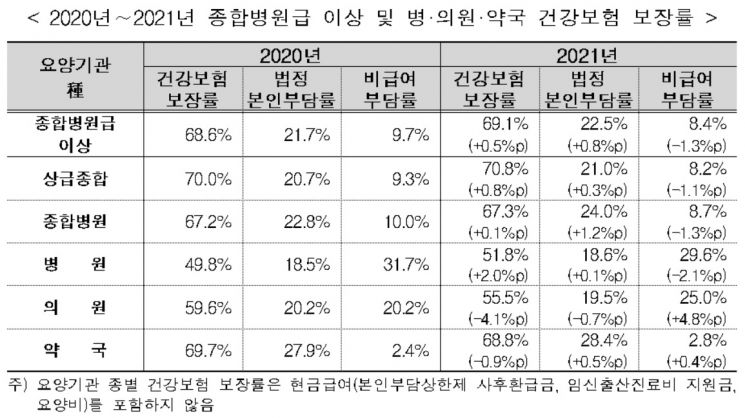
By medical institution type, the coverage rates for general hospitals and hospitals increased, but the overall coverage rate declined due to a drop at the clinic level. The coverage rate for general hospitals and above rose by 0.5 percentage points to 69.1%, attributed to expanded coverage for chest ultrasound and decreased use of non-reimbursable premium hospital rooms (single rooms). The coverage rate at clinics fell by 4.1 percentage points during the same period due to an increase in non-reimbursable services such as manual therapy (rehabilitation and physical therapy) and multifocal intraocular lenses for cataract surgery (treatment materials), which raised the non-reimbursable burden rate.
Increase in Coverage for Severe and High-Cost Treatments
The coverage rate for severe and high-cost treatment diseases, which impose a heavy financial burden, steadily increased. First, the coverage rate for the four major severe diseases?cancer, heart disease, cerebrovascular disease, and rare severe incurable diseases?rose by 0.1 percentage points to 84.0%. The coverage rate for the top 30 severe and high-cost treatment diseases per capita (such as leukemia, pancreatic cancer, lymphoma) increased by 0.5 percentage points to 82.6%. Additionally, the coverage rate for diseases ranked within the top 50 also rose by 0.2 percentage points to 80.3%.
By age group, coverage rates were higher for children under 5 years old (71.0%) and seniors aged 65 and above (70.3%) compared to other age groups. However, for those aged 65 and above, while coverage rates increased at hospital level and above, the coverage rate at the clinic level decreased by 0.9 percentage points compared to the previous year due to increases in manual therapy and multifocal intraocular lenses for cataract surgery.
There were also some differences in health insurance coverage rates by income class. Coverage rates by income quintile for workplace and regional subscribers showed that lower-income groups had higher coverage rates than higher-income groups, and the effect of the out-of-pocket maximum payment system was more pronounced in the lower-income groups.
Government "Strengthening Non-Reimbursable Service Management"... Medical Community Opposes
The government interpreted the recent health insurance coverage rate as indicating a need to enhance the effectiveness of managing non-reimbursable services at the clinic level. The government's policy is to continuously identify tasks to strengthen coverage in essential medical fields directly related to life that are necessary for the public, while reinforcing management of non-reimbursable services. This includes reviewing the coverage criteria for MRI and ultrasound, which have been criticized for overuse, reducing unnecessary financial expenditures, and increasing coverage for severe diseases that require high insurance support to improve actual coverage.
To this end, the Ministry of Health and Welfare plans to establish a 'Second Comprehensive Plan for Strengthening Non-Reimbursable Service Management' soon through consultations with related ministries. Kwon Byung-ki, Director of Essential Medical Support at the Ministry of Health and Welfare, explained, "Strengthening health insurance coverage in essential medical fields is a task that the state must continuously undertake with responsibility from the perspective of welfare for the vulnerable. Regarding non-reimbursable service management, we plan to propose additional measures for the rational use of non-reimbursable services beyond what has already been presented."
However, clashes seem inevitable as the medical community opposes measures such as the non-reimbursable service reporting system. Previously, the Korean Medical Association criticized, "The non-reimbursable service system has made a significant contribution to elevating Korea's medical level from low fees and low reimbursements to that of advanced medical countries. They are trying to control non-reimbursable services by framing them as corruption and social evils, ignoring these positive aspects."
The National Association of Metropolitan and Provincial Medical Association Presidents also issued a statement, saying, "The government's excessive intervention, which hastily defines non-reimbursable items as the root of all evil in an effort to raise the health insurance coverage rate and control non-reimbursable services, undermines market autonomy, induces price competition among medical institutions and patient attraction, severely damages the trust relationship between patients and medical institutions, and leads to a decline in the quality of medical services, with the damage ultimately borne by the patients."
© The Asia Business Daily(www.asiae.co.kr). All rights reserved.



















