Seminar on the Current Status and Development Plans of the Korean Golf Course Industry Held
New Classification Backlash Feared: 'Increased Tax Rates Burden Golfers'
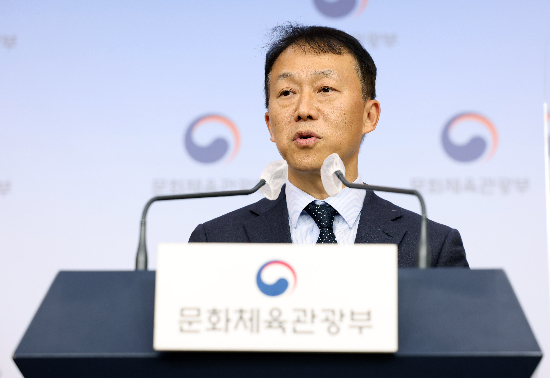 Choi Bogeun, Director of the Sports Bureau at the Ministry of Culture, Sports and Tourism, is speaking at a briefing on the revision of the 'Sports Promotion Act' last November.
 [Photo by Ministry of Culture, Sports and Tourism]
The golf course industry is engaged in a 'game of nerves' over the increased property tax rates for non-member golf courses compared to before, while the government has expressed its intention to minimize the side effects of the policy. This is interpreted as an effort to dispel public concerns that individual golf courses might raise green fees in proportion to the increased taxes.
On the 10th, Choi Bo-geun, Director of the Sports Bureau at the Ministry of Culture, Sports and Tourism, attended the seminar titled ‘Current Status and Development Plans of the Korean Golf Course Industry’ held at the National Assembly Members' Office Building in Yeouido, and stated that the property tax rate for non-member golf courses under the new golf course classification system will be about 60-70% of that for member golf courses. The specific property tax rate applied to non-member golf courses under the changed classification system has not yet been decided.
Last May, the government announced a new golf course classification system through the amendment to the ‘Act on the Installation and Use of Sports Facilities’ (hereinafter referred to as the Sports Facilities Act). The previous dichotomous system of member and non-member was changed to a three-category system: member, non-member, and public type. Non-member golf courses, which are an intermediate form between member and public types, cannot recruit members like public golf courses and are subject to higher property tax rates than the general rate.
In November last year, through the administrative notice ‘Notice on Designation of Public Golf Courses,’ which was an administrative announcement of the enforcement decree of the Sports Facilities Act amendment, the government announced that to be classified as a public golf course, the admission fee must be 34,000 KRW lower than the non-member price of member golf courses. For public golf courses to continue receiving tax benefits, they must lower green fees to the level announced by the government or change to non-member golf courses and bear higher property tax rates than before (land 0.2~0.4%, buildings 0.25%).
The problem is that golf courses choosing the non-member system may pass the increased tax burden onto general golfers. This could be done by raising green fees or significantly increasing food and beverage prices. Some voices have argued that the plan to raise property taxes on non-member golf courses itself is unfair. They claim it is unreasonable to impose higher taxes even though they cannot recruit members, just like public golf courses.
Director Choi said, “We believe that non-member golf courses also need some property tax benefits,” and explained, “Internally, we are currently considering adjusting the property tax of non-member golf courses to about 60-80% of that of member courses.” The specific level of individual consumption tax is currently being discussed by the Ministry of Economy and Finance and is expected to be announced next week.
Director Choi also expressed his intention to actively consider easing golf course construction regulations. Currently, the ‘Tourism Promotion Act’ does not have separate regulations regarding golf course area. The Ministry of Culture, Sports and Tourism manages golf course areas within 30% of tourism complexes through its own regulations. Although the number of domestic golf courses is expected to reach 567 by the end of this year, the shortage of golf courses is still anticipated.
Director Choi stated, “It is inappropriate for the Ministry of Culture, Sports and Tourism to restrict golf course construction through its own regulations despite the absence of legal provisions,” and added, “We will review appropriate levels and promptly improve the situation if problems arise.”
© The Asia Business Daily(www.asiae.co.kr). All rights reserved.

















