Coin Winter Hits as Exchange Restructuring Woes Mount
Huobi Token Plummets About 30% Since Early Last Month
[Asia Economy Reporter Lee Jung-yoon] After the bankruptcy of the global virtual asset exchange FTX, another exchange, Huobi, has faced a crisis. Warning signs such as workforce reductions have been detected, and the price of its self-issued coin has also plummeted.
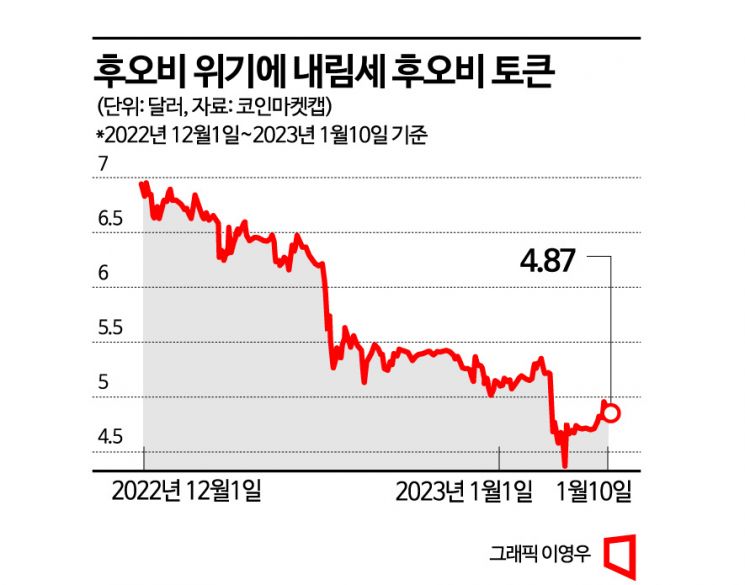
According to CoinMarketCap, a global virtual asset market relay site, on the 10th, Huobi Token was recorded at $4.87 (approximately 6,085 KRW), down 29.73% from early last month. Although it showed a rise of around 1% on that day, Huobi Token experienced a sharp decline around the 16th of last month and the 5th of this month. On the 6th of this month, it even dropped to $4.30, the lowest since November 21 of last year.
Huobi Token is a proprietary coin issued by Huobi, a global exchange ranked within the top 10 worldwide. It is an ERC-20 token that meets the compatibility requirements with Ethereum. It can be used within the ecosystem built by Huobi. It serves as a means for virtual asset spot and futures trading and offers fee discount benefits. Within the Huobi ecosystem, it is also used as cloud deposit and project listing deposit, and above all, it has the advantage of receiving profit distribution from the exchange. Huobi repurchases Huobi Tokens from holders under the name of profit distribution and burns them to support the price. The total issuance of Huobi Tokens is capped at 2,039.8 billion tokens, and records of repurchase and burning are disclosed to investors to ensure transparency. Additionally, Huobi allocates a certain portion of its profits to a member protection fund composed of Bitcoin and Huobi Tokens.
Virtual assets issued by exchanges can be traded like regular coins and have additional benefits like Huobi Token. However, the recent sharp decline in Huobi Token’s price is due to negative developments at the issuing exchange. On the 6th, Huobi announced plans for restructuring, intending to reduce about 20% of its global workforce. The workforce restructuring is scheduled to be completed by the end of the first quarter of this year. Furthermore, as the liquidity crisis triggered by the FTX incident spread throughout the coin market, Huobi experienced a large-scale capital outflow. During the first week of this month, Huobi’s net outflow amounted to approximately 120 billion KRW, with about 64% of that, 77 billion KRW, disappearing in a single day.
When exchange-issued virtual assets face a downturn like recently, their prices reflect market conditions and additionally react to negative news about the exchange. In the case of Huobi Token, the price dropped due to worsening market conditions amid tightening concerns, and the negative news about Huobi further amplified the price decline. An industry insider said, "Exchange-issued coins are affected not only by the industry but also by individual issues of the exchange. Since these utility coins are used in exchange operations, how they are used is a crucial factor in price determination. Therefore, it is advisable to carefully analyze the individual exchange’s situation and negative news before investing."
This characteristic can also be found in coins issued by other exchanges. Binance, the global market share leader, issued Binance Coin, which ranks 4th in total market capitalization. However, when the global accounting firm Mazars announced the suspension of transactions with Binance on the 16th of last month, the price of Binance Coin fell from the $260 range to $231. In the case of FTX, due to liquidity issues, the price of its self-issued coin FTT plunged from $24 to $1.2.
© The Asia Business Daily(www.asiae.co.kr). All rights reserved.
![Clutching a Stolen Dior Bag, Saying "I Hate Being Poor but Real"... The Grotesque Con of a "Human Knockoff" [Slate]](https://cwcontent.asiae.co.kr/asiaresize/183/2026021902243444107_1771435474.jpg)
















