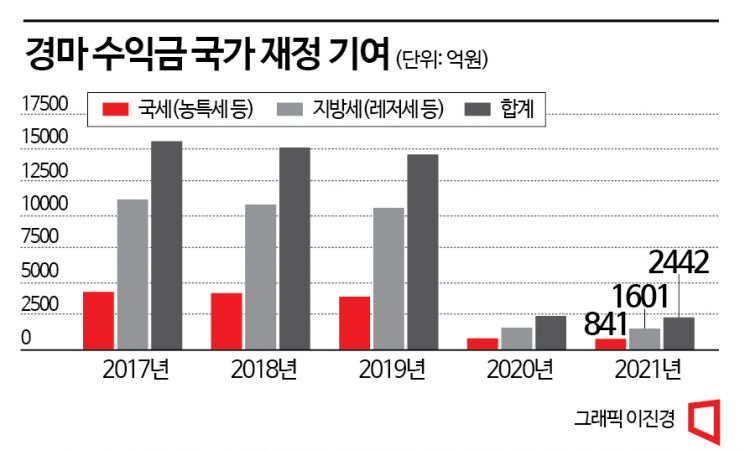
[Asia Economy Sejong=Reporter Kim Hyewon] COVID-19 has tightly shackled the horse racing industry. During the suspension period from March 2020 to October of the following year, the revenue loss alone approached 13 trillion won. Normally, the industry contributed about 1.5 trillion won to national finances through combined national and local taxes, but during this period, it shrank to around 200 billion won. Additionally, the 70% of annual net profit that was usually donated to the Livestock Development Fund was not contributed at all last year.
This is why there is a growing call to expand the currently offline-only betting ticket sales system to online, to ensure the sustainability of the horse racing industry, which is vulnerable to external variables like viruses. It is said that the horse racing industry also needs to transition to an untact (non-face-to-face) system like cycle racing, motorboat racing, or Lotto. Similar industries such as Sports Toto (2004), Lotto (2018), and cycle and motorboat racing (2021) have already shifted from in-person sales to online-based sales.
According to the Korea Racing Authority on the 11th, the introduction of a 100% real-name online betting ticket sales system in the horse racing industry is entering its final countdown. This system allows users who find it difficult to visit racecourses or off-track betting centers to register as real-name account members and purchase betting tickets from locations outside the venues using mobile or other electronic communication means. Unlike lotteries and Sports Toto, which sell tickets daily, horse racing tickets will be sold only on race days, which are Fridays, Saturdays, and Sundays.
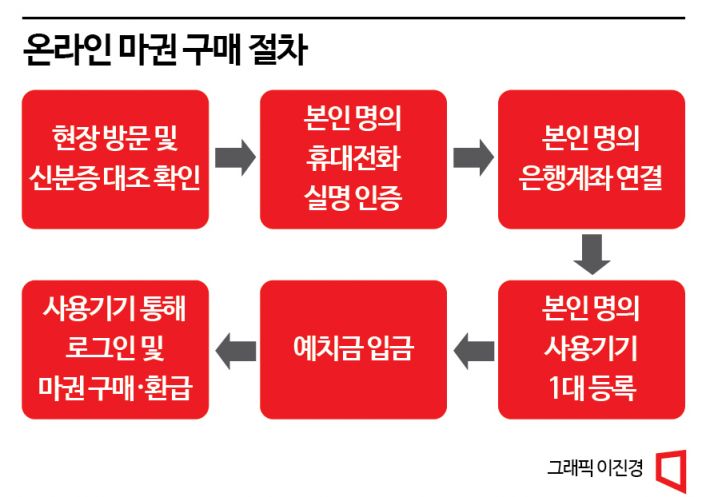
Online betting ticket purchases will be operated under a strict 100% real-name system, involving procedures such as on-site ID verification, real-name authentication of the user's mobile phone, linking a bank account, and registering one device for use.
The controversy over gambling addiction will be directly addressed with multiple layers of safeguards to ensure responsible gaming. Currently under discussion with the government, measures include limiting the purchase amount per race to 50,000 won as in cycle and motorboat racing, or setting a separate total online sales cap. When approaching the sales cap, the number of races will be reduced and sales suspended in stages. Off-track betting centers will gradually be reduced while monitoring online sales trends. Enforcement and penalties for various side effects arising from opening the online space will be strengthened severalfold. The reward for reporting illegal sites is 500 million won.
Is online horse race betting allowed overseas? According to the International Federation of Horseracing Authorities annual report, there are 60 member countries in total, and except for a few countries such as four Middle Eastern nations where betting is prohibited for religious reasons, most allow it. Among countries that operate betting ticket sales, only a very small number, including Korea, do not offer online sales. Notably, Korea is the only country among the top 10 in betting ticket sales that does not implement online sales. A Korea Racing Authority official stated, "Overseas, online sales have helped absorb demand from off-track betting centers and reduce illegal markets, mitigating social side effects," adding, "Despite the COVID-19 crisis, they have actively responded to the post-COVID era by implementing spectator-free races and expanding TV broadcasts using digital media."
There is also analysis that once online betting ticket sales are established, they will absorb illegal users and help prevent social harms such as addiction and tax evasion. Currently, the scale of illegal horse racing is close to 7 trillion won, about 94% of legal horse racing.
In Korea, there are seven types of legally permitted gambling industries, including horse racing, casinos, cycle and motorboat racing, lotteries, sports promotion lottery tickets, and bullfighting. As of last year, the total sales of these industries amounted to 14.3758 trillion won. Sales of sports promotion lottery tickets and lotteries are increasing. However, casinos and racing-related industries are stagnant or declining, sharing the commonality that online or non-face-to-face purchases are not possible. The horse racing industry's sales, which averaged nearly 8 trillion won annually, plummeted to the 1 trillion won level during the COVID-19 period.
Horse racing, which accounts for about 81% of the domestic horse industry, is viewed not merely as a betting medium but as a complex industry encompassing the primary to quaternary sectors. The logic follows from horse production (primary), racehorse breeding and training (secondary), horse racing (tertiary), to horse racing information distribution (quaternary). The domestic horse industry size through this is about 3.3 trillion won, creating approximately 24,000 jobs. Through horse racing operations, about 1.5 trillion won is paid annually in local and national taxes, contributing to local finances and regional balanced development. The Livestock Development Fund, accumulating about 150 billion won annually, also comes from the horse racing industry.
© The Asia Business Daily(www.asiae.co.kr). All rights reserved.
![Clutching a Stolen Dior Bag, Saying "I Hate Being Poor but Real"... The Grotesque Con of a "Human Knockoff" [Slate]](https://cwcontent.asiae.co.kr/asiaresize/183/2026021902243444107_1771435474.jpg)

















