[Asia Economy New York=Special Correspondent Joselgina] American consumers expect both inflation and consumer spending to slow down simultaneously over the next year. This diagnosis suggests that while the Federal Reserve's (Fed) interest rate hikes ease inflationary pressures, consumer spending is inevitably contracting. Amid growing recession warnings, more than half of Wall Street's major investment banks predict that the Fed will raise interest rates further to the 5.00~5.25% range this year.
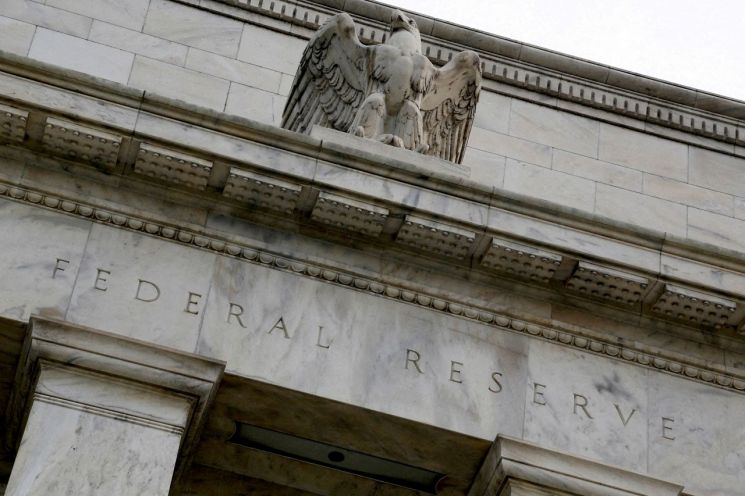
◆Declining Short-Term Inflation Expectations in the U.S.
According to the December consumer outlook survey released on the 9th (local time) by the New York Federal Reserve Bank, the expected inflation rate for the next year fell by 0.2 percentage points to 5% compared to the previous month. This is the lowest level since July 2021. It has shown a slowing trend since reaching an all-time high of 6.78% in June last year.
Prices of essential goods such as groceries and gasoline are expected to stabilize. Grocery prices are projected to rise by 7.6%, and gasoline prices by 4.1% over the next year. Although still high, these figures are 0.7 percentage points lower than the previous month's forecast. The expected increase in housing rent for the same period slowed to 9.6%, the lowest in 21 months.
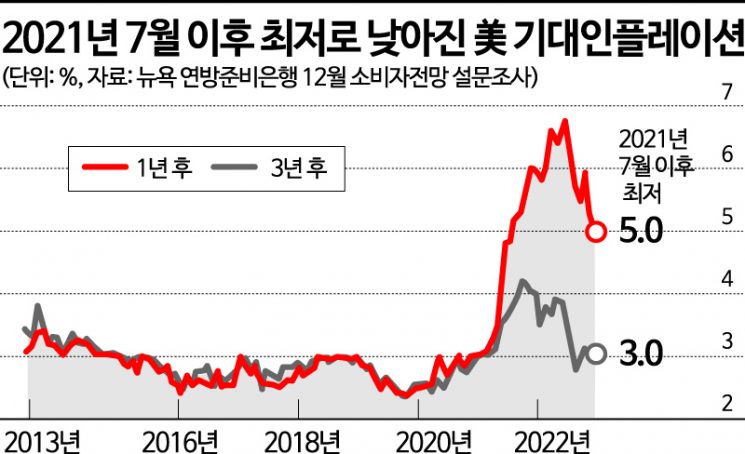
The downward trend in short-term inflation expectations is interpreted as a sign that the Fed is making progress in its fight against inflation. The Fed, which has positioned itself as an 'inflation fighter,' raised the benchmark interest rate by a total of 4.25 percentage points over seven hikes last year and has signaled further increases in the new year. Economic media CNBC evaluated this as "still well above the Fed's 2% inflation target, but a step forward in the battle against soaring household living costs."
Inflation expectations, which reflect economic agents' forecasts of future inflation rates, influence pricing decisions for various goods and services and wage increase demands, ultimately impacting actual inflation. The expected inflation rate over the next three years remained unchanged at 3% compared to the previous month.
However, consumers anticipate that while inflationary pressures will ease over the next year, spending will also decrease. In this survey, the forecast for household spending growth one year ahead was 5.9%, the lowest since January 2022. This figure dropped sharply by 1.0 percentage point from 6.9% the previous month. Considering that leading economic experts have pointed out the depletion of disposable income as a factor for the impending recession, this cannot be analyzed solely as an effect of easing inflationary pressures. It is seen as a cooling signal in consumer sentiment, which supports a significant portion of the U.S. economy.
◆"Must Maintain 5% Range for a Long Time" Fed Signals Further Rate Hikes
Amid recession concerns and expectations of inflation peaking, hawkish remarks from Fed senior officials continue to pour out daily.
Raphael Bostic, President of the Atlanta Federal Reserve Bank, attending a forum hosted by the Atlanta Rotary Club, stated, "Interest rates may be raised to the 5.0~5.25% range to curb excess demand," adding, "We need to maintain that level for a long time." This suggests that the current U.S. interest rate of 4.25~4.5% could be raised by at least 0.75 percentage points. He also drew a line against market expectations of rate cuts, saying he is not someone who supports a pivot (direction change).
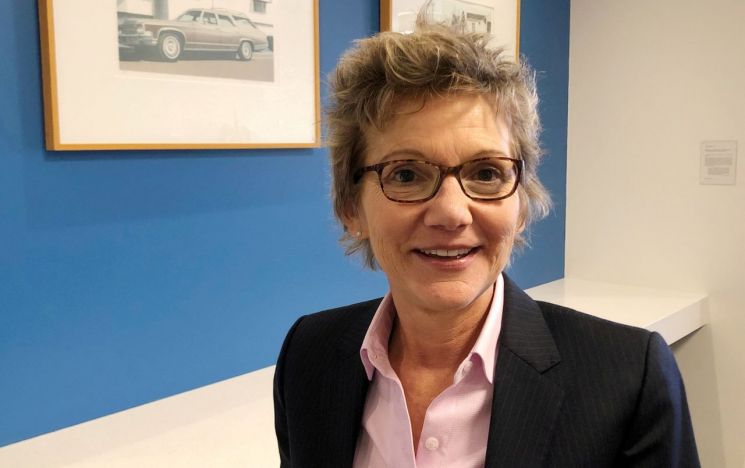
On the same day, Mary Daly, President of the San Francisco Federal Reserve Bank, also pointed out that "it is too early to declare victory" in the fight against inflation. This aligns with earlier remarks by Fed Chair Jerome Powell, who emphasized the need for clearer evidence that inflation is continuously declining toward the 2% target, rather than relying on one or two indicators. Daly said, "The Fed will raise rates above 5%," and it is reasonable to maintain that peak for 11 months. When asked if the Fed would keep rates above 5% for a long time, she replied, "Yes, it will."
The 5% range for interest rates also matches the final rate forecasts of major Wall Street investment banks. According to a recent survey conducted by the Bank of Korea's New York office targeting 12 local investment banks (IBs), more than half?7 firms?forecast the U.S. terminal interest rate to be between 5.00 and 5.25%. This is an overall increase compared to two months ago when only 4 firms (one-third) expected rates in that range. Additionally, these investment banks anticipate that the Fed will pause rate hikes in the first half of the year and begin cutting rates in the second half.
◆Market Awaits CPI... Baby Step Hike Expected in February
The market is currently focused on the U.S. Consumer Price Index (CPI) for December, scheduled for release on the 12th. Investors are expected to look for trend signals confirming that inflation has peaked and is declining. The current Wall Street consensus anticipates a 6.6% year-over-year increase, down from 7.1% the previous month.
The overheated labor market is also considered a key factor for future monetary policy. Despite consecutive tightening measures, employment data released this year still show a robust level. The Fed is wary of a vicious cycle where an overheated labor market drives up workers' wages, which then feeds back into inflationary pressures.
Some speculate that the Fed might slow the pace again at the Federal Open Market Committee (FOMC) meeting scheduled for January 31 to February 1. On that day, Presidents Bostic and Daly also indicated that the possibility of a baby step (a 0.25 percentage point rate hike) remains open, depending on CPI and other economic data. According to the Chicago Mercantile Exchange (CME) FedWatch, the federal funds futures market currently prices in a 79.7% chance of a 0.25 percentage point rate hike in February, a significant increase from about 67% a week ago.
© The Asia Business Daily(www.asiae.co.kr). All rights reserved.



















