Fines Imposed on Current and Former Executives
Corporation Also Sentenced to a 30 Million Won Fine
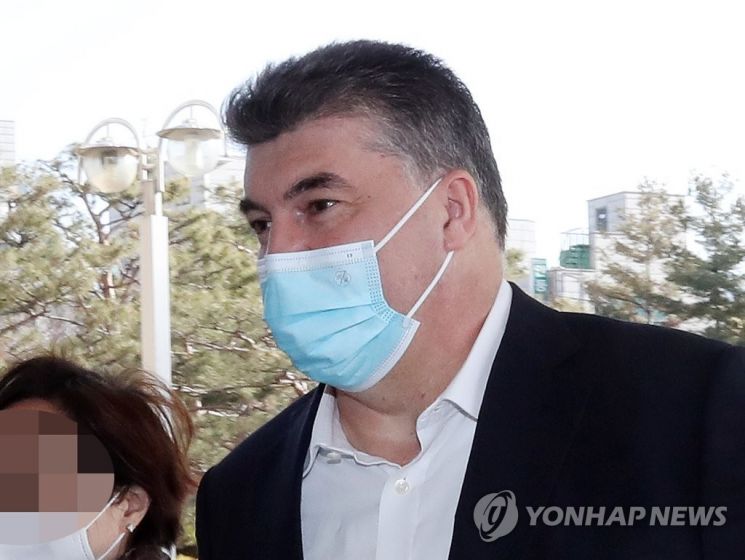 Kaher Kazem, former president of GM Korea, who was indicted on charges of illegally dispatching subcontracted workers, is entering the Incheon District Court in Michuhol-gu, Incheon City on the afternoon of the 9th to attend the sentencing hearing.
[Asia Economy Reporter Choi Seok-jin, Legal Affairs Specialist] Former Korea GM (GM) President Kaher Kazem (53), who was indicted on charges of illegal dispatch of workers prohibited under the Act on the Protection of Dispatched Workers (Dispatch Act), received a suspended prison sentence in the first trial.
On the 9th, Judge Kwak Kyung-pyeong of the Criminal Division 2 at Incheon District Court sentenced former President Kazem, who was charged with violating the Dispatch Act, to 8 months in prison with a 2-year suspension.
Judge Kwak also sentenced four former and current Korea GM executives charged with the same offense to fines of 7 million won each, and 13 representatives of partner companies to fines ranging from 2 million to 5 million won. Under the joint penalty provision of the Dispatch Act, Korea GM as a corporation was also fined 30 million won on the same day.
Former President Kazem and five former and current Korea GM executives were indicted on charges of illegally dispatching 1,719 workers from 24 partner companies to Korea GM’s factories in Bupyeong, Incheon; Changwon, Gyeongnam; and Gunsan, Jeonbuk, from September 2017 to December 2021.
Workers belonging to partner companies were assigned to 'direct production process' tasks such as automobile body manufacturing, painting, and assembly at the three Korea GM factories, which are prohibited from dispatch under the law.
Representatives of the partner companies were charged with illegally dispatching workers to the Bupyeong, Changwon, and Gunsan factories without obtaining dispatch business permits from the Minister of Employment and Labor during the same period.
Article 5(1) of the Dispatch Act (Target Work for Worker Dispatch, etc.) states that "worker dispatch business shall be limited to work deemed appropriate considering professional knowledge, skills, experience, or the nature of the work, excluding direct production process work in manufacturing," thereby restricting the types of work to which workers can be dispatched as prescribed by Presidential Decree.
Paragraph 3 of the same article lists prohibited work for worker dispatch businesses, including ▲work at construction sites ▲loading and unloading work ▲work of seafarers under the Seafarers Act ▲hazardous or dangerous work under Article 58 of the Industrial Safety and Health Act.
Paragraph 5 of the same article prohibits engaging in worker dispatch business in violation of these provisions or receiving worker dispatch services from those conducting such business. Violations are punishable under Article 43 of the same law by imprisonment of up to three years or fines of up to 30 million won.
The court judged the relationship between Korea GM and the partner companies as illegal dispatch rather than a legitimate subcontracting contract.
Judge Kwak pointed out, "The tasks of the partner company workers were simple and repetitive work set by Korea GM, and cannot be considered work requiring professionalism or technical skills distinct from regular employees."
He added, "Considering the relationship between Korea GM and the partner companies, each partner company’s workers worked at workplaces under Korea GM’s control, following the pace set by Korea GM," concluding that "this should be regarded as worker dispatch."
In the trial, the defendants’ lawyers denied the illegal dispatch charges, arguing that "Korea GM’s subcontracting form followed modern automobile industry standards."
However, Judge Kwak stated, "Former and current executives including former President Kazem did not resolve the illegal dispatch issue despite losing related civil cases," and "As the representative of Korea GM at the time, former President Kazem should bear the greatest responsibility for this crime."
Former President Kazem, who had not attended the previous sentencing hearing, appeared in a black suit at the sentencing hearing on this day.
The Ministry of Employment and Labor, which investigated the case reported by the Korea GM Non-regular Workers Branch of the Korean Metal Workers’ Union in January 2018, transferred the case to the prosecution in December 2019. After supplementary investigations, the prosecution indicted former President Kazem and others in July 2020.
© The Asia Business Daily(www.asiae.co.kr). All rights reserved.
![Clutching a Stolen Dior Bag, Saying "I Hate Being Poor but Real"... The Grotesque Con of a "Human Knockoff" [Slate]](https://cwcontent.asiae.co.kr/asiaresize/183/2026021902243444107_1771435474.jpg)











