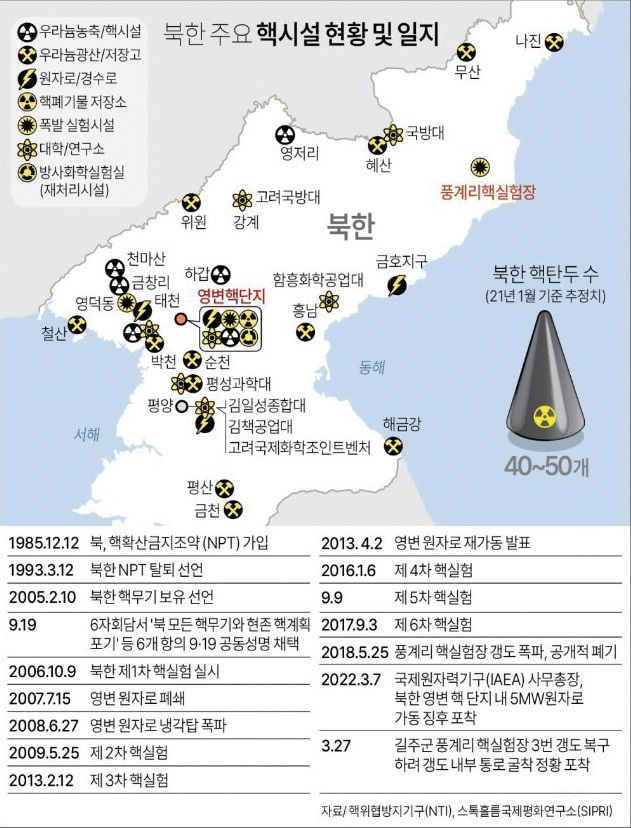
[Asia Economy Yang Nak-gyu, Military Specialist Reporter] The Treaty on the Non-Proliferation of Nuclear Weapons (NPT) is an international organization established by five countries: the United States, Russia, the United Kingdom, France, and China. It recognizes each other's possession of nuclear weapons while aiming to reduce them and prohibits non-nuclear-weapon states from developing nuclear weapons. Upon joining the NPT, member states are also obligated to undergo inspections by the International Atomic Energy Agency (IAEA). There are exceptions, however. These include India, Pakistan, and Israel, which possess unofficial nuclear weapons not recognized by the international community. North Korea is also included. North Korea formally declared its withdrawal from the NPT on January 10, 2003. Twenty years later, North Korea has embarked on nuclear weapons production, becoming the greatest challenge on the Korean Peninsula.
U.S. Raises Suspicions of North Korea’s Highly Enriched Uranium Development, Leading to NPT Withdrawal
North Korea withdrew from the NPT amid the second North Korean nuclear crisis triggered by the issue of highly enriched uranium (HEU). In October 2002, James Kelly, then U.S. Deputy Assistant Secretary of State for East Asian and Pacific Affairs, visited North Korea as a special envoy of President George W. Bush and raised suspicions about HEU development during talks with Kang Sok-ju, First Vice Minister of the Ministry of Foreign Affairs. Kang stated, "If the United States abandons its hostile policy toward North Korea and guarantees the security of the North Korean regime, it can address U.S. security concerns, including the nuclear development plan using enriched uranium."
The HEU suspicions raised by the U.S. were proven true. In December 2002, the U.S. government and the Korean Peninsula Energy Development Organization (KEDO) suspended the provision of heavy fuel oil to North Korea. North Korea reacted strongly, declaring the restart of its nuclear facilities and removing IAEA surveillance cameras and seals installed at the Yongbyon nuclear facility. Additionally, it brought in fuel rods for the '5MWe reactor' and expelled three IAEA inspectors.
When the IAEA passed a resolution in January of the following year urging the restoration of the nuclear facility monitoring system and an explanation of the HEU program, North Korea issued a 'Statement of the Government of the Republic' and formally withdrew from the NPT. It also declared the nullification of the IAEA safeguards agreement. Immediately, moves to develop nuclear weapons began. From February of that year, the reactor was restarted, and in March, North Korea declared through the New York channel the resumption of missile test launches and the operation of nuclear reprocessing facilities.
As the North Korean nuclear crisis became a reality, China, South Korea, and North Korea met in Beijing in April of the same year. It was the first meeting among the three parties. Subsequently, the Six-Party Talks were established, and the September 19 Joint Statement was agreed upon, but North Korea conducted six nuclear tests.
Last Year’s 10th NPT Review Conference Held but North Korea Condemnation Declaration Failed Due to Russian Opposition
To prevent this, the 10th NPT Review Conference was held last August at the United Nations (UN) headquarters in New York, with participation from 116 countries and regions worldwide. The NPT Review Conferences have been held every five years since the treaty came into effect in 1970, but this one was held after seven years due to delays caused by the COVID-19 pandemic.
Expectations were high because it was the only way to stop North Korea, which was preparing for its seventh nuclear test. However, Russia, engaged in the war in Ukraine, opposed the declaration, and the conference ended without adopting it. The declaration included many contents condemning North Korea’s nuclear provocations and urging denuclearization.
Russia opposed a phrase in the 36-page draft declaration of the NPT Review Conference that expressed "serious concerns about military activities at the Zaporizhzhia nuclear power plant (occupied by Russia)." The adoption of the conference’s outcome requires the approval of all 191 member states. The international community tried to persuade Russia for four weeks, but to no avail.
As a result, concerns are emerging that joint international responses to North Korea’s nuclear issues will become increasingly difficult. The suspended nuclear arms reduction discussions are also unlikely to progress. The United States and Russia, which possess 90% of the world’s nuclear warheads, announced a five-year extension of the New Strategic Arms Reduction Treaty (New START) last February and discussed follow-up measures, but these were halted after Russia’s invasion of Ukraine in February. China, which possesses 350 nuclear warheads, is not participating in nuclear arms reduction talks at all. It is also uncertain whether joint sanctions against North Korea at the NPT level, led by the U.S., Japan, and the European Union (EU), will be imposed amid rumors of a seventh nuclear test.
© The Asia Business Daily(www.asiae.co.kr). All rights reserved.
![Clutching a Stolen Dior Bag, Saying "I Hate Being Poor but Real"... The Grotesque Con of a "Human Knockoff" [Slate]](https://cwcontent.asiae.co.kr/asiaresize/183/2026021902243444107_1771435474.jpg)
















