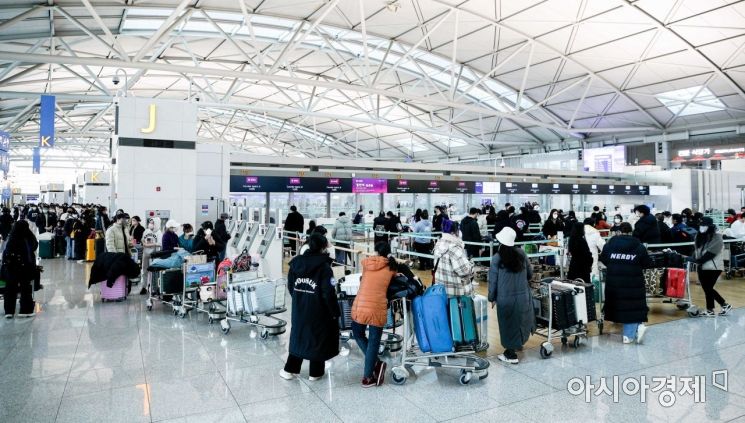
[Asia Economy Reporter Yoo Hyun-seok] As the skies have reopened after a long three-year tunnel of COVID-19, the aviation industry is stretching its wings. However, aircraft-related accidents continue to occur. Since these accidents are due to the surge in international flight demand, the industry advises more thorough safety inspections.
According to the aviation statistics from the Ministry of Land, Infrastructure and Transport's Air Portal aviation information system on the 9th, the total number of international flights from January to November last year was 79,071, a 32.1% increase compared to the same period the previous year. During the same period, the number of passengers reached 77,122,232, a 442.1% increase, thanks to the recent surge in travelers to Southeast Asia and Japan.
As a result, the aviation industry is finally stretching its wings. After facing a crisis of collapse due to the three-year COVID-19 pandemic, passenger numbers are rapidly increasing. Some low-cost carriers (LCCs) appear to have turned profitable in the fourth quarter of last year.
However, the rapid increase in passengers and flights has led to a series of aviation accidents. In the case of Korean Air, accidents occurred consecutively at its subsidiary, Korea Airport Corporation. On December 27 and in April last year, there were casualties resulting in two deaths. There were also aircraft accidents. Korean Air’s A330 passenger aircraft had to return or make emergency landings due to engine problems. In October, a plane in Cebu, Philippines, veered off the runway and made an emergency landing. Asiana Airlines also experienced an incident in August where an aircraft could not take off due to engine defects, requiring a replacement flight.
Not only major airlines but also LCCs have frequently caused accidents. At Incheon International Airport, there was a collision incident involving Lao Airlines and Air Premia aircraft. Additionally, on December 22, a Hi Air flight departing from Ulsan to Jeju had its aircraft get stuck in a grassy area during landing. Furthermore, T’way Air had to return a flight departing from Jeju in November due to defects. In April and August, newly introduced A330 aircraft also experienced problems, leading to replacement flights or emergency landings.
The industry explains that the recent aviation accidents are largely influenced by the increase in flight numbers and manpower shortages. During the period when flights were reduced due to COVID-19, the number of accidents also decreased. However, as flights rapidly increased, incidents naturally became more frequent.
In fact, before COVID-19 in 2019, there were 3 aircraft accidents and 6 serious incidents, totaling 9 cases. In 2020, when COVID-19 spread widely, there were 4 accidents and 3 serious incidents, totaling 7 cases, a decrease of 2. In 2021, the total was 3 cases with 2 accidents and 1 serious incident.
Under the Aviation Act, an aircraft accident refers to death, serious injury, disappearance of a person, significant damage or destruction of an aircraft, or structural defects. A serious incident refers to an event that could have developed into an aircraft accident.
Safety hazards are similarly defined. Safety hazards refer to anything that affects or could affect aviation safety related to aircraft operations and navigation safety facilities, aside from aircraft accidents and serious incidents. These cases decreased from 1,152 in 2019 to 333 in 2020 and 266 in 2021. An industry official explained, "As flights increase recently, incidents and accidents may appear more frequently."
Nevertheless, there are opinions that companies should make more efforts and investments in safety. Aircraft accidents can lead to major disasters causing significant casualties if mishandled. Professor Hwang Yong-sik of Sejong University said, "Because several signals in aircraft can lead to major accidents, thorough preparation is necessary," adding, "Each airline must conduct inspections and invest to respond to various crisis situations."
© The Asia Business Daily(www.asiae.co.kr). All rights reserved.

















