The Core is 'Improper Solicitation'... Existence of 'Awareness and Understanding of Current Issues'
Prosecutors Judge It Was Not a 'Voluntary Donation'... Seem to Have Secured Testimonies and Evidence
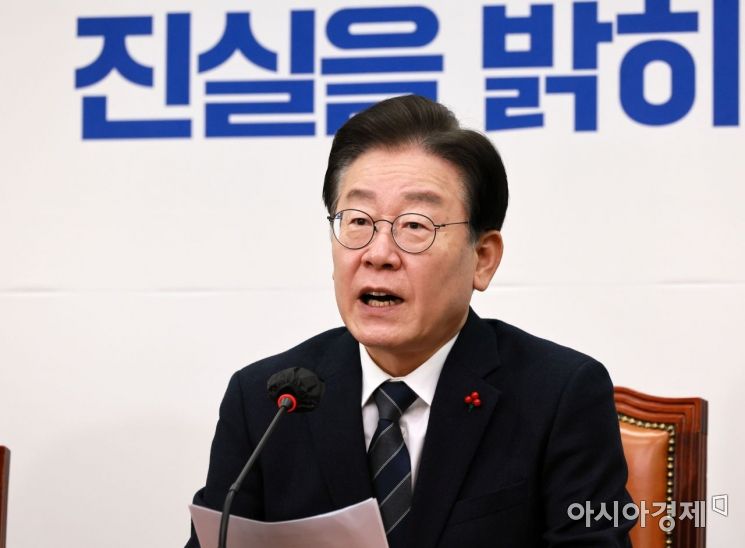
[Asia Economy Reporter Choi Seok-jin, Legal Affairs Specialist] On the morning of the 10th, Lee Jae-myung, leader of the Democratic Party of Korea, will appear at the Suwon District Prosecutors' Office Seongnam Branch as a suspect in the 'Seongnam FC Sponsorship Fund' case to undergo investigation. This comes a full four years and six months after the Bareunmirae Party accused Lee of third-party bribery in June 2018.
Lee and the Democratic Party assert that "the police had already dismissed the case without charges years ago, but the prosecution is reopening the investigation with political intentions," expressing confidence in proving their innocence. On the other hand, the prosecution claims, "During the Moon Jae-in administration, neither the police nor the prosecution conducted a proper investigation, but there is sufficient evidence to prove the charge of third-party bribery," showing confidence in their investigation.
According to the legal community on the 9th, whether the charge of third-party bribery applied to Lee is established depends on whether the sponsorship funds were exchanged under mutual recognition and understanding regarding various permits and corporate issues, that is, the proof of 'implicit solicitation'.
Hundreds of millions to billions in sponsorship funds secured, followed by resolution of issues
The 'Seongnam FC sponsorship fund' suspicion centers on the allegation that Lee, while serving as mayor of Seongnam and as the club owner of Seongnam FC, secured large sponsorship funds from companies in exchange for resolving corporate issues.
In fact, after the Seongnam Ilhwa football team was transformed into the citizen football team Seongnam FC and Lee became the club owner, six companies within Seongnam city?Doosan Construction, Naver, Nonghyup Bank, Bundang CHA Hospital, Hyundai Department Store, and Alphadom City?provided a total of approximately 16 billion KRW in sponsorship and advertising fees to Seongnam FC from 2015 to 2017.
The prosecution views the sponsorship funds, ranging from several hundred million to several billion KRW from these companies, as payments made in exchange for resolving various civil complaints involving permits, which Lee, as the mayor of Seongnam at the time, had authority over. For example, Doosan Construction gained enormous profits by having the land (3,000 pyeong) for a general hospital in Jeongja-dong, Bundang-gu, rezoned for commercial use in November 2015. Other companies also had their issues resolved, such as building permits for a second office (Naver), extension of Seongnam city’s treasury contract (Nonghyup Bank), and land use changes for the Bundang Police Station site (CHA Hospital), which the prosecution sees as linked to the sponsorship funds as quid pro quo.
‘Unlawful solicitation’ is the key requirement for third-party bribery
Article 130 of the Criminal Act (Provision of Bribes to a Third Party) states, "If a public official or arbitrator receives an unlawful solicitation related to their duties and causes a third party to provide a bribe or requests or promises such provision, they shall be punished by imprisonment for not more than five years or disqualification for not more than ten years."
Although the legal provision is titled 'Provision of Bribes to a Third Party,' when a public official who could be the subject of bribery does not receive the bribe directly but causes a third party to give the bribe, the public official is charged with 'third-party bribery receipt,' and the bribe giver is charged with 'third-party bribery provision.'
Moreover, if the value of the bribe given to the third party exceeds 100 million KRW, under Article 2 of the Act on the Aggravated Punishment of Specific Crimes, the penalty is increased to life imprisonment or imprisonment for not less than ten years, along with a fine of two to five times the bribe amount.
If a family member or someone considered an 'economic community' with the public official receives the bribe, it is treated as if the public official received it directly, and the charge is not third-party bribery but joint bribery receipt. For example, during the state manipulation scandal, although Samsung provided a horse to Choi Seo-won (formerly Choi Soon-sil)'s daughter, the charge against former President Park Geun-hye was bribery receipt, not third-party bribery receipt. In this case, since Seongnam FC was a separate corporation from Lee, the establishment of third-party bribery charges may be an issue.
Furthermore, for third-party bribery to be established, an 'unlawful solicitation'?which is not required for general bribery charges?must be recognized. However, the Supreme Court holds that the 'unlawful solicitation' necessary for third-party bribery does not have to be illegal or improper but includes "a solicitation linking the execution of duties to a quid pro quo for the execution of those duties." Also, whether the third party was aware that the money was a bribe is not a requirement for the crime.
Meanwhile, some Democratic Party figures argue that "Lee did not receive a single penny," citing this as evidence of the prosecution's excessive investigation. However, under third-party bribery laws, it is not a requirement that any portion of the bribe given to the third party be passed on to the public official.
In 2006, the Supreme Court recognized the guilt of third-party bribery in the case where former Fair Trade Commission Chairman Lee Nam-gi was asked by SK Telecom for leniency in a corporate merger review and caused a specific temple to receive a 1 billion KRW donation. The court stated, "If any money or goods are given in relation to a public official's duties, even if given as a donation or out of goodwill, it cannot be exempted from being considered a bribe."
Proof of ‘mutual recognition and understanding’ between Lee and companies on issues is crucial
The prosecution appears to judge that the sponsorship was not voluntary, considering the circumstances of the companies at the time, the unusually large amounts of sponsorship, and the actions taken by Seongnam city after securing the sponsorship. There are also reports that the prosecution has obtained evidence that some companies lacked the capacity to pay sponsorship funds or refused requests for donations.
Additionally, the prosecution is said to have secured documentary evidence supporting the quid pro quo relationship between the sponsorship funds and the resolution of corporate issues during the seizure and search process, aside from witness testimonies.
In particular, considering the Supreme Court's stance on 'unlawful solicitation' as clarified in the state manipulation scandal, the prosecution believes it is fully possible to apply the charge of third-party bribery to Lee.
Attorney A, a former prosecutor, said, "No one will confess to having explicitly solicited and exchanged money, so explicit unlawful solicitation cannot exist. Ultimately, 'implicit solicitation' is necessary, and regarding this, through cases like corporate donations to the Mir and K-Sports Foundations in the state manipulation scandal, the legal principle was established that 'if an issue exists and there is mutual recognition and understanding of the issue, implicit unlawful solicitation can be recognized, so if money is exchanged with quid pro quo in such a situation, third-party bribery is established."
Previously, in 2011, the Supreme Court ruled in a case where a local district mayor implicitly solicited and received a donation of a pavilion worth about 500 million KRW related to construction permits, stating that "to recognize implicit unlawful solicitation by implied expression of intent, there must be mutual recognition or understanding between the parties that the subject matter of the solicitation and the money or goods provided to the third party are quid pro quo for the execution of duties," and "therefore, if money or goods are given to a third party based on vague expectations of leniency or motives unrelated to the execution of duties without such recognition or understanding, it cannot be considered implicit unlawful solicitation, nor does it matter if the public official first requested the third party to provide the money or goods."
In other words, in this case, the key point determining the establishment of third-party bribery is whether there was mutual recognition and understanding between Lee and the companies such as Doosan Construction that donated sponsorship funds that the funds were given as payment for resolving issues.
Case criticized for ‘poor investigation’ by police and prosecution... Lee’s response draws attention
During the Moon Jae-in administration, the police initially investigating this case delayed the investigation for three years and three months from June 2018 to September 2021 before deciding not to prosecute.
Subsequently, after the complainant filed an objection, the Seongnam branch investigation team concluded that supplementary investigation was necessary. However, Park Eun-jung, former head of the Seongnam branch and a prominent pro-government prosecutor, repeatedly rejected the investigation team’s opinions. Eventually, Park Ha-young, then deputy chief prosecutor of the Seongnam branch, resigned in protest against Park Eun-jung’s unfair actions. Park Eun-jung was reported to the prosecution and the Corruption Investigation Office for High-ranking Officials on charges of abuse of authority and is under investigation.
Following instructions from the higher authority, the Suwon District Prosecutors' Office, the Seongnam branch requested supplementary investigation from the police. The police conducted the supplementary investigation but only found issues with Doosan Construction’s case and sent the case to the prosecution with a recommendation for indictment. However, the prosecution, judging that the sponsorship funds from other companies also involved quid pro quo, conducted a comprehensive seizure and search and has been reinvestigating the case thoroughly.
Previously, Lee, who had virtually refused to respond to the prosecution’s written investigation in a public election law violation case, is now drawing attention as to whether he will again refuse to testify, stating "I will reveal the truth in court," or whether he will provide detailed testimony to refute the prosecution’s claims point by point. Depending on Lee’s attitude during the testimony, it is expected that the prosecution will decide how much of the testimonies and evidence they have secured to present in order to pressure Lee.
On the 10th, before the scheduled 10:30 a.m. investigation, Lee is expected to announce the Democratic Party leadership’s position on the prosecution’s investigation at the Seongnam branch. Considering that Kim Jong-geun, LKB’s lead attorney who has been handling the case and is a former judge, is involved, it is possible that another lawyer will accompany Lee during the investigation. Prosecutor Yoo Min-jong, head of the Criminal Division 3, is expected to lead the investigation.
Meanwhile, Lee is also under investigation by the Seoul Central District Prosecutors' Office for the Daejang-dong case. With key aides such as former party representative office political coordination chief Jeong Jin-sang and Democratic Research Institute deputy director Kim Yong already indicted and detained, Lee remains the only one left under investigation in the Daejang-dong case.
It is currently unknown whether the prosecution will conclude the Seongnam FC case first and then start investigating the Daejang-dong case, or conduct investigations into both cases simultaneously and proceed with judicial action around the same time. According to the prosecution’s assessment, the amount involved in the Seongnam FC case is large enough to request an arrest warrant solely based on this case. However, as seen in the case of Democratic Party lawmaker Roh Woong-rae, it is difficult to pass a consent to arrest, so whether the prosecution will proceed with Lee’s detention despite this is a point to watch.
© The Asia Business Daily(www.asiae.co.kr). All rights reserved.

















