Strategic Move to Seize the Autonomous Driving Market
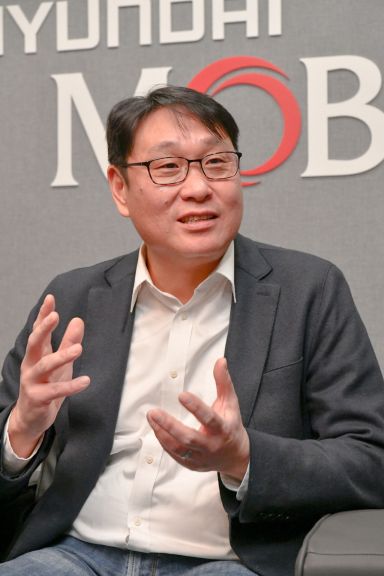
[Las Vegas=Asia Economy Reporter Park Sun-mi] Hyundai Mobis is currently organizing a dedicated team for semiconductor development and business, preparing a comprehensive semiconductor strategy optimized for future mobility. The company is also collaborating with global semiconductor company Qualcomm to develop a 'Level 3' autonomous driving integrated controller. They plan to develop a software platform for the integrated controller by sourcing Qualcomm's high-performance semiconductors. The development target is set for the first half of this year.
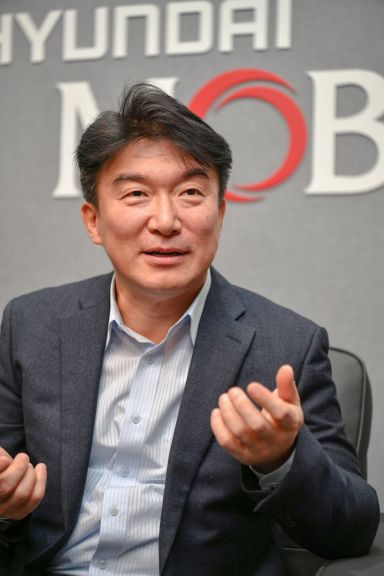
Cheon Jae-seung, Executive Director in charge of future technology convergence at Hyundai Mobis, and Kim Young-kwang, Executive Director of the Business Strategy Office, held a press briefing at CES 2023 on the 5th (local time) and stated, "Hyundai Mobis has been pursuing the development of an independent autonomous driving software platform to supply global automakers," adding, "Through this collaboration, we have secured a strong ally in the semiconductor field, Qualcomm, and expect to expand orders for autonomous driving and ADAS (Advanced Driver Assistance Systems) product lines targeting global customers."
Regarding the specific collaboration structure between Hyundai Mobis and Qualcomm, Executive Director Kim explained, "Qualcomm is among the 'top 3' companies supplying semiconductors for autonomous driving systems," and "Mobis leads the development of the controller platform while simultaneously developing the software and hardware that go into the controller." He added, "Qualcomm supplies the high-performance semiconductors used in the hardware," and "the controller platform development is expected to be completed by the first half of this year." He also mentioned, "This collaboration with Qualcomm is part of a strategy to secure a leading position in the Level 3 autonomous driving market," and "we plan to pursue global marketing activities with other global mobility companies as well."
If Hyundai Mobis successfully creates the controller platform and secures global mobility companies as customers, it will be the first case of its kind. Although there have been previous orders for autonomous driving radar sensors, there has been no experience in securing orders in the controller segment. Regarding Hyundai Mobis's unique advantages among companies supplying Level 3 autonomous driving components, they said, "It is impossible for an automotive parts company alone to internalize all the technologies required to make an autonomous driving system controller," adding, "Mobis has strong partners in Hyundai Motor Company and AutoEver, so the three companies can collaborate to develop a more complete form of autonomous driving controller, which is the biggest advantage."
On the semiconductor supply shortage issue that struck the automotive industry last year, they explained, "Although vehicle production was disrupted due to semiconductor shortages over the past two years, signals indicate that the shortage is gradually easing this year," and "we do not expect semiconductor supply disruptions to be as severe as last year." Hyundai Mobis's new local production base for electric vehicle parts in North America, aimed at responding to the electrification market, is scheduled to be completed by 2025, coinciding with the completion of Hyundai Motor Group's new plant in Georgia. Executive Director Kim said, "The investment scale is $1.3 billion, the investment period is from 2023 to 2030, and the target completion date is 2025."
Meanwhile, regarding the future PBV concept car model 'M.Vision TO' unveiled at this CES, Executive Director Cheon explained, "It is a concept car that showcases the convergence of electrification, autonomous driving, and connectivity, which will be the core of future mobility," adding, "'M.Vision TO' focuses on mobility, allowing the vehicle's interior space to be maximized according to the user's purpose." He continued, "We demonstrated the M.Vision TO performing crab driving; although this may be difficult to apply to low-cost delivery PBVs, the product competitiveness is so high that there will definitely be demand for this technology," and "Mobis will continue to develop related technologies."
© The Asia Business Daily(www.asiae.co.kr). All rights reserved.


















