Father Antaehoon leads fierce action in 'Gapoui Ryeo' organized by him
"Killing officials and plundering people under the pretext of excluding foreigners"
With six comrades, launches surprise attack on over 20,000 enemy soldiers at Daejangso
The Donghak Peasant Revolution was an anti-feudal and anti-foreign movement that took place in 1894, centered around Jeon Bong-jun. The peasants rose up to resist corruption and foreign intervention. Although it ended in failure, it is considered to have influenced later events such as the Gabo Reform and the March 1st Movement. Not all historical accounts are entirely laudatory. There are quite a few records distorted by injustice. Representative examples include the patriotic scholar Hwang Hyun’s "Maecheon Yarok" and the independence activist Park Eun-sik’s "Doknip Undong Jiheolsa" (History of the Independence Movement’s Bloodshed). The former details the misdeeds of the Donghak followers. Similar content is found in the latter: "The Donghak followers spread their influence across various regions, recklessly committing murder and looting with fierce intensity. The people, who had long lived in peaceful times, were all terrified and scattered in flight."
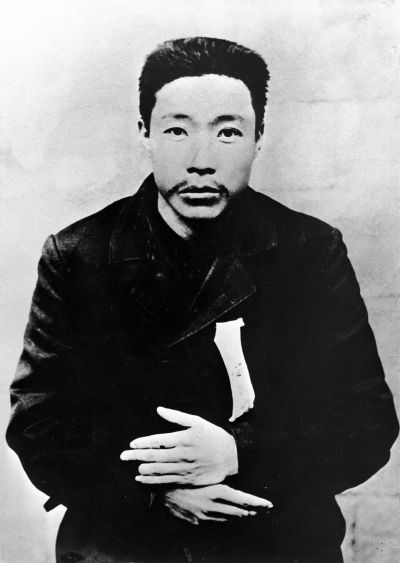
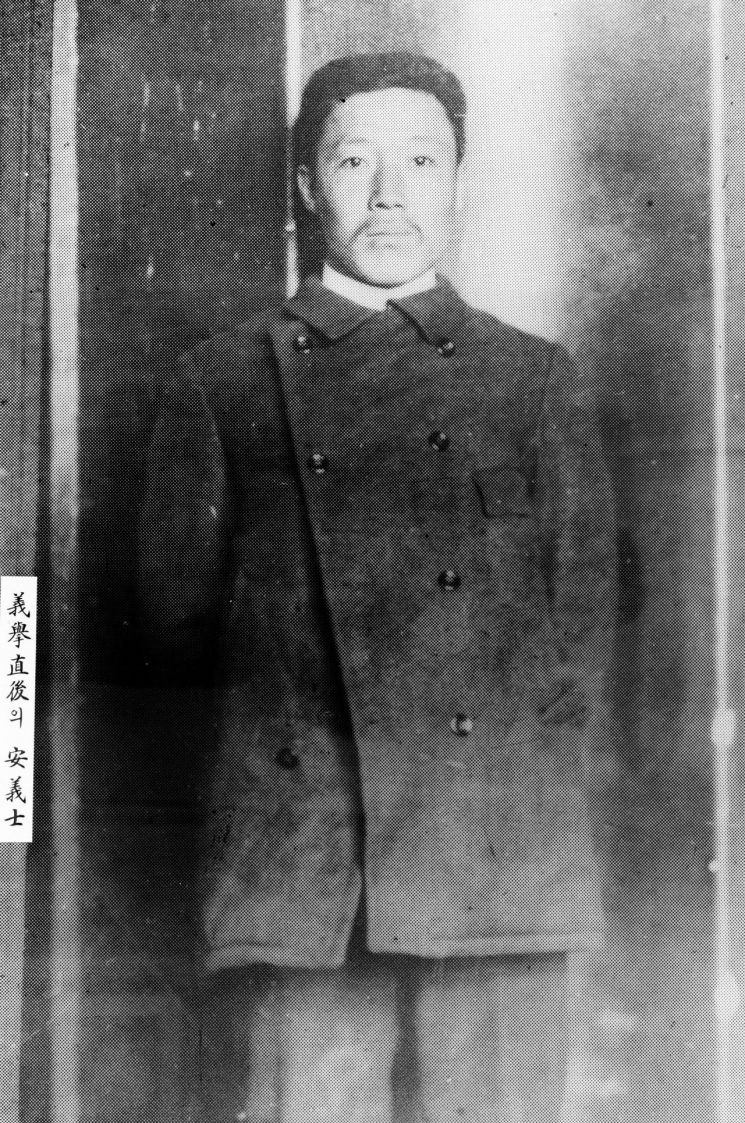
It seems that Ahn Jung-geun, who assassinated Ito Hirobumi and died a martyr, thought similarly. In his prison autobiography "An Eung-chil History," he wrote, "The Donghak followers, under the pretext of expelling foreigners, crossed counties killing officials and plundering the property of the people." He added, "My father (Ahn Tae-hoon), unable to endure the violence of the Donghak followers, gathered comrades, distributed proclamations, raised a militia, called marksmen, and even incorporated women and children into the ranks. The seventy regular soldiers thus assembled camped at Cheonggye Mountain and resisted."
The fact that the enemy in his first battle was the Donghak army is perplexing. This is because most people educated in schools today have a positive impression of the Donghak movement. Perhaps for this reason, some books about Ahn Jung-geun describe the Donghak followers as a group of wrongdoers. A biography of great figures written by novelist Jo Jung-rae is an example: "Not all Donghak followers acted righteously for a world of equality under the principle of Innaecheon (humanity is heaven) or to build a new world by driving out corrupt and rotten officials. There were those who, under the guise of being Donghak followers, committed acts of robbery and theft everywhere. The righteous Donghak followers had to fight again to eliminate such fake Donghak followers."
It is difficult to label these as 'fake' Donghak followers. Their leader was Won Yong-il. He participated in the uprising alongside Kim Yu-young, Han Hwa-seok, and Bang Chan-du, and in 1896, he met Choi Si-hyung, the second leader of Donghak, and formally became a Donghak believer. Their activities, including occupying the provincial government office in Haeju and the naval base in Ongjin during the Donghak Peasant War, were later officially recognized.
In Hwanghae Province, unlike other regions, there were few anti-Donghak forces led by yangban aristocrats opposing the Donghak army. The Gabo Righteous Army organized by Ahn Tae-hoon, who gathered local mountain hunters and youths, was practically the only one. The purpose of the yangban class in organizing troops at that time was simple: to protect their vested interests or to seize opportunities for advancement by gaining merit. Ahn Tae-hoon’s case was different. Kim Sam-woong, a researcher of independence movement history and pro-Japanese anti-nationalist history, wrote in his book "Ahn Jung-geun Biography," "Ahn Tae-hoon had previously joined the enlightenment faction." He added, "Although this was later, he converted to Catholicism and actively engaged in missionary work, leading the acceptance of Western culture. From this perspective, Ahn Tae-hoon’s anti-Donghak stance might have stemmed from an enlightened viewpoint."
Professor Hwang Jae-moon of the Kyujanggak Institute for Korean Studies at Seoul National University focuses on the incident where Ahn Tae-hoon was included in the student delegation led by Park Young-hyo. The Donghak followers were hostile to enlightenment figures represented by Park Young-hyo. This is confirmed in the Korean proclamations issued during the second uprising: "Despite the king’s kindness, three ports were opened for trade. In October of the Gapsin year, the four ringleaders (Kim Ok-gyun, Park Young-hyo, Hong Young-sik, Seo Gwang-beom) aided the enemy, endangering the military government, but thanks to the efforts of loyal subjects, the traitors were eliminated. (...) Upon reflection, even if the officials differ, among Koreans, the principle of expelling the Japanese invaders and rejecting peace with them (Cheokwa Cheokhwa) was generally accepted."
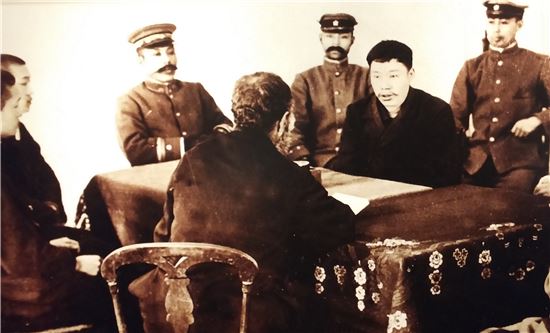 The scene of Ahn Jung-geun's last words
The target of expelling the Japanese (Cheokwa) was Japan. The meaning of Cheokhwa, i.e., what was to be rejected, is unclear. It could be China or the enlightenment movement. Professor Hwang interpreted in his book "Ahn Jung-geun Biography," "If it is the former, the declaration’s intent was to reject foreign powers in general; if the latter, it meant rejecting Japanese forces and the enlightenment faction relying on them." He emphasized, "If interpreted as the latter, the second uprising of the Donghak followers would inevitably have conflicted with Ahn Tae-hoon’s political stance."
Although both enlightenment and Donghak aimed at anti-feudalism, there was a stark difference in ideological orientation and practical logic. The former embraced and pursued Western logic, while the latter rejected foreign powers and sought anti-feudalism based on traditional logic. The former was inevitably seen as a collaborator with foreign invasion. The former also easily labeled the latter as a peasant rebellion or bandits. Ahn Jung-geun feared even greater chaos. In "An Eung-chil History," he wrote, "Because the government troops could not enter due to the Donghak uprising, Qing troops crossed over, and Japanese troops also crossed. As Japan and Qing clashed, it seemed a great war was bound to break out."
At that time, he was sixteen years old. Despite his father’s objections, he carried a gun and volunteered as a vanguard and scout. Ahn Jung-geun won dozens of battles. Each time, his fierce shooting terrified the enemy. However, the advantageous positions were held by about 20,000 Donghak followers. Though a ragtag group, their spirit and bravery were no less than any army. Having the character of class liberation, they did not easily retreat. They occupied Jangyeon County, Sincheon County, Jangsu Mountain Fortress, and Suyang Mountain Fortress, and even attempted a surprise attack on the Gabo Righteous Army.
Upon receiving urgent news, Ahn Tae-hoon launched a preemptive attack. He ordered forty regular soldiers under the mountain hunter No Je-seok to go out. Ahn Jung-geun moved separately with six comrades. They advanced to scout and reached close to the enemy commander’s location. Later, he recalled his actions at the time as follows:
"Hiding and lying down among the trees, I observed the enemy camp’s situation. The banners fluttered in the wind, and the lights soared into the sky, making it as bright as daytime. People and horses were noisy and utterly undisciplined. I looked at my comrades and said, 'If we attack the enemy camp now, we will surely achieve great merit.' They asked, 'How can a small group of weak soldiers defeat tens of thousands of the enemy?' I replied, 'That is not so. According to military strategy, if you know the enemy and yourself, you will win every battle. From what I see, the enemy is a disorderly crowd gathered recklessly. If the seven of us unite our minds and strength, even if they number a million, they are nothing to fear. It is still dark, so if we strike unexpectedly, it will be a crushing victory. Do not hesitate and follow my plan.' They all agreed, and we finalized the plan. At my command, the seven of us simultaneously fired at the enemy commander’s location. The thunderous gunfire shook heaven and earth, and bullets rained like hail. The enemy was unprepared and had no time to react. Without even wearing armor, they abandoned their weapons and fled, pushing and trampling each other across the mountains and fields. We pursued the victorious momentum."
The bold momentum did not last long. At dawn, the Donghak followers realized that Ahn Jung-geun’s forces were not significant. They quickly surrounded and launched attacks from all sides. Ahn Jung-geun could not find an escape route and was in great distress. However, a group of soldiers came running from behind with gunfire, rescuing him from danger. These were reinforcements remaining at the main camp. Ahn Tae-hoon’s unit suffered no casualties and achieved a great victory. They also secured spoils such as firearms, horses, and military provisions.
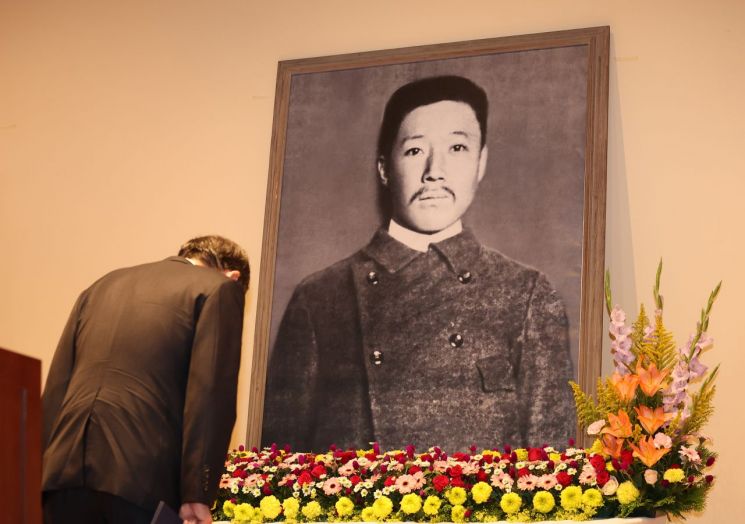
Ahn Jung-geun became the hero of the victory by boldly executing the operation with confidence and persuasion. However, the subsequent pursuit was clearly reckless. No matter how defeated and fleeing the enemy was, it is difficult for seven men alone to chase 20,000. Although the arrival of reinforcements helped avert the crisis, it cannot be seen as a wise strategy. Professor Hwang wrote in "Ahn Jung-geun Biography," "From this single battle, one can infer Ahn Jung-geun’s attitude toward combat. It was generally bold and brave but also showed recklessness. We need to examine how this attitude continued or changed throughout Ahn Jung-geun’s life."
© The Asia Business Daily(www.asiae.co.kr). All rights reserved.
![Clutching a Stolen Dior Bag, Saying "I Hate Being Poor but Real"... The Grotesque Con of a "Human Knockoff" [Slate]](https://cwcontent.asiae.co.kr/asiaresize/183/2026021902243444107_1771435474.jpg)


















