Average 2-Year Returns of 6 New Deal Funds at -30.3%
KOSPI Returns Recorded at -26.89% During the Same Period
Green Funds and Unification Funds Also Falter After Regime Change
[Asia Economy Reporter Park So-yeon] It has been revealed that the New Deal Fund, established to support the 'Korean New Deal,' a key economic policy of the Moon Jae-in administration, has suffered a disastrous performance, with returns plunging as much as minus 50%.
According to FN Guide on the 6th, the average return over the past two years of six New Deal Funds launched by Samsung Active Asset Management, NH-Amundi Asset Management, KB Asset Management, Shinhan Asset Management, and Mirae Asset Management recorded -30.3%. This is a poorer performance compared to the KOSPI volatility (-26.89%) during the same period.
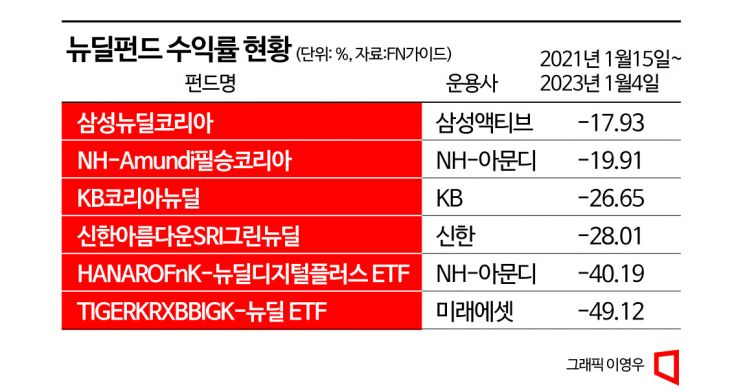
From January 15, 2021, to the 4th of this month, the returns were as follows: Samsung New Deal Korea -17.93%, NH-Amundi Pilseung Korea -19.91%, KB Korea New Deal -26.65%, Shinhan Beautiful SRI Green New Deal -28.01%, HANARO FN K-New Deal Digital Plus ETF -40.19%, and TIGER KRX BBIG K-New Deal ETF -49.12%.
These six funds were the ones that former President Moon Jae-in subscribed to. In January 15, two years ago, former President Moon invested 10 million KRW each in five New Deal Funds and 50 million KRW in the Pilseung Korea Fund, considering the digital and green sectors as well as small and medium-sized enterprises, to encourage the 'Korean New Deal' policy.
Experts analyze that a combination of factors, including the change of administration and sluggish stock market, contributed to this outcome. Funds created based on the policy needs of past administrations often experienced a frenzy like a trend but ultimately ended in tears for investors. Policies pursued with a long-term roadmap by the government sometimes lose momentum due to regime change, and while these industries may be sectors the government needs to actively foster, they may lack competitiveness from a market perspective.
Government-led funds like the New Deal Fund are commonly referred to as 'government-controlled funds.' This is because they are not voluntarily created by the market but are used as a means to maximize policy effects by the government. Many cases relied more on patriotism than on returns, which resulted in poor performance. Due to these inherent limitations, government-controlled funds that appeared with each regime change ended up fizzling out.
The Green Fund led by the Lee Myung-bak administration is a representative example. After former President Lee presented low-carbon green growth as a national vision, 42 related fund products were launched by 2012. The Unification Fund emphasized by the Park Geun-hye administration saw a sharp decline in returns after the closure of the Kaesong Industrial Complex, and funds like the Youth Hope Fund were also discontinued due to plummeting returns.
Experts advise against chasing short-lived returns. A source from the asset management industry said, "Not only the New Deal Fund of the Moon Jae-in administration but also policy funds created by past administrations such as Park Geun-hye’s have shone briefly and ultimately disappeared," adding, "Decisions should not be made solely based on government will or trends; each investor should conduct in-depth analysis before making investment decisions."
© The Asia Business Daily(www.asiae.co.kr). All rights reserved.
![Clutching a Stolen Dior Bag, Saying "I Hate Being Poor but Real"... The Grotesque Con of a "Human Knockoff" [Slate]](https://cwcontent.asiae.co.kr/asiaresize/183/2026021902243444107_1771435474.jpg)
















