About 2.8 Million Visitors in 7 Months Since Cheongwadae Opening
Insadong Sees Increase in Tourists After Installation of Hangul Signboards
Residents Can Apply for Hangul Signboards at District Office
But Budget and Aging Issues Require Review
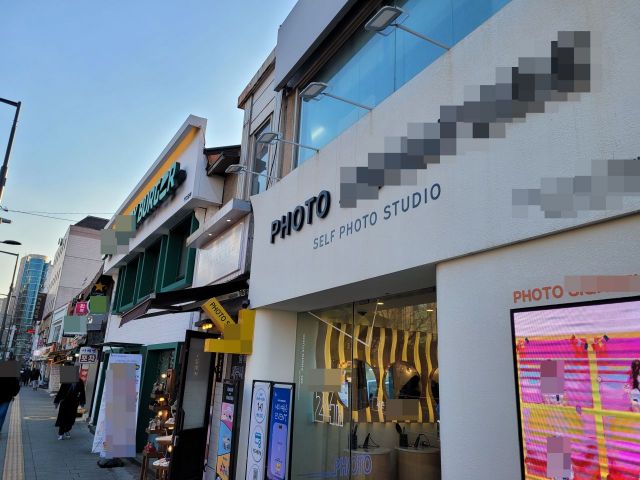 On the 4th, the commercial area near Cheongwadae and Gyeongbokgung that I visited had more than half of the signs in foreign languages. Citizens said that since many foreign tourists visit, unified Hangul signs would provide a new experience.
 /Photo by Gong Byungseon mydillon@
On the 4th, Tongui-dong in Jongno-gu, Seoul, near the Blue House, was filled with foreigners wearing colorful hanbok. The foreigners strolled along the stone wall path of Gyeongbokgung Palace leading up to the Blue House, chatting with each other. They stopped while walking to take photos with Seoul as the backdrop. However, the photo backgrounds included signs written in English. Signs such as OOO Cafe, OOO Photo Studio, and OOO Burger, all written only in English, lined the streets. Although there were a few franchise stores with Korean signs, they were very rare. Office worker Kim (27) said, "Not only the Blue House but also Gyeongbokgung Palace attracts many foreign tourists," adding, "Unified Korean signs would offer tourists a unique experience."
According to the Cultural Heritage Administration on the 6th, about 2.8 million tourists visited the Blue House, which opened with President Yoon Suk-yeol's inauguration, over seven months starting from May 10 last year. The commercial district near the Blue House also became a popular spot with many visitors following the opening. This year, a budget of 21.7 billion KRW is being invested to create a complex cultural space at the Blue House, and it is expected that tourists will continue to visit this area steadily.
However, the signs in the commercial districts near the Blue House, such as Tongui-dong, Hyoja-dong, and Chebu-dong, were "all mixed up." Signs written only in foreign languages accounted for half of all signs. The colors of the signs, including yellow, green, and black, lacked uniformity. Local residents hoped that the signs would be unified in Korean since many tourists visit due to the Blue House opening. Tongui-dong resident Ji (77) said, "Korean signs would look better in terms of uniformity," adding, "Elderly people who have felt uncomfortable because of signs written in foreign languages near the Blue House would welcome Korean signs even more."
There is also an analysis that Korean signs positively impact the increase in tourists. According to the Ministry of Culture, Sports and Tourism, Insadong in Jongno-gu, Seoul, was visited by 26.4% of all tourists in Seoul in 2005, before the Korean sign project began. After starting the Korean sign project in 2008, the number of tourists visiting Insadong increased further. The proportion of tourists visiting Insadong among all tourists in Seoul rose to 33.4%. In 2019, it recorded 35.9%, stabilizing the proportion of tourists visiting Insadong in the 30% range.
Residents Near the Blue House Want Korean Signs... District Office to Review Aging and Other Factors
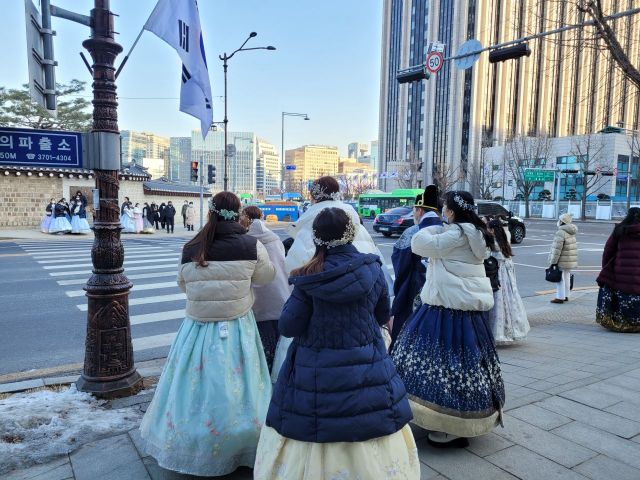 Foreign tourists visiting near Gyeongbokgung Palace on the 4th. They are renting and wearing colorful hanbok from a hanbok rental shop while sightseeing. / Photo by Gong Byung-sun mydillon@
Installing Korean signs is carried out by residents forming a consultative body and applying to the Jongno District Office. The Jongno District Office selects project targets by "road units" and provides subsidies. A Jongno District Office official explained, "Applications will be accepted this month to select this year's Korean sign installation targets," adding, "If selected for sign replacement, up to 3 million KRW per business will be supported."
However, there are limits to how quickly signs in the commercial districts near the Blue House can be replaced. Ultimately, it is a budget issue. The budget for the Korean sign project, which was 400 million KRW last year, has been reduced to 200 million KRW this year. Although 800 million KRW was invested over the past two years to actively promote the project, it has faced budget constraints. A Jongno District Office official said, "The advertising development fund, which finances the Korean sign project, is insufficient," explaining, "The fund's resources come from fines and penalties, but due to the economic downturn caused by COVID-19, delinquencies have increased, naturally tightening the budget."
Additionally, the aging of signs must be examined. For example, signs made of 'Pana Flex' are considered for replacement projects. Pana Flex signs are made by covering lights with fabric, making them cost-effective and the most commonly seen on the streets. However, they are not visually appealing in terms of design and are known to emit carcinogens when incinerated. The Jongno District Office explained that it is necessary to first check whether signs in areas such as Hyoja-dong, Tongui-dong, and Chebu-dong are made of Pana Flex and thus aged.
Geonbeom Lee, head of the Korean Language Culture Solidarity, emphasized, "When foreign tourists come to Korea, an easy way to experience the culture is by encountering Korean signs," adding, "Since characters like English or Spanish are rarely seen overseas, Korean signs can offer tourists a unique experience only found in Korea."
© The Asia Business Daily(www.asiae.co.kr). All rights reserved.
![Clutching a Stolen Dior Bag, Saying "I Hate Being Poor but Real"... The Grotesque Con of a "Human Knockoff" [Slate]](https://cwcontent.asiae.co.kr/asiaresize/183/2026021902243444107_1771435474.jpg)

















