30,553 Repeat Offenses of Fraud Crimes in 2021
Low Sentencing Standards and Decreased Recovery Rate of Damages Identified as Causes
"Measures Needed Such as Public Disclosure of Habitual Offenders"
[Asia Economy Reporter Seoyul Hwang] #In August last year, Ahn Mo (26), who was involved in a fraud case where the suspect swindled at least 15 victims out of 15.77 million won, sought legal advice here and there but was told that since it was a small amount and a first offense, it would only result in a suspended sentence. However, when he opened the verdict in December last year, it was revealed that the suspect’s multiple prior convictions for similar fraud crimes worked against him, resulting in a one-year prison sentence. Although the sentence was harsher than expected, Ahn appealed, “Since the sentencing for fraud crimes is generally low, the recidivism rate seems high as well,” and added, “I knew that the sentencing for crimes in our country was low, but experiencing it firsthand, I now understand why people say it feels so unfair.”
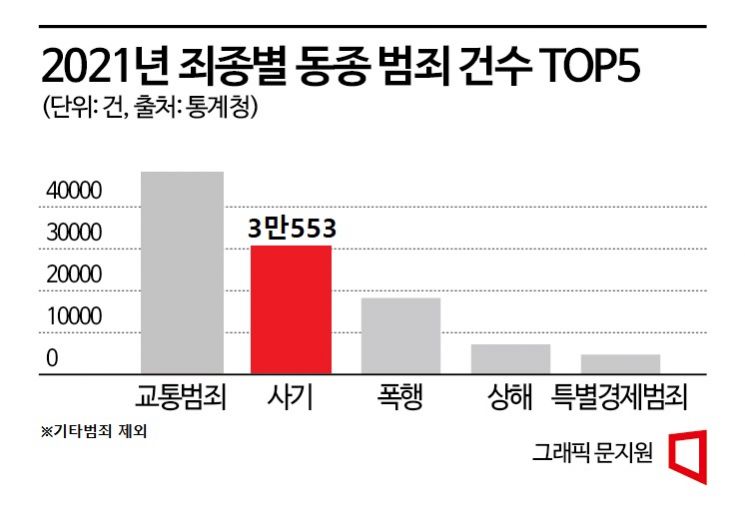
The low sentencing standards and the fact that victims do not have to be fully compensated act as incentives for committing fraud crimes again.
According to the Statistics Korea report “Recidivism Types and Periods” on the 5th, in 2021, repeat offenses of the same type of fraud crimes numbered 30,553 cases, second only to traffic crimes (47,996 cases).
The recurrence period for repeat fraud offenses was also relatively short. Cases of committing fraud again within one month numbered 3,155, within three months 2,956, within six months 2,820, and within one year reached 10,873. Within two years, there were 3,260 cases, within three years 3,281 cases, and beyond three years 4,208 cases.
The low sentencing standards are cited as a reason for the high number of repeat fraud offenses. As in Ahn’s case, general fraud under 100 million won carries a basic sentence of 6 months to 1 year and 6 months, and even with aggravating factors such as malicious methods or repeat offenses, the maximum prison term is 2 years and 6 months. For amounts exceeding 30 billion won, the maximum sentence is 13 years depending on aggravating factors. Kim Daegun, head of the Legal Policy Research Office at the Korea Institute of Criminology and Justice, explained, “The punishment level for fraud crimes is not high, and although certain economic aggravation laws allow for heavier penalties if there is a gain from the damage, it is not easy to prove this, so many cases are not punished accordingly.”
The fact that the recovery rate is not very high also serves as an incentive to commit fraud crimes again. Of the total fraud crime damage amounting to 15.3523 trillion won, only 7.0021 trillion won was recovered, which is just 45.6%. Seo Ji-won, a lawyer at Naran Law Firm, said, “In many cases, fraud suspects do not have assets under their own name, so they try to make partial repayments at an appropriate level,” adding, “Sometimes they repay 20-30% of the damage amount and obtain a settlement agreement or make a deposit, or sometimes they choose to be punished without any repayment.”
Experts pointed out that to prevent recidivism in fraud crimes, it is necessary to reduce information asymmetry and raise sentencing standards. In the past, fraud crimes involved perpetrators deceiving victims one-on-one, but now there are many mass fraud crimes targeting unspecified large numbers of people, spreading damage throughout society. Kim emphasized, “In addition to raising sentencing standards, it is necessary to disclose personal information of habitual fraud offenders who have been convicted.”
© The Asia Business Daily(www.asiae.co.kr). All rights reserved.
![Clutching a Stolen Dior Bag, Saying "I Hate Being Poor but Real"... The Grotesque Con of a "Human Knockoff" [Slate]](https://cwcontent.asiae.co.kr/asiaresize/183/2026021902243444107_1771435474.jpg)











