Parents born in the 1990s
Next 7-8 years are crucial
Comprehensive support for housing, childcare, and education
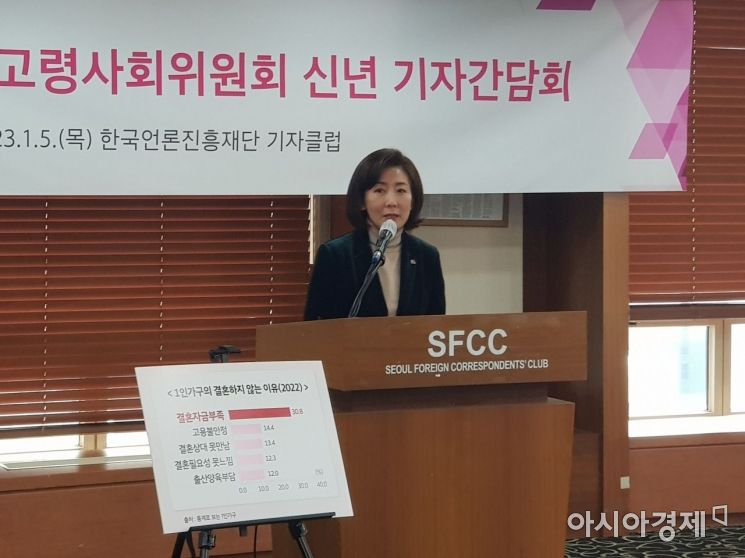 Na Kyung-won, Vice Chairperson of the Low Birthrate and Aging Society Committee, is giving opening remarks at a press briefing held on the 5th at the Korea Press Center in Jung-gu, Seoul. Photo by Lee Kwan-joo
[Asia Economy Reporter Lee Gwan-joo] Na Kyung-won, Vice Chairperson of the Low Birthrate and Aging Society Committee, emphasized on the 5th that "this is the last golden time to solve the low birthrate problem," adding, "Incorrect policies should be boldly abolished or supplemented, and effective policies that have not been introduced so far should be boldly implemented to turn the population crisis into an opportunity."
Vice Chairperson Na views the current time as the last chance to overcome the population crisis due to the population structure. While 600,000 people were born annually in the 1990s, the number decreases to 400,000 for those born in the 2000s. If the crisis is not overcome within the next 7 to 8 years, when the 1990s generation is likely to become parents, the base population itself will be too small to resolve the issue.
She then proposed solutions within five major frameworks: ▲ enhancing the perceived effectiveness of housing support policies ▲ extending parental leave periods and alleviating concerns about career breaks ▲ meticulous establishment of the care and education system ▲ reducing the childcare burden for multi-child families ▲ preventing blind spots in childbirth according to family types.
Vice Chairperson Na stated, "Young people should not postpone marriage and childbirth due to economic reasons," and added, "Considering policies already underway such as housing introduction and jeonse loan support for newlyweds and youth, we will review additional support that can be practically felt." She also said, "We must increase the actual usage rate of maternal and paternal leave systems by guaranteeing childcare time for working parents while minimizing career breaks through measures such as reduced working hours and promoting the employment of substitute workers."
Among these, she mentioned extending the parental leave period closely related to working moms and working dads from the current 12 months to 18 months, guaranteeing a certain salary through reduced working hours, and the so-called 'half-half parental leave' to compensate for career breaks. She also pointed out the need to review whether interest on housing purchase and jeonse loans can be further reduced and whether a certain portion of the principal can be forgiven to solve economic issues related to marriage.
She also expressed the opinion that the Yoon Suk-yeol administration’s ongoing 'three major reforms'?labor, pension, and education reforms?are aligned with solving the low birthrate and aging problems. Vice Chairperson Na said, "For example, labor reforms such as continuous employment will help expand economic activities among the elderly, and flexible working hours allow balancing work, life, and family. Pension reform will enhance pension sustainability, easing the burden on future generations, and education reform will help many generations reluctant to have children due to education costs."
Regarding doubts about the effectiveness of 'cash welfare' to solve low birthrate issues, Vice Chairperson Na responded, "Giving money does not make people decide to have children, but no country has increased birthrates without investing money." She added, "The recent introduction of parental benefits is meaningful in compensating for income loss due to parental leave and expanding choices for various forms of child-rearing," emphasizing that "various child-rearing systems must go hand in hand."
Furthermore, Vice Chairperson Na stressed that solving the low birthrate problem requires not only policy changes but also social and cultural transformations. She said, "To understand how serious the current crisis is, South Korea is the only country in the world with a total fertility rate below 1. According to a Goldman Sachs report, South Korea’s economic size will shrink more than Nigeria’s in 50 years," adding, "Cooperation from all citizens and related ministries is necessary. We must continuously pay attention to population policies and turn the crisis into an opportunity."
© The Asia Business Daily(www.asiae.co.kr). All rights reserved.
![Clutching a Stolen Dior Bag, Saying "I Hate Being Poor but Real"... The Grotesque Con of a "Human Knockoff" [Slate]](https://cwcontent.asiae.co.kr/asiaresize/183/2026021902243444107_1771435474.jpg)
















