Companies Hiring Foreign Developers
185,000 Positions Unfilled in Q3 Last Year
Population Decline Among Youth and COVID-19 Impact
"Policy Efforts Needed to Expand Labor Supply"
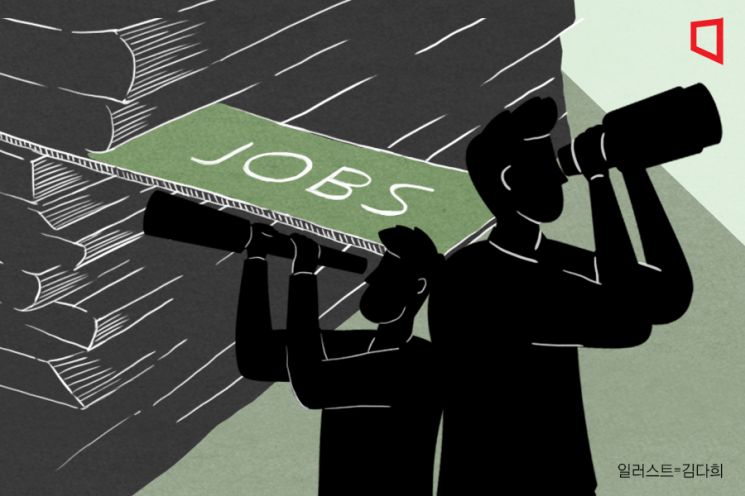
Although there is currently a job shortage due to the economic recession, it is expected that even large corporations will face hiring difficulties in three years due to population decline. A warning has been issued that the population aged 25-34 entering the labor market is decreasing, making it difficult for not only small and medium-sized enterprises but also large corporations to hire as many new employees as they want. Professor Cho Young-tae of Seoul National University Graduate School of Public Health recently stated at a forum, "In three years, it will be difficult for not only small and medium-sized enterprises but also large corporations to recruit people." He revealed that the population aged 25-34 decreased from 7 million in 2015 to 6.5 million in 2021. From 2026 to 2030, an additional 900,000 people will decrease over five years. If this trend continues, starting in 2026, three years from now, even large corporations will find it difficult to find people.
◆Changed Hiring Trends= The hiring trends in the small and medium-sized enterprise sector have already changed. Executive A of a small and medium-sized enterprise recently received this question from a job seeker in their 20s during a new employee interview: "Um... if I join, who will I be working with?" Executive A tried to hide his embarrassment and replied, "We are still discussing which department to assign new employees to." Due to many employees not showing up even after passing, he had no choice but to respond cautiously to what seemed like an inappropriate question.

Companies experiencing a shortage of developers are reaching out to foreign students. Shin Sung-won, Vice President of OneTwoCM, a fintech specialist company, participated in a job fair held at COEX in Seoul last October and conducted interviews with foreign job seekers. One 20-something female developer from Indonesia who was interviewed that day was proficient in both Korean and English, attracting 'love calls' from several companies. Skilled job seekers now choose companies, and companies are seeking talent. Vice President Shin said, "She was interviewed as a prospective graduate at the time and started working with us from January this year," adding, "Her salary is at the same level as that of a domestic university graduate new employee." He said, "Companies are struggling to find suitable talent. In the past, only software specialist companies needed developers, but now even distribution and manufacturing industries are seeking developers, leading to a shortage of supply."
◆185,000 Unfilled Positions= The hiring difficulties of companies are also reflected in the data. Let's look at the labor force survey by occupation conducted by the Ministry of Employment and Labor, announced at the end of last December. In the third quarter of last year (July to September), despite businesses with one or more employees actively recruiting, the number of unfilled positions reached 185,000. This is a 37.6% (51,000) increase compared to the same period the previous year. The unfilled rate, which indicates the proportion of unfilled positions relative to the number of job openings, increased by 3.4 percentage points to 15.4% compared to the same period last year. The most common reason for unfilled positions was "working conditions such as wage levels do not meet job seekers' expectations," accounting for 28.1%.
While the employment market had been sluggish for a long time due to the aftermath of the 1998 Asian Financial Crisis and the 2009 Global Financial Crisis, COVID-19 rather created new job demand. The Korea Development Institute (KDI) analyzed in its economic outlook report last November that jobs related to healthcare, quarantine, caregiving, and IT increased due to COVID-19 response. The Boston Consulting Group (BCG) estimated that the labor force needed in South Korea by 2030 will be 32 million, but the actual supply is predicted to be 26 million. In other words, 6 million job vacancies will exist seven years from now. The era of not being able to find employment due to lack of jobs is ending, and an era where jobs cannot be filled due to lack of workers is coming.
KDI Research Fellow Kim Ji-yeon stated, "A decrease in labor input can lead to a decline in our economy's growth rate," adding, "Policy efforts are needed to expand labor supply by increasing the utilization of currently underutilized labor pools such as women, young elderly, and foreigners."
© The Asia Business Daily(www.asiae.co.kr). All rights reserved.
!["I'd Rather Live as a Glamorous Fake Than as a Poor Real Me"...A Grotesque Success Story Shaking the Korean Psyche [Slate]](https://cwcontent.asiae.co.kr/asiaresize/183/2026021902243444107_1771435474.jpg)


















