Seoul City 2040 Seoul Urban Master Plan Confirmed and Announced
Height Restrictions Removed, Redevelopment Projects Expected to Gain Momentum
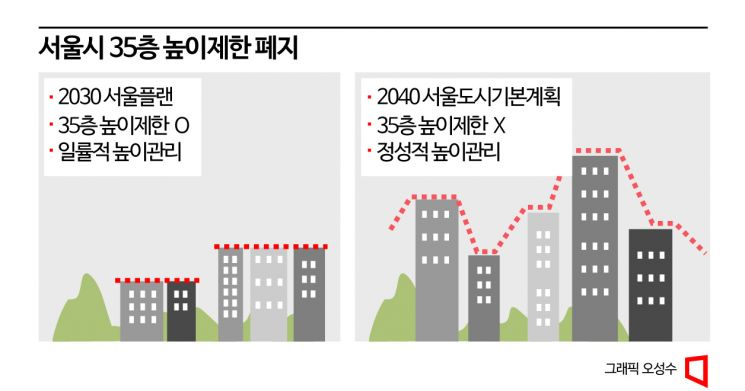
[Asia Economy Reporter Onyu Lim] The Park Won-soon-era "35-floor rule," which uniformly restricted the height of apartments in Seoul, has been abolished after nine years. With the possibility of ultra-high-rise apartments emerging in areas such as Yeouido and Yongsan, Seoul's skyline is expected to become more diverse.
Seoul City finalized and announced the "2040 Seoul Urban Master Plan" on the 5th, which includes this change. The Seoul Urban Master Plan is the highest-level spatial plan that serves as a guideline for various plans the city pursues. It is typically established every five years under the National Land Planning Act.
In formulating this plan, the city focused on citizens' daily living spaces to improve quality of life while strengthening Seoul's urban competitiveness.
◆The 35-floor limit that created "matchbox apartments" is gone= The most notable change is the abolition of the "35-floor rule." This rule limited residential buildings in the third-class general residential area to 35 floors or less and was established in 2013 during former Mayor Park Won-soon's tenure under the "Seoul Skyline Management Principles." The purpose was to prevent ultra-high-rise buildings from monopolizing sunlight and views and to harmonize with low-rise buildings and natural scenery. However, it was criticized for producing uniform "matchbox apartments" in areas like Jamsil, which lowered the city's competitiveness. Consequently, Mayor Oh Se-hoon abolished the 35-floor rule through the 2040 master plan.
With the removal of height restrictions, more diverse design proposals can emerge in apartment complexes undergoing redevelopment projects. A Seoul city official said, "Since the total floor area and floor area ratio remain unchanged, buildings will be spaced apart, creating sight corridors (spaces to secure views) and producing a more varied landscape."
Experts also expect that abolishing the 35-floor rule will boost redevelopment and reconstruction projects and foster creative urban landscapes. Kim Deok-rye, senior researcher at the Korea Research Institute for Housing and Urban Affairs, said, "Uniform floor regulations have made it difficult to create beautiful skylines. Going forward, as high-density development in downtown Seoul becomes possible, various views of the Han River and Namsan will be secured."
The market anticipates that the abolition of the 35-floor rule will accelerate redevelopment projects by creating diverse skylines. Areas expected to benefit include redevelopment complexes in the Gangnam area and along the Han River, where projects had previously stalled.

◆Development without land-use constraints through "Beyond Zoning"= In the 2040 master plan, the city presented the vision for Seoul over the next 20 years as "My livable Seoul, Everyone's Seoul in the world," and established seven major goals, sectoral strategic plans, spatial plans, and regional plans to realize this vision.
The seven major goals are ▲ Creating walkable daily life zones ▲ Reorganizing waterfront-centered spaces ▲ Three-dimensional infrastructure ▲ Innovation of central functions ▲ Future transportation infrastructure ▲ Carbon-neutral safe city ▲ Urban planning paradigm shift.
One notable change is the newly introduced "Beyond Zoning" as a future urban management paradigm. This system aims to promote convergent and complex land use that considers regional characteristics while maintaining the designated purposes of land-use zones for efficient use of urban space. With Beyond Zoning, flexible and mixed-use development becomes possible without being constrained by land use for residential, office, commercial, or leisure purposes. A Seoul city official explained, "We plan to lower barriers to changing land-use zones and maximize the use of systems like minimum regulation zones to create multifunctional complex areas suited to regional characteristics."
The city began preparing the 2040 master plan in 2019 and announced key contents in March last year. After public hearings, consultations with related agencies, and gathering opinions from the city council, the legal procedures were completed with the urban planning committee's review in November. This announcement marks the completion of all procedures.
Jo Nam-jun, Director of Seoul City Urban Planning Bureau, said, "The significance of the 2040 Seoul Urban Master Plan lies in transitioning to flexible urban planning that reflects rapid social and environmental changes. We hope this plan will serve as a blueprint and play a key role in improving citizens' quality of life and urban competitiveness."
© The Asia Business Daily(www.asiae.co.kr). All rights reserved.
![Clutching a Stolen Dior Bag, Saying "I Hate Being Poor but Real"... The Grotesque Con of a "Human Knockoff" [Slate]](https://cwcontent.asiae.co.kr/asiaresize/183/2026021902243444107_1771435474.jpg)












