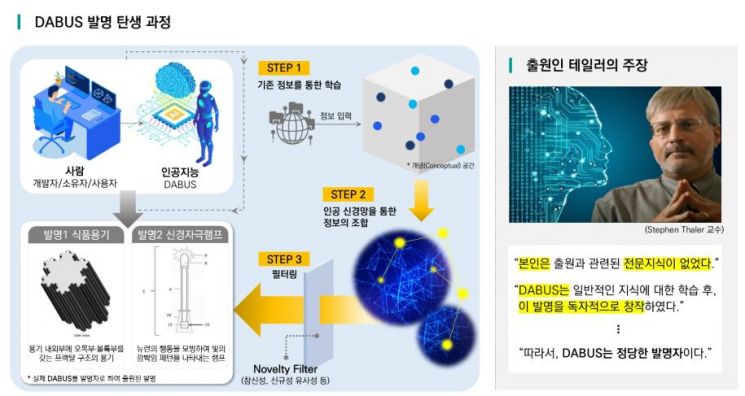
 Diagram of the invention process of 'Dabus'. Dabus is an artificial intelligence developed by American AI expert Steven Taylor. Provided by the Patent Office.
[Asia Economy (Daejeon) Reporter Jeong Il-woong] Whether to grant inventor status to artificial intelligence will be decided through the courts. This comes as the Korea Intellectual Property Office (KIPO) denied AI inventions, prompting a patent applicant who listed AI as the inventor to file an administrative lawsuit.
KIPO announced on the 5th that Steven Taylor (an AI expert), the applicant, has filed an administrative lawsuit against the decision last year to invalidate a patent application that listed artificial intelligence as the inventor.
Steven Taylor, an AI developer from the United States, filed an international patent application naming an AI called ‘DABUS’ as the inventor with 16 patent offices, including South Korea.
The applicant himself claims to have no related knowledge of the inventions filed and asserts that ‘DABUS,’ which he developed, independently created two different inventions, such as a food container, by learning general knowledge.
However, on September 28 of last year, KIPO invalidated Steven Taylor’s application, effectively treating the application as if it never existed.
Currently, major patent offices and courts in countries such as South Korea, the United States, Europe, and the United Kingdom recognize only natural persons as inventors under patent law or precedent and do not acknowledge artificial intelligence. The invalidation of Steven Taylor’s application last year is no exception.
However, in March of last year, the German Federal Patent Court ruled that “only natural persons are recognized as inventors, but when listing inventors, it is permissible to include information about artificial intelligence.”
Unlike the general refusal to recognize AI as the primary inventor, Steven Taylor is attempting again through litigation to grant inventor status to artificial intelligence. The matter has thus moved from KIPO to the courts.
Notably, lawsuits challenging the refusal to recognize AI as an inventor have mainly been conducted in the United States, Europe, Germany, the United Kingdom, and Australia, and this is the first case filed against KIPO among Asian countries, drawing significant attention.
Earlier, KIPO led a thematic discussion on the issue of AI inventors at the World Intellectual Property Organization (WIPO) in September last year and agreed in December to cooperate with the patent offices of Germany, the United Kingdom, and France to establish intellectual property systems related to AI in the future.
Currently, major countries in the intellectual property field agree that “although the technology level has not yet reached the point where AI independently invents without human intervention, inconsistencies between countries in legal systems could hinder AI industry development, so international harmonization is essential,” KIPO explained.
Under this policy, the UK and Germany plan to conduct hearings on the DABUS patent application at their supreme courts, and KIPO intends to consult with the respective patent offices on response measures once supreme court rulings are issued in each country.
Lee In-sil, Commissioner of KIPO, said, “Considering the rapid development of AI technology, it is clear that proactive preparation is necessary for intellectual property issues related to AI inventors.” He added, “KIPO will play a role in establishing AI-related intellectual property systems by comprehensively considering Korea’s administrative lawsuit and major countries’ supreme court rulings to help the international community reach a harmonious consensus.”
© The Asia Business Daily(www.asiae.co.kr). All rights reserved.

















