Luminance (Brightness) Improved by 60%, Viewing Angle Enhanced by 30%
Maximum Brightness of Up to 2100 Nits, the Highest Currently Available
Energy Efficiency Improved by Approximately 22% and More
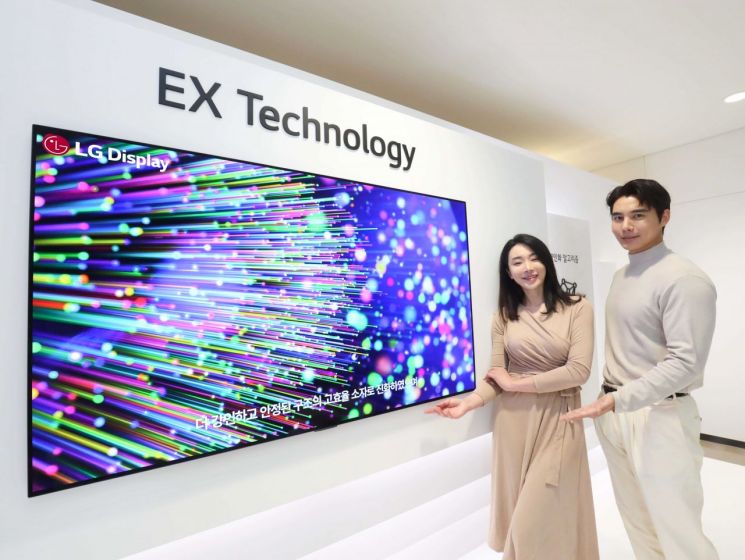
[Asia Economy Reporter Moon Chaeseok] LG Display announced on the 4th (local time) that it unveiled a new 3rd generation OLED (Organic Light Emitting Diode) TV panel product made with 'Meta Technology' at CES 2023, the world's largest electronics and IT exhibition in Las Vegas, USA. This innovative product improves brightness by 60%, viewing angle by 30%, and energy efficiency by 22%.
The principle of Meta Technology combines ultra-fine lenses and brightness enhancement algorithms. The ultra-fine lenses maximize the light emission of organic materials, making the screen brighter. After launching the 2nd generation OLED TV panel last year, the company released the 3rd generation this year. LG Display has devoted 10 years to Meta Technology. LG Display stated, "It is evaluated as proof of leadership in large OLED technology."
The 3rd generation OLED TV panel achieves 2100 nits (1 nit = brightness of one candle), 61.5% brighter than the previous 1300 nits. It is the brightest among existing OLED TV panels.
LG Display has emphasized that the strength of OLED lies in 'perfect black reproduction.' With the powerful light of Meta Technology added, it can produce vivid light and colors as in nature. It is said to offer an immersive experience that breaks down the boundaries between virtual and reality.
The secret to dramatically increasing brightness is the 'micro lens array' ultra-fine lenses. Tiny, convex lens patterns invisible to the eye are coated with self-emitting organic materials to maximize light emission. This solves the problem of light not escaping outside due to internal panel reflection, which previously prevented the screen from becoming brighter.
The new product improves energy efficiency by about 22% compared to panels with the same brightness. For the 3rd generation OLED TV panel, based on a 77-inch 4K model, 5,117 micro lenses per pixel, totaling 42.4 billion micro lenses, were embedded. This allows light that was lost due to internal reflection to be thoroughly emitted outside.
LG Display independently developed the brightness enhancement algorithm called 'Meta Booster.' This technology precisely analyzes brightness information for each video frame and adjusts it in real time to enhance screen brightness and color expression. It enriches the 'High Dynamic Range (HDR)' technology that makes bright areas brighter and dark areas darker.
Providing the widest viewing angle is also an attractive feature of the product. It is equipped with hundreds of billions of micro lenses. The angle at which brightness is half of the front screen was expanded to 160°, a 30% improvement compared to existing products.
The wider angle allows for detailed video reproduction. LG Display said, "It produces an effect similar to a dragonfly's compound eyes, which have millions of convex lenses and can see 360°."
The unique infinite contrast ratio and rich color expression of OLED, where each pixel emits light without a backlight, are fully preserved. The amount of harmful blue light emission was reduced. The screen flicker phenomenon was eliminated. The use of plastic was reduced by more than 90% compared to LCD (Liquid Crystal Display).
LG Display plans to first apply Meta Technology to premium OLED TV panels produced this year, including 4K 55, 65, and 77 inches and 8K 77 and 88 inches. It will then expand to all lineups. The company aims to secure leadership in the high-end TV market OLED segment.
Hyunwoo Lee, Executive Vice President and Head of Large Business Division at LG Display, said, "Developing the Meta Technology, a super-gap technology, means that OLED TV picture quality has evolved to a level incomparable to existing products," adding, "We will expand and lead the ultra-premium OLED TV market."
© The Asia Business Daily(www.asiae.co.kr). All rights reserved.