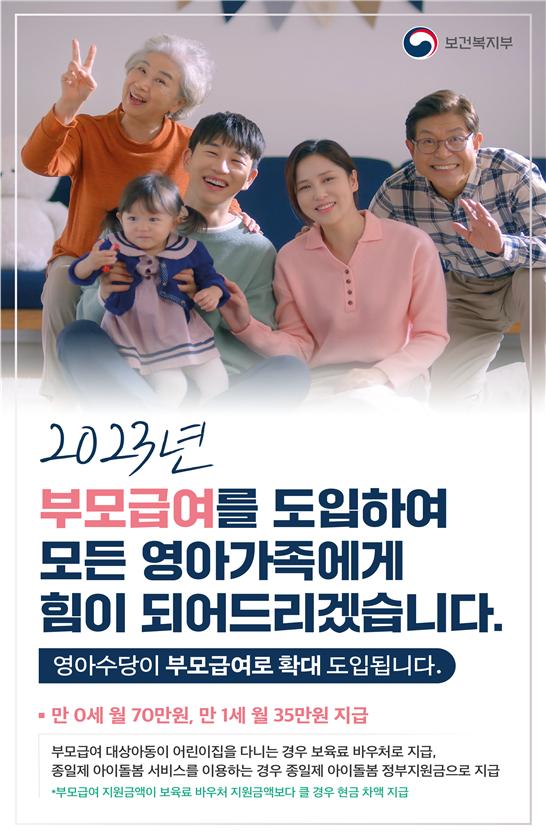
[Asia Economy Reporter Lee Gwan-ju] Starting this year, the basic livelihood security living allowance will be expanded, and the asset criteria for recipients of living and medical benefits will be relaxed. The existing infant allowance will be expanded to a 'parent allowance,' providing 700,000 KRW monthly to parents of children aged 0. The threshold for catastrophic medical expense support will be lowered to reduce the burden of medical costs. Here is a brief summary of the major health and welfare policy changes in the new year.
▶Expansion of Basic Livelihood Security Benefits and Relaxation of Asset Criteria= For a four-person household, the maximum living allowance will increase from 1.54 million KRW to 1.62 million KRW. The regional classification method applied when calculating assets for living and medical benefit recipients will be reorganized into four categories (Seoul, Gyeonggi, Metropolitan/Sejong/Changwon, Others), and the basic asset deduction amount and residential asset limit standards will be relaxed. Through the relaxation of asset criteria, it is expected that about 35,000 households will newly receive living allowances and about 13,000 households will newly receive medical benefits.
▶Increase in Emergency Welfare Support Living Allowance= Emergency welfare support is a program that quickly assists households facing sudden crises and difficulties in livelihood. For a four-person household, the living allowance will be increased by 5.47% compared to the second half of last year.
▶Increase in Disability Allowance= The disability allowance rate, which has been maintained since 2015 (40,000 KRW per month for home care, 20,000 KRW per month for facility care), will be increased by 50% this year to 60,000 KRW per month for home care and 30,000 KRW per month for facility care.
▶Allowing Activity Support Applications for Disabled Persons Under 65 with Geriatric Diseases= From this year, persons under 65 with geriatric diseases such as dementia and cerebrovascular disease will also be able to apply for activity support benefits. It is expected that about 2,700 people currently using long-term care will be able to additionally use this service.
▶Strengthening Support for Youth Preparing for Independence (Formerly Protected Children)= The independence allowance paid for five years after leaving child welfare facilities or foster care will increase from 350,000 KRW to 400,000 KRW per month. From the second half of this year, health insurance co-payments will be reduced to the level of medical benefits (Type 2).
▶Introduction of Parent Allowance= For children aged 0, 700,000 KRW will be paid monthly, and for children aged 1, 350,000 KRW will be paid monthly. If using daycare centers, the payment will be made as a childcare fee voucher, and if using full-day child care services, it will be provided as a government subsidy for full-day child care.
▶Lowering the Threshold for Catastrophic Medical Expense Support= The medical expense criterion is support when out-of-pocket medical expenses exceed 10% of annual income, and the asset criterion is relaxed to 700 million KRW or less. The limit will increase from the existing 30 million KRW to 50 million KRW, and support will be available for all diseases.
▶Expansion of Care Services for Persons with Developmental Disabilities and Disabled Children= A pilot project will be promoted to provide temporary (one week) 24-hour care when caregivers of persons with developmental disabilities face emergencies such as hospitalization or family events. The monthly hours of daytime activity services supporting adult persons with developmental disabilities will be expanded by 29 hours.
▶Expansion of Social Service-Type and Private Sector Senior Jobs= Social service-type senior jobs and private sector senior jobs linked to private employment will be expanded. Compared to the previous year, 38,000 more jobs will be added, including 15,000 social service-type and 23,000 private sector jobs.
▶Development of Non-Face-to-Face Medical Technology= Over the next four years, a total of 40 billion KRW will be invested to develop and conduct demonstration research on non-face-to-face medical technologies for infectious disease response to prepare for future pandemics. Technologies will be developed to treat patients at home during infectious disease situations and to quickly transfer them to hospitals if necessary. The effectiveness of these technologies will be verified through a non-face-to-face medical platform.
© The Asia Business Daily(www.asiae.co.kr). All rights reserved.

















