Less Volatile Than Bitcoin, Gaining Interest
Strengths in Security and Anonymity ... Demand Rises Amid Pressure from Investigative Agencies
[Asia Economy Reporter Lee Jung-yoon] Monero, a virtual asset with strengths in security and anonymity, is gaining renewed attention. This is due to increased virtual asset regulations and pressure from investigative agencies.
Monero, which had been noted mainly in the dark web and other underground markets, is attracting investors who prioritize personal information protection, recording smaller declines than Bitcoin during the virtual asset downturn.
According to the global virtual asset market tracking site CoinMarketCap on the 4th, Monero was trading in the $150 range. Compared to early May last year, before the virtual asset downturn fully began due to the Terra-Luna incident, interest rate hikes, and the bankruptcy of virtual asset exchange FTX, when it was $229, this represents a 34% drop. This is a relatively better situation compared to the flagship virtual asset Bitcoin. On the same day, Bitcoin was trading around $16,850, a roughly 56% plunge from about $38,307 in early May last year. Notably, Monero outperformed Bitcoin in price fluctuations over the past week as well. Bitcoin rose 1.3%, while Monero increased by more than 4.5%. It ranks 23rd in total coin market capitalization.
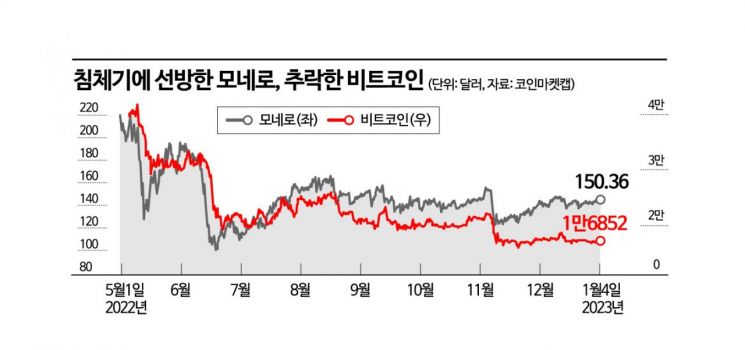
Monero, developed in April 2014, continues to attract investors due to its excellence in personal information protection. Following the recent FTX incident, regulatory authorities and investigative agencies worldwide have increased pressure, boosting demand for coins with strong security features.
Monero protects personal information through ring signatures and stealth addresses. Ring signatures involve using multiple contract addresses that combine not only the sender but also other participants' addresses within the Monero blockchain group when sending Monero. While other coins transmit through a single sender address, Monero uses multiple combined addresses like a ring, so only the fact that the sender is a member of the group is disclosed, but the exact identity cannot be confirmed.
Additionally, the stealth address feature creates a one-time address, allowing the sender and receiver to conduct transactions. Only the parties involved in the transaction can determine the address, and exchanges occur at unique blockchain addresses that others cannot link. Not only the amount of coins transacted but also the sending and receiving addresses are obfuscated to prevent identifying who participated in the transaction.
Thanks to this dual mechanism of ring signatures and stealth addresses, Monero is known as a leading privacy coin that is difficult to trace transaction histories. However, due to its outstanding security, Monero is sometimes exploited for illegal transactions. Virtual asset research platform Xangle stated, "The project focuses on personal information protection and aims to provide users with a high level of anonymity by obscuring not only the amount transferred but also the identities of both the sender and receiver of transactions," adding, "While its strong privacy features earn it high praise from some, its anonymity can lead to illegal activities, making it a target of criticism."
 During the 2020 Telegram Nth Room case, Jo Joo-bin, the operator of the 'Doctor's Room,' and his accomplices were also known to have used Monero. Photo by Yonhap News
In particular, Monero is used as a means for illegal transactions such as drugs and pornography on the dark web, accessible only through specific browsers. During the 2020 Telegram Nth Room case, it was reported that Cho Ju-bin, the operator of the 'Doctor's Room,' and his associates used Monero. On Twitter, promotional posts such as "We launder all cryptocurrencies (Bitcoin, Ethereum, Monero, etc.). We provide illegal fund concealment and exchange consulting" can also be easily found.
© The Asia Business Daily(www.asiae.co.kr). All rights reserved.


















