Unplug the Cable or Use the 'Low Voltage Cutoff Setting'
#. Kang Mo (30), an office worker commuting from Suwon, Gyeonggi Province to a workplace in Seoul, broke into a sweat on his way to work last month during a cold wave. He got into his car to go to work, but the engine wouldn't start because the battery was dead. He said, "I left early because of the cold wave, but I thought the bus would be stuck too, so I took a half-day off and called insurance. The weather keeps getting colder, and indoor parking is difficult, so I'm very worried."
Damage such as car battery discharge continues due to the ongoing cold wave in the new year. During heavy snow or subzero temperatures, simply preparing for vehicle maintenance can prevent battery discharge damage.
Increase in Winter Emergency Dispatches... Over 80,000 Cases During Cold Waves
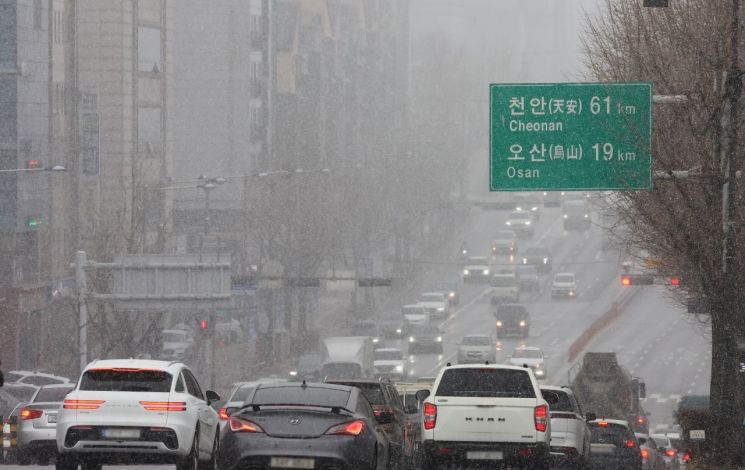 On the afternoon of the 13th of last month when it snowed, vehicles were moving slowly on Gyeongsu-daero, Paldal-gu, Suwon-si, Gyeonggi-do. Photo by Yonhap News
According to the insurance industry on the 3rd, from the 5th to the 16th of last month, when the cold wave first hit this winter, the number of emergency dispatch service cases for automobile insurance from four non-life insurance companies?Samsung Fire & Marine Insurance, Hyundai Marine & Fire Insurance, KB Insurance, and DB Insurance?totaled 635,091, averaging about 50,000 cases per day.
In particular, on the 5th of last month, when the lowest temperature in Seoul dropped to minus 7 degrees Celsius, there were 80,889 cases in one day, and on the 14th, when it dropped to minus 11 degrees Celsius, it reached 82,860 cases, showing that the number of emergency dispatch service cases increased as the temperature dropped.
It was found that 60% of the dispatch cases were due to battery discharge. In such subzero weather, car battery discharge frequently occurs because the electrolyte in the car battery is very sensitive to temperature, and the lower the temperature, the greater the battery consumption. If possible, parking in an indoor garage is a way to prevent battery discharge, but if you have no choice but to park outdoors, it is necessary to familiarize yourself with winter battery management methods.
Beware of 'Black Box' as a Cause of Battery Discharge
Among them, special attention should be paid to managing the black box. The black box is considered the biggest cause of car battery discharge in winter. According to emergency dispatch statistics from the insurance industry, the causes of car battery discharge often include improperly closed car doors, leaving hazard lights, parking lights, or interior lights on, but in winter, a significant portion is reported to be due to parking with the black box attached in cold places.
In winter, it is necessary to use the black box's 'low voltage cut-off setting' function to automatically turn off when the battery voltage drops below a certain level. For black boxes without this function, caution is needed, such as parking where closed-circuit television (CCTV) is visible and unplugging the black box's power cable.
If you fail to prevent battery discharge, it is advisable to be familiar with services such as towing and battery jump-start through the emergency dispatch service of the non-life insurance company you are subscribed to. Also, since a battery that has been discharged once is prone to failure, it should be replaced every three years.
© The Asia Business Daily(www.asiae.co.kr). All rights reserved.

















