Sale Restriction Period Eased from Maximum 10 Years to 3 Years
Abolition of Actual Residence Requirement for Housing under the Subscription System
Removal of Price Criteria for Mid-term Loan Guarantee
No Obligation to Dispose of Existing Home for Single-Home Subscription Winners
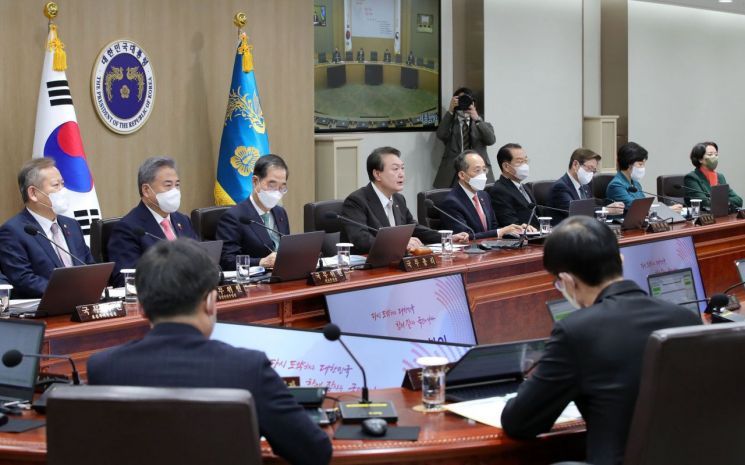
[Asia Economy Reporter Kim Min-young] The government has decided to lift all regulations on areas except for the three Gangnam districts of Seoul (Gangnam, Seocho, Songpa) and Yongsan District. Along with this, the private land price ceiling system will be completely lifted in all areas except the three Gangnam districts and Yongsan District. The resale restriction period in the metropolitan area will also be eased from the current 10 years to a maximum of 3 years, and the mandatory residence requirement applied to housing under the metropolitan area price ceiling system will be abolished. Furthermore, from now on, buyers will be able to receive interim payment loans for all pre-sale housing regardless of the sale price.
◆Regulatory areas lifted except Gangnam 3 districts and Yongsan... Focus on increasing transaction volume= The Ministry of Land, Infrastructure and Transport announced major policy tasks for 2023 through the '2023 Ministry of Land, Infrastructure and Transport Work Report' on the 3rd. This is interpreted as a measure to prevent a market hard landing amid a deepening transaction cliff caused by endless housing price declines and sharp interest rate hikes.
First, to increase the abnormally contracted housing transaction volume, the government decided to lift regulations on all areas except the three Gangnam districts and Yongsan District in Seoul.
The Ministry of Land, Infrastructure and Transport held a Residential Policy Deliberation Committee on the 2nd and reviewed the 'Adjustment Plan for Speculative Overheated Districts and Adjustment Target Areas,' deciding to lift regulations on the remaining 21 districts of Seoul except Gangnam, Seocho, Songpa, and Yongsan, as well as the entire Gyeonggi Province. Likewise, the Ministry of Economy and Finance held the Real Estate Price Stabilization Deliberation Committee on the same day and decided to maintain only the three Gangnam districts and Yongsan District as housing speculation areas, lifting regulations elsewhere. This regulatory area lift will take effect from 0:00 on the 5th, after the official gazette publication is completed.
Once lifted from the regulatory areas, heavy taxation on multiple homeowners such as comprehensive real estate tax and capital gains tax will disappear, and loan limits such as loan-to-value ratio (LTV) will be expanded.
Ham Young-jin, head of the Zigbang Big Data Lab, said, "In areas where regulations are lifted, various tax and loan restrictions such as multiple homeowner capital gains tax and acquisition tax, comprehensive real estate tax surcharges, and prohibition of mortgage loans for households owning two or more houses will be significantly reduced," adding, "This is expected to ease the barriers and restrictions for buyers entering the housing market."
Along with this, the private land price ceiling system will be completely lifted in all areas except the three Gangnam districts and Yongsan District. The Ministry of Land, Infrastructure and Transport explained, "Considering the recent housing market situation and inconveniences to actual demanders caused by the price ceiling system, the designation of the price ceiling system will be lifted in the remaining 14 districts of Seoul and the entire Gyeonggi Province."
Moreover, the mandatory application of the price ceiling system to urban complex projects and residential regeneration innovation district projects will also be lifted. The effect of lifting the price ceiling system will apply to applications for resident recruitment approval submitted after 0:00 on the 5th, following the official gazette publication.
Lee Eun-hyung, a research fellow at the Korea Construction Policy Research Institute, evaluated, "Overall, this is a measure to ease factors hindering real estate market transactions and induce a soft landing of the market. Even if short-term visible effects are hard to expect, it is positive as a long-term policy direction toward market normalization through deregulation," but added, "However, the current problem of uncertainty regarding the upper limit of the US base interest rate is an external factor, so it is difficult to offset its impact with domestic policies such as deregulation."
Resale restrictions will also be eased. Currently, the metropolitan area has a resale restriction period of up to 10 years, and non-metropolitan areas up to 4 years. The government will immediately start revising the Enforcement Decree of the Housing Act to ease the metropolitan area resale restriction to 3 years for public land and regulated areas, 1 year for densely controlled zones, and 6 months for other areas. For non-metropolitan areas, the restriction will be eased to 1 year for public land and regulated areas, 6 months for metropolitan city urban areas, and completely abolished for other areas. Accordingly, even if the pre-sale was made before the decree revision but resale restrictions remain, the revised decree will be applied retroactively.
◆Massive deregulation in the pre-sale market... Will unsold inventory be resolved?= Measures to revive the stagnant pre-sale market will also be implemented. Due to recent interest rate hikes, the pre-sale market has fallen into a slump, and unsold inventory is increasing nationwide, raising concerns about liquidity crises for construction companies. In response, the government will ease various regulations to resolve unsold inventory.
First, the mandatory residence requirement for housing subject to the metropolitan area price ceiling system will be abolished. Currently, buyers of housing under the metropolitan area price ceiling system are required to reside in the house for 2 to 5 years from the move-in date. Going forward, the mandatory residence requirement will be abolished for housing under the metropolitan area price ceiling system and general sales in public redevelopment. This will also be applied retroactively even if the residence requirement has already been imposed. Additionally, regardless of the Housing Act amendment, for areas where the private land price ceiling system designation is lifted, houses sold after the lift will not have a 2 to 3 year mandatory residence requirement.
These measures are expected to somewhat ease the near transaction cliff in the pre-sale rights market. Ham Young-jin of the Big Data Lab said, "With the abolition of the 2 to 5 year mandatory residence requirement applied to metropolitan area price ceiling system housing (law amendment underway), some demanders who found it difficult to get loans or move in can now prepare move-in payments through leases or sales, opening exit routes," adding, "The related system improvements will be applied retroactively to previous buyers, and attempts to trade pre-sale rights, which had shown a transaction cliff, are expected to slightly increase centered on Seoul."
The price ceiling for interim payment loan guarantees will also be removed. At the end of last year, the Housing and Urban Guarantee Corporation (HUG) raised the price ceiling for interim payment loan guarantees from 900 million KRW to 1.2 billion KRW, but houses priced above 1.2 billion KRW were still difficult to apply for due to funding burdens on actual demanders. Moreover, HUG's interim payment loan guarantee is limited to 500 million KRW per person, causing difficulties in funding when interim payments exceed 500 million KRW. Therefore, the government plans to abolish the price ceiling for HUG interim payment loan guarantees, allowing interim payment loans for all pre-sale housing regardless of price. The per-person guarantee limit for interim payment loans will also be abolished. The government plans to implement this within the first quarter of this year after revising HUG's internal regulations and preparing banking systems.
Additionally, the regulation that prohibited special supply allocation for houses priced over 900 million KRW in speculative overheated districts will be abolished, allowing special supply for all houses regardless of price. If the revision is completed by February this year, it will apply to cases where the project entity applies for resident recruitment approval after implementation.
The obligation for one-household winners to dispose of their existing house will also be abolished. Previously, if a one-household winner in the metropolitan area or metropolitan cities won a pre-sale, they had to dispose of their existing house within 2 years from the move-in date. However, due to recent transaction stagnation making it difficult to dispose of existing houses and causing delays in moving in, the government decided to abolish this obligation. The government plans to complete the revision of the Housing Supply Rules in February, reorganize the subscription system, and implement it in the first half of the year, applying it retroactively even to those who won before implementation.
Furthermore, the eligibility requirements for non-priority subscription will be eased. In the past, non-priority subscription for unsold units caused by winners' withdrawal or contract cancellation after the main subscription was only available to non-homeowners, limiting the resolution of unsold units. From February, homeowners will also be able to apply for non-priority subscription.
◆Housing market slump hits construction companies... Support for funding= The government will also promote liquidity support measures for construction companies facing funding difficulties due to rising interest rates and housing market slump. To minimize construction companies' funding risks and ensure smooth housing supply, HUG project financing (PF) loan guarantees will be newly established and expanded for each project stage.
As part of this, before construction starts, the supply scale of PF loan guarantees will be expanded to 10 trillion KRW this year to smoothly transition from bridge loans to main PF loans, and interest rates and screening requirements will be improved. Also, for PF-ABCP and others with short maturities after construction start that pose high funding risks, a new guarantee product allowing refinancing with longer-term loans has been introduced. Furthermore, a 5 trillion KRW unsold PF guarantee product will be issued to support projects facing funding difficulties due to unsold units before completion, and applications are currently being accepted.
Along with this, a special law including the promotion system and relocation measures for the first-generation new town redevelopment projects will be proposed in February and the government will focus on passing it through the National Assembly.
© The Asia Business Daily(www.asiae.co.kr). All rights reserved.
![Clutching a Stolen Dior Bag, Saying "I Hate Being Poor but Real"... The Grotesque Con of a "Human Knockoff" [Slate]](https://cwcontent.asiae.co.kr/asiaresize/183/2026021902243444107_1771435474.jpg)











