President Yoon Mentions "Korea-US Joint Nuclear Planning and Exercises"
President Biden Responds "No Joint Nuclear Exercises"
[Asia Economy Yang Nak-gyu, Military Specialist Reporter] The South Korean and U.S. leaders gave conflicting answers regarding joint exercises in response to the North Korean nuclear threat, causing confusion. President Yoon Suk-yeol mentioned ‘Korea-U.S. Joint Planning and Joint Exercise’ on nuclear matters, while U.S. President Joe Biden used the term ‘Joint Nuclear Exercise.’
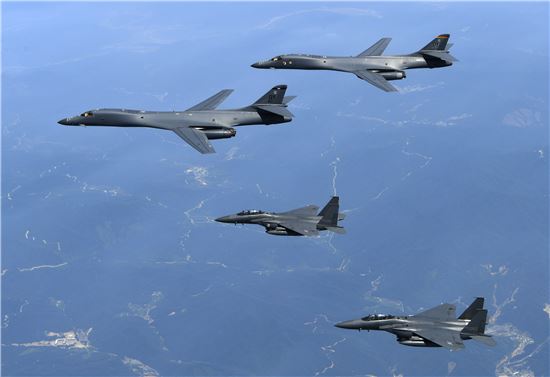 US Air Force Strategic Bomber B-1B
According to diplomatic and security authorities on the 3rd, President Yoon recently stated in an interview with the Chosun Ilbo, "We are discussing the concept of joint planning and joint exercises on nuclear issues with the U.S. for effective extended deterrence, and the U.S. is quite positive about it." However, President Biden, upon returning from vacation and entering the White House in Washington D.C., was asked by reporters whether they are currently discussing joint nuclear exercises with South Korea, to which he replied, "No."
Joint planning and joint exercises on nuclear matters differ in meaning from nuclear war exercises. Joint planning means reflecting South Korea’s position in the U.S.’s nuclear policy, strategy, operational plans, and rapid deterrence and response measures. Based on this, the U.S. conducts exercises deploying nuclear strategic assets on the Korean Peninsula, which constitutes the joint exercises.
The South Korea-U.S. defense authorities agreed at the 54th Security Consultative Meeting (SCM) held last November to hold an annual extended deterrence means operation exercise (DSC TTX) assuming North Korea’s nuclear use scenarios in response to changes in North Korea’s nuclear strategy and capabilities.
On the other hand, nuclear war exercises are terms possible only among nuclear-armed countries. South Korea, which does not possess nuclear weapons, cannot conduct nuclear war exercises with the U.S. President Biden is expected to give a negative answer in this context as well.
Kim Eun-hye, the presidential office’s chief spokesperson, also said on the 3rd, "President Biden’s remark was a straightforward response to the question of whether they are discussing ‘nuclear war exercises,’ so naturally he had to say ‘No.’ The two countries are discussing information sharing, joint planning, and joint execution plans regarding the operation of U.S. nuclear power assets to respond to North Korea’s nuclear threat."
Accordingly, South Korea and the U.S. are expected to begin various combined exercises as early as the first half of the year. Shin Beom-chul, Deputy Minister of National Defense, said the day before that Korea-U.S. joint planning and joint exercises are a higher-level concept of deploying U.S. strategic assets, adding, "It is about upgrading the overall planning and practical training on how South Korea and the U.S. will respond in specific situations where North Korea uses nuclear weapons under the Yoon Suk-yeol administration," and "Such exercises will take place at some point."
The exercises currently under discussion include ‘SNOWCAT,’ where U.S. nuclear delivery strategic bombers B-2 or B-52 operations are supported by allied fighter jets. Among the three pillars of U.S. nuclear power, joint exercises involving strategic bombers are considered the most effective way to send deterrence messages. The deployment of a U.S. B-52 strategic bomber near the Korean Peninsula escorted by the South Korean Air Force for combined exercises on the 20th of last month also falls under the broad meaning of SNOWCAT.
Joint exercise plans for nuclear delivery means are also becoming possible. In the past, after North Korean provocations heightened tensions in Northeast Asia, the U.S. sent B-52 bombers to the Chikdo firing range to conduct exercises dropping simulated warheads. This is a NATO-level SNOWCAT.
A military official forecasted, "Korea-U.S. joint planning and exercises on nuclear matters will strengthen deterrence against North Korea and enhance trust in extended deterrence guarantees for South Korea."
© The Asia Business Daily(www.asiae.co.kr). All rights reserved.
![Clutching a Stolen Dior Bag, Saying "I Hate Being Poor but Real"... The Grotesque Con of a "Human Knockoff" [Slate]](https://cwcontent.asiae.co.kr/asiaresize/183/2026021902243444107_1771435474.jpg)















