Yongin Severance Hospital Ophthalmology Professor Jiyongwoo's Team
Detection of Brain Disease Biomarkers Through Aqueous Humor
Development of a Biosensing System for Diagnosis
Expected to Help Delay Progression of Various Neurological Diseases
and Assist in Determining Prevention and Treatment Timing
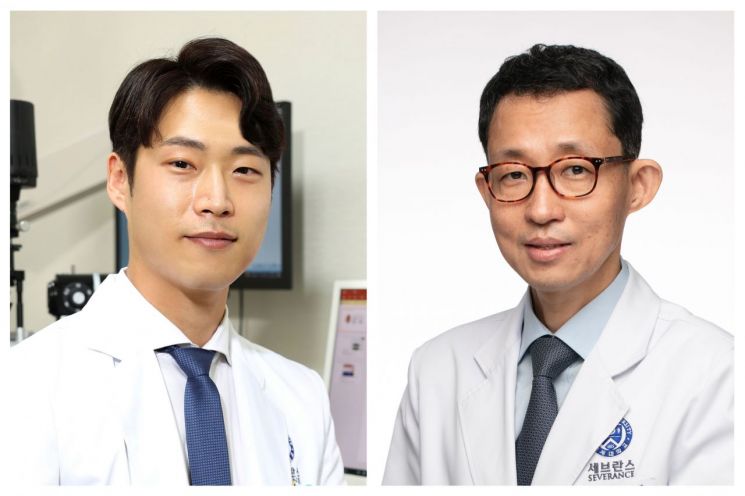 Professor Ji Yong-woo, Department of Ophthalmology, Yongin Severance Hospital (left), Professor Lee Hyung-geun, Department of Ophthalmology, Gangnam Severance Hospital.
[Asia Economy Reporter Lee Gwan-ju] Domestic researchers have succeeded in developing smart intraocular lens technology that can diagnose various neurological diseases through the eyes.
Professor Ji Yong-woo from the Department of Ophthalmology at Yonsei University College of Medicine's Yongin Severance Hospital and Professor Lee Hyung-geun from Gangnam Severance Hospital's Department of Ophthalmology announced on the 3rd that they have developed a smart intraocular lens through joint research with the Department of Chemical and Biological Engineering at Yonsei University College of Engineering and the Nano Process Laboratory at the Korea Institute of Machinery and Materials.
Intraocular lenses have so far been used solely for vision improvement purposes. The research team has been conducting research for years to enable early diagnosis of brain diseases through ocular fluids such as tears and aqueous humor, inspired by the eye’s characteristics of being directly connected to the brain and allowing internal observation. To detect biomarkers through the eye and actually utilize them for diagnosis, an appropriate biosensing system is required, and this technology was developed for that purpose.
When the hydrogel pattern conjugated with antibodies reacts with the target biomarker, it contracts. The smart intraocular lens detects biomarkers based on the principle of using changes in the moir? signal generated when the contracted pattern overlaps with a reference grid.
Using the moir? signal allows for nanoscale high-sensitivity detection compared to directly observing changes in the hydrogel. Additionally, it enables intuitive detection without using electrochemical or fluorescent markers commonly employed in existing biosensors, and it does not require external power or light sources, making it suitable as an implantable sensor. The moir? signal can be observed through a slit-lamp microscope used in frontline clinics, making postoperative monitoring easy.
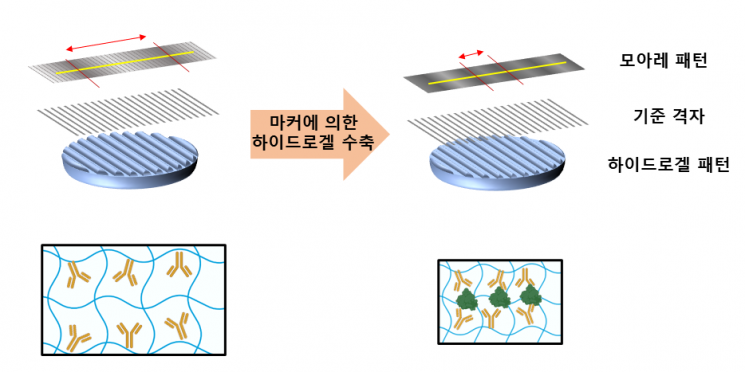 The smart intraocular lens detects biomarkers based on the principle of using changes in the moir? signal generated when the contracted hydrogel pattern, narrowed by the reaction with the target biomarker, overlaps with the reference grid.
The safety of the surgery to implant the smart intraocular lens has already been proven. Intraocular lens implantation is performed as part of cataract surgery, which is the most frequently and safely performed surgery worldwide. It also ranks first in the number of surgeries annually in Korea.
The research team used all materials for technology development with future commercialization in mind, utilizing those previously used in existing intraocular lenses or other human implants. They also confirmed biocompatibility, safety, and biomarker detection capability through human ocular cell experiments, ex vivo pig eye experiments, and preclinical in vivo experiments using live rabbits.
This development is evaluated as laying the foundation for equipping intraocular lenses with diagnostic sensing capabilities to detect biomarkers of various neurological diseases, including ophthalmic diseases and degenerative brain diseases, enabling early diagnosis. It is also expected that the smart intraocular lens will help slow disease progression, prevent diseases, and determine appropriate treatment timing.
Professor Ji said, "With the rapid increase in the elderly population entering a super-aged society, age-related eye diseases such as cataracts and degenerative brain diseases like Alzheimer's dementia have simultaneously emerged as serious social problems. We hope that the smart intraocular lens will play a significant role in preventing and early diagnosing degenerative brain diseases in the future."
This research was published in 'Bioactive Materials' (IF 16.874), a top international journal in the field of biomaterials.
The research team has filed patents related to smart intraocular lens technology domestically and internationally and plans to accelerate commercialization of the core technology by securing about 3 billion KRW over three years through the 'Nano Connect Project' in industry-academia-hospital collaboration with Korea I-Tech, the only intraocular lens manufacturer in Korea.
© The Asia Business Daily(www.asiae.co.kr). All rights reserved.
![Clutching a Stolen Dior Bag, Saying "I Hate Being Poor but Real"... The Grotesque Con of a "Human Knockoff" [Slate]](https://cwcontent.asiae.co.kr/asiaresize/183/2026021902243444107_1771435474.jpg)

















