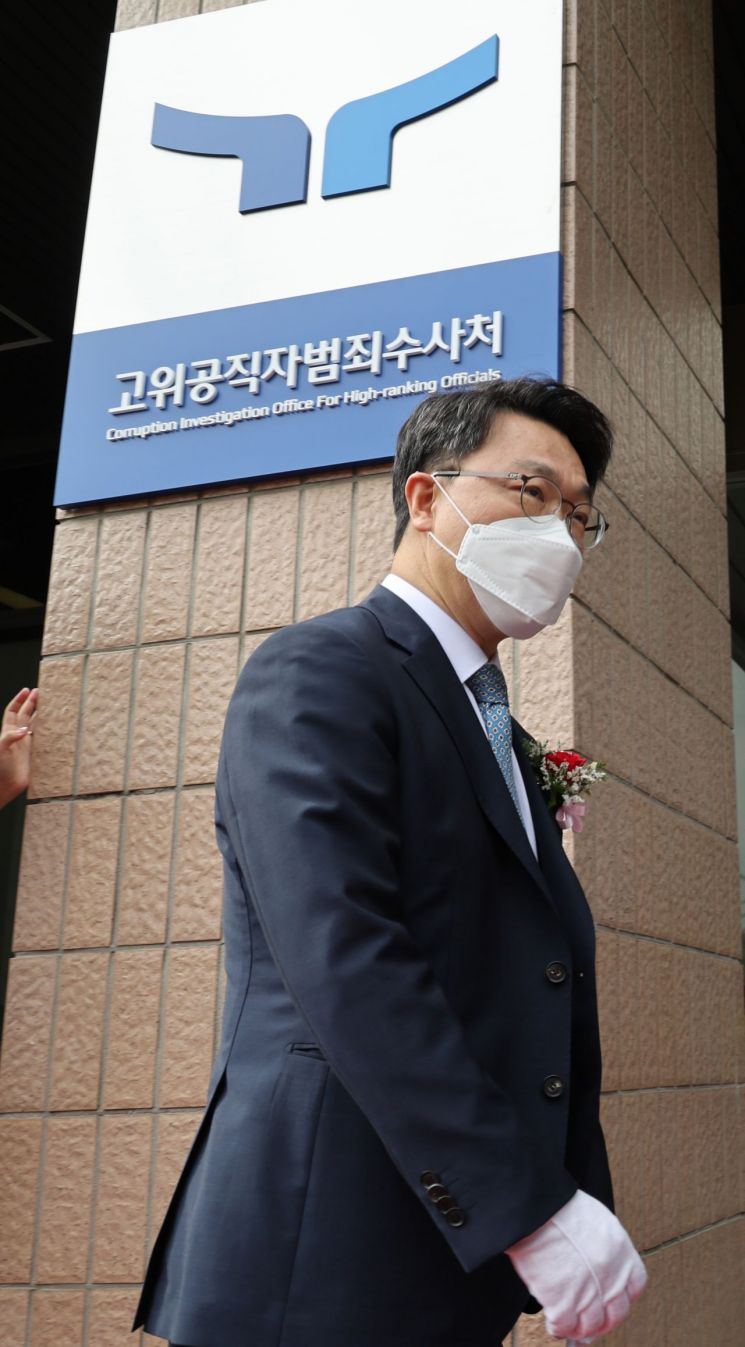
 Kim Jin-wook, Chief of the Corruption Investigation Office for High-ranking Officials (CIO) [Photo by Yonhap News]
[Asia Economy Reporter Kim Hyung-min] According to the legal community on the 3rd, Kim Jin-wook, the head of the High-ranking Officials' Crime Investigation Office (Gong-su-cheo), started his New Year's work after holding a kick-off ceremony the previous morning. The ceremony was held quietly with only internal members attending, without any external guests. It is said that the news of the ceremony was not disclosed outside. This appears to be due to awareness of criticism from political and legal circles over the modest investigation record left during the two years since its launch.
There is a forecast that a considerable amount of attention from the legal community will be directed toward Gong-su-cheo this year. This is because this year is Kim's final year in office. Kim, who took office as the inaugural head in January 2021, will end his term in January 2024. The fate of Gong-su-cheo is expected to depend on how Kim leads during the remaining year.
However, the reality is not easy. The government, which shows a policy of reducing Gong-su-cheo's investigative functions, is expected to take concrete actions this year. In particular, the government can push for the abolition of Gong-su-cheo's "priority investigative authority," which was guaranteed under Article 24 of the Gong-su-cheo Act, at any time. Additionally, the scope of corruption crimes subject to direct investigation by the prosecution has expanded through amendments to the Ministry of Justice's enforcement decree, allowing the prosecution to investigate bribery and corruption cases involving high-ranking officials, thereby putting pressure on Gong-su-cheo and making it difficult for it to function properly. There is also analysis that the government's recent decision to reinforce the inspection team under the Public Service Management Officer of the Prime Minister's Office will further narrow Gong-su-cheo's standing.
The top priority task for Gong-su-cheo, which needs to show change, is its personnel composition. Kim is likely to focus on completing the personnel composition early in the year. Within this month, one chief prosecutor and three prosecutors are scheduled to be hired. Once the hiring is completed, Gong-su-cheo is expected to fill its quota of 25 prosecutors. Afterwards, organizational restructuring and personnel measures may be implemented, such as establishing departments essential for investigations and assigning suitable personnel. In the "Final Report on Organizational Capacity Enhancement" created in November last year, Gong-su-cheo stated the need to increase the proportion of trial prosecutors, secure prosecutors for the parliamentary response investigation department, establish an asset recovery organization, and improve the three-year term for prosecutors.
Through this, Gong-su-cheo must demonstrate its capabilities in investigations and trials. The key issue is whether it can properly investigate the "living power." On the 30th of last month, Gong-su-cheo received a complaint from the civic group "Citizens' Action for Judicial Justice (Sasehaeng)" against Minister of Justice Han Dong-hoon. Sasehaeng claimed that Minister Han disclosed suspect information and leaked official secrets when explaining the arrest consent bill for Democratic Party lawmaker Roh Woong-rae in the National Assembly. Gong-su-cheo will soon decide how to handle this case. Gong-su-cheo also receives court judgments on major cases. On the 27th, Cho Hee-yeon, the Seoul Metropolitan Office of Education Superintendent, who is accused of unfairly specially hiring dismissed teachers, will receive the first ruling at the Seoul Central District Court. This case was the "No. 1 case" investigated by Gong-su-cheo after its launch. The bribery case of Chief Prosecutor Kim Hyung-jun, who was indicted as the first case, was acquitted in the first trial and is now preparing for the second trial.
Meanwhile, in the political arena, the Democratic Party of Korea is showing a supportive atmosphere for Gong-su-cheo by proposing more than four bills to expand Gong-su-cheo's personnel and scope. This is also analyzed as a device to check the current government, which seeks to expand the prosecution's investigative authority. Conflict with the ruling party seems inevitable. Lawmakers Kwon In-sook and Ki Dong-min each included provisions in the Gong-su-cheo Act amendment bill to expand the number of Gong-su-cheo prosecutors from 25 to 40, investigators from 40 to 80, and administrative personnel from 20 to 80.
© The Asia Business Daily(www.asiae.co.kr). All rights reserved.

















