[Asia Economy Reporter Byeon Seon-jin] Attention is focused on whether the high-intensity quarantine measures to prevent the spread of COVID-19 originating from China will effectively block the domestic inflow of variant viruses. Experts say that since international travel is free, it is impossible to completely block the inflow of variant viruses, but they emphasize the importance of slowing the spread through strengthened quarantine so that the healthcare system can function properly.
After mandatory PCR testing for foreigners from China... 1 in 8 tested positive
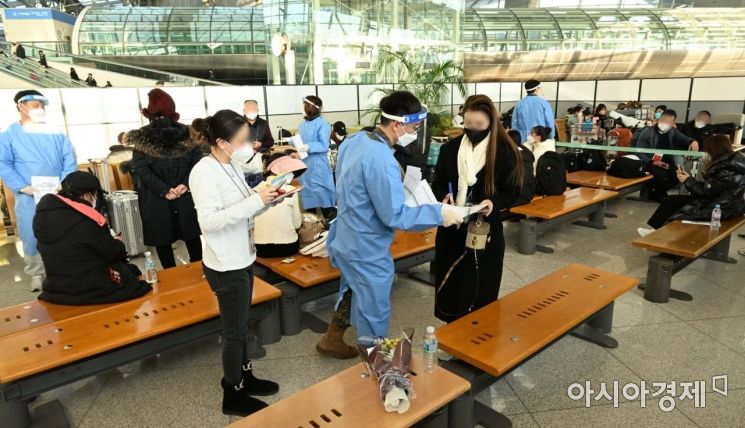 On the 2nd, when the high-intensity quarantine measures for COVID-19 testing of arrivals from China were implemented, arrivals from China at Incheon International Airport Terminal 1 underwent COVID-19 tests and waited for the results at the waiting area. / Yeongjongdo - Photo by Jinhyung Kang aymsdream@
According to the Korea Disease Control and Prevention Agency on the 3rd, a total of 1,092 passengers from China arrived at Incheon Airport on the 2nd, when flights from China were consolidated to this airport. From that day, foreigners with short-term stays of 90 days or less coming from China must undergo a polymerase chain reaction (PCR) test at the testing site upon arrival. As of 5 p.m., among 718 arrivals (269 Koreans and 449 foreigners), test results were available for 106 people. Among them, 13 people (12.3%) tested positive. This means 1 in 8 people tested positive. As more tests are conducted and results come out, the number of confirmed cases is expected to increase.
The problem is that the maximum capacity of the currently secured temporary home quarantine facilities is 100 people. Considering the trend that 149 confirmed cases from China arrived over seven days from December 26 to January 1 last year, the capacity of facilities for seven-day quarantine is likely to be severely insufficient.
Also, since Koreans and long-term foreign residents must get tested at public health centers and wait at home until results come out even if they arrive from China, this is one of the factors increasing concerns about variant spread. Due to the suspension of short-term visa issuance within China from the 2nd to the 31st to block travel demand to Korea, the proportion of Koreans and long-term foreign residents on flights from China is expected to gradually increase.
No way to block indirect entry... Variant inflow from the U.S. also a loophole
For arrivals by air and sea from Macau and Hong Kong, there are no separate high-intensity quarantine restrictions, which is also causing controversy. Because of this, posts are being shared on Chinese online communities suggesting that one can take a bus from Shenzhen (Shenzhen·深?) in China to Hong Kong and enter indirectly. Regarding this, Jeong Gi-seok, head of the COVID-19 Special Response Team and member of the National Infectious Disease Crisis Response Advisory Committee, explained at a regular briefing on the 2nd, “Since this is the first measure, the policy was first announced for China, which has the largest number of arrivals. Going forward, we will consider checking whether arrivals through hub airports, including Hong Kong, have stayed in China within the last 10 days.”
Quarantine experts expect that the high-intensity quarantine measures for arrivals from China will at least slow the rapid spread of variant viruses.
Professor Cheon Eun-mi of the Respiratory Medicine Department at Ewha Mokdong Hospital said, “Even with strong quarantine measures, since some Chinese people enter indirectly through neighboring regions such as Hong Kong and Macau, it is impossible to completely block the inflow of variant viruses,” but added, “By isolating confirmed cases through quarantine, the inflow speed can be significantly slowed.” She explained, “If the spread is slow, the public can acquire natural immunity while focusing care on severe patients, but if the opposite happens and densely populated areas like the Seoul metropolitan area are infected, the healthcare system cannot sustain itself, and excess deaths will occur.”
Recently, the XBB.1.5 variant, which is rapidly spreading in the U.S., has already entered the country, increasing concerns for health authorities. Derived from BA.2, XBB was first detected domestically on December 8 last year, with a total of 13 cases confirmed (6 domestic and 7 imported). The XBB.1.5 variant is known for its very high immune evasion ability, allowing infection even after vaccination, but unlike arrivals from China, it does not undergo separate PCR testing.
Emphasis on slowing variant inflow... "Public should prepare through vaccination"
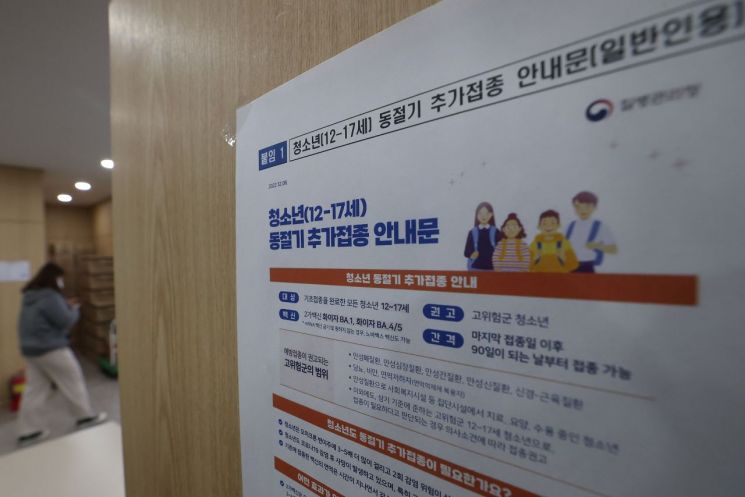
Since it is impossible to completely block the domestic inflow of new variants, health authorities urge vaccination to prepare for them. Committee member Jeong Gi-seok compared unvaccinated severe patients to “jaywalking accidents,” stating, “People get flu vaccines, so there is no medical reason not to get the COVID-19 vaccine, which causes more severe, longer-lasting illness and has a higher fatality rate than the flu.”
© The Asia Business Daily(www.asiae.co.kr). All rights reserved.


















