2021 Production Value 98.2 Billion KRW... 20% Increase YoY
Increased Hospital Consumption... Demand Expansion Due to Government Support
The medifood market continues to show stable growth. This is because it offers the advantage of easy nutritional management, steadily increasing demand not only from patients and the elderly population but also from chronic disease patients and the general public. Last year's production value is also expected to exceed 100 billion KRW.
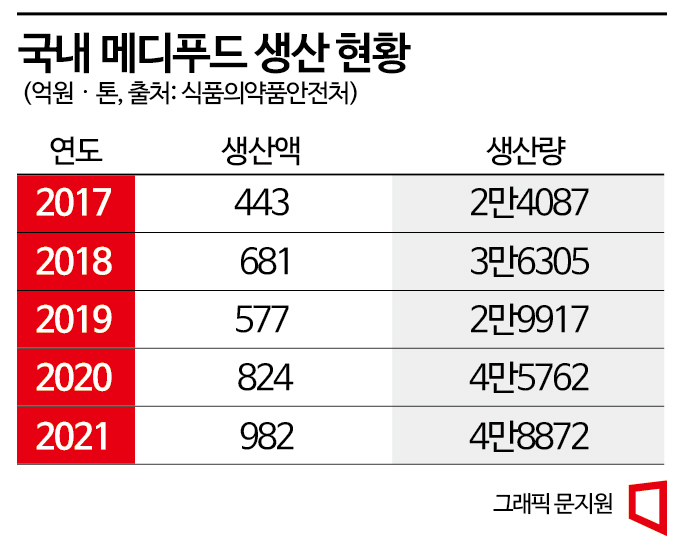
According to the Ministry of Food and Drug Safety on the 3rd, the domestic medifood production value in 2021 was 98.2 billion KRW, showing a 19.2% increase compared to 2020. The medifood production value, which was around 44.3 billion KRW in 2017, grew by more than 50% to 68.1 billion KRW the following year, and continued to grow, more than doubling in size over four years until 2021. Considering the recent growth trend, last year's production value is expected to have easily surpassed 100 billion KRW.
During the same period, production volume also increased rapidly. In 2021, domestic medifood production volume was 48,872 tons, a 6.8% increase compared to the previous year (45,762 tons). The production volume, which was 24,087 tons in 2017, grew by 50.7% to 36,305 tons in just one year, and exceeded 40,000 tons in 2020, showing a 102.9% growth over four years until 2021.
Medifood refers to foods manufactured and processed to supply sufficient nutrition or to restrict or supplement certain nutrients for people who have limited ability to normally ingest, digest, absorb, or metabolize food, or who have different physiological nutritional requirements due to clinical conditions such as disease or surgery.
Domestic medifood is accelerating its growth thanks to increased consumption within hospitals and nursing hospitals by patients hospitalized for surgery or disease treatment. Additionally, as the society enters an aging phase, the elderly population and chronic disease patients are increasing, and demand for convenient nutritional management is rising, expanding production scale. Furthermore, oral products, which are relatively easy to consume, are also consumed by the general public besides patients, which is another factor driving demand growth. Moreover, since December 2019, the Ministry of Agriculture, Food and Rural Affairs and the Ministry of Food and Drug Safety have selected medifood as one of the five promising food sectors and announced market development plans, adding government support that is boosting market growth.
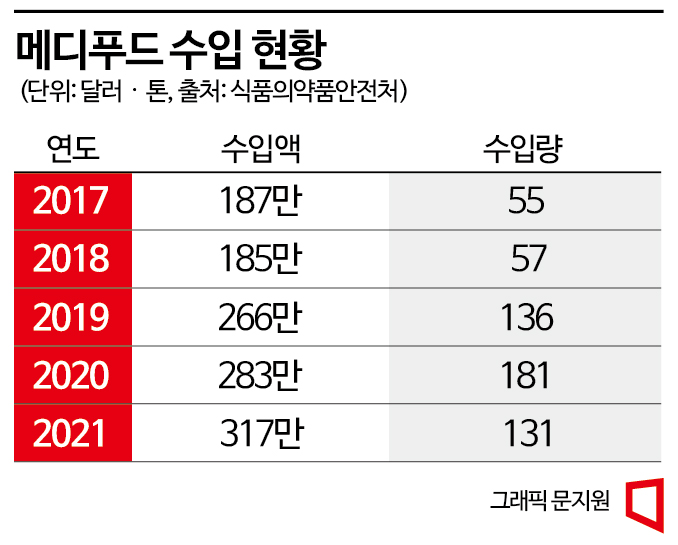
Currently, most of the medifood produced domestically is consumed within the country, with imports exceeding exports. As of 2021, export value was only 800,000 USD (about 1 billion KRW), while import value was around 3.17 million USD (about 4 billion KRW). The domestic medifood industry is a latecomer compared to Europe, the United States, and Japan, and differences in medifood classification systems by country make exports difficult. On the other hand, imports are steadily increasing due to the aging population and increased health awareness caused by COVID-19, which has expanded the domestic medifood market and increased demand for various products needed by consumers.
The product category with the largest import and export volume is food for patients with congenital metabolic disorders, accounting for 92.5% of total exports and 62.1% of imports. Other products are patient foods. Food for congenital metabolic disorder patients currently has small domestic production and production scale but steady demand, leading to active imports. Patient foods are partially imported by Daesang and Korea Medical Food from Japan and the United States, respectively, for dysphagia patients’ thickening foods, and Namyang Dairy Products imports and sells the 'Prejubin' product, while Handok imports and sells 'Neogate.'
© The Asia Business Daily(www.asiae.co.kr). All rights reserved.


















