President Yoon's First New Year's Address Since Inauguration
Economy Mentioned 11 Times, Exports 6 Times, North Korea '0'
Labor Reform Identified as Top Priority
[Asia Economy Reporter Baek Kyunghwan] President Yoon Seok-yeol's 1900-character New Year's address fully reveals the Yoon administration's governance philosophy in its second year, centered on the economy and reform. He identified exports as the foundation of the economy and declared, "I will personally oversee export strategies," pledging to find new export engines to expand South Korea's export territory. His commitment to reform was also clear. Using the term 'vested interests,' he warned that a country mired in such interests "has no future."
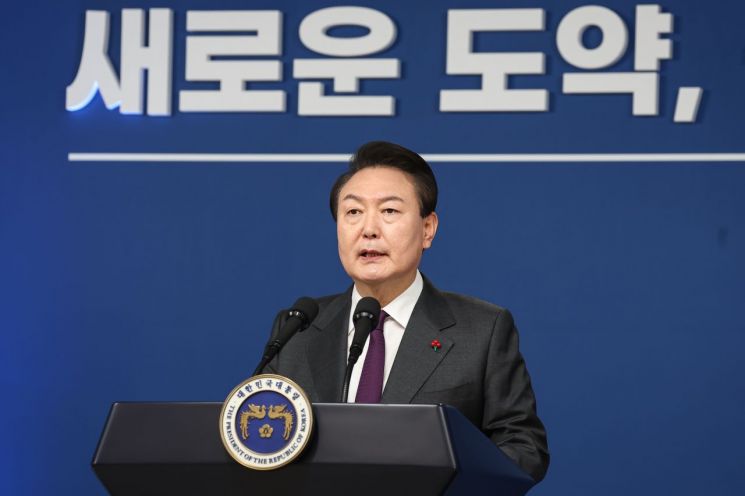
According to the Presidential Office on the 2nd, President Yoon's New Year's address, which was broadcast live for about 10 minutes the previous day from the briefing room of the Yongsan Presidential Office, was held with only aides present instead of the usual New Year's press conference conducted by previous presidents. The address contained keywords from the economic policies President Yoon introduced over the past six months last year.
Possibility of Global Economic Recession Again This Year... "Breakthrough Through Exports"
In his New Year's address, President Yoon mentioned 'economy' 11 times, 'exports' 6 times, and 'reform' 8 times. This was to strongly convey to the public on the first day of the new year the firm commitment to push forward the three major reforms and expand export capabilities. Contrary to expectations that the address would confirm a tough stance on North Korea, he did not mention North Korea even once, focusing solely on the 'economy.'
Evaluating the domestic and international economic situation last year as "challenging both inside and outside the country amid the complex crisis and uncertainty of the global economy," President Yoon foresaw that the global economy this year is more likely than ever to face a recession. Accordingly, he promised, "We will closely monitor the severe economic situation where the impact of the global economic downturn could lead to a slowdown in our real economy," and "We will proactively manage to ensure that the inevitable interest rate hikes to curb inflation do not expand into excessive debt burdens for households and businesses."
He chose exports as the breakthrough. President Yoon said, "We must overcome the complex crisis through exports," adding, "Our export strategy must be different from the past." He further explained, "Countries that share universal values such as freedom, human rights, and the rule of law are forming economic and industrial solidarity, and solidarity based on universal values is the most strategic choice in the current diplomatic reality."
In fact, the Yoon administration mobilized all ministries on multiple fronts last year to promote exports. When South Korea's economic pillar, exports, was at risk, differentiated detailed strategies such as the 'three major key markets' and 'three major strategic markets' were introduced. The government is also accelerating the establishment of a dedicated export support system across all ministries. President Yoon, who views overcoming the global complex crisis through export promotion as essential, personally chaired export strategy meetings and set the goal of becoming one of the 'world's top five export powers.'
Pointing Out Entrenchment in Maintaining Vested Interests, 'Labor Reform' as a Driver of Economic Growth
His commitment to the three major reforms was emphasized by elaborating on all three areas: labor, education, and pensions. In particular, President Yoon identified 'labor reform' first, stating, "A country mired in maintaining vested interests and seeking rents has no future." He stressed, "We must drive our economic growth through labor reform," and added, "We will make every effort to flexibly reform the labor market to meet changing demands, establish fairness in labor-management and labor-labor relations, and improve workplace safety."
He also pointed out the dual structure of the labor market. President Yoon explained, "Government support should be differentiated between companies transitioning to job-based and performance-based pay systems and those stuck in seniority-based systems due to compromises with aristocratic, militant unions." He said, "The starting point of such labor reform is labor-management rule of law," emphasizing, "Labor-management rule of law is the way to prevent unnecessary disputes and conflicts and truly respect the value of labor."
This reflects President Yoon's intention to pursue future labor reforms based on the rule of law in principle. Having previously suppressed the Cargo Solidarity collective transport refusal incident on a 'principled' basis, he is expected to respond firmly and according to principles to union opposition to reforms.
Regarding education reform, he stated, "We will boldly transfer authority over higher education, which is directly linked to our country's competitiveness, to local regions and support linking it with local industries." President Yoon said, "Without such education reform, achieving regional balanced development is difficult," adding, "Regional balanced development is the shortcut to solving the low birthrate problem, and we will diversify curricula so that the future generation can receive the education they desire and ensure everyone enjoys fair opportunities."
Regarding pension reform, he mentioned, "Countries that have succeeded in pension reform share the commonality of aiming for social consensus through long-term research and discussion to reach conclusions," and said, "We will swiftly promote scientific investigation and research on pension finances, gather public opinion, and conduct public discourse to submit reform proposals to the National Assembly."
No New Year's Press Conference but Encouragement to Various Figures
On this day, opposition parties criticized President Yoon for choosing a 'solo New Year's address' instead of a New Year's press conference, saying, "President Yoon, who promised to communicate with the people after relocating the Presidential Office, is building a wall of non-communication."
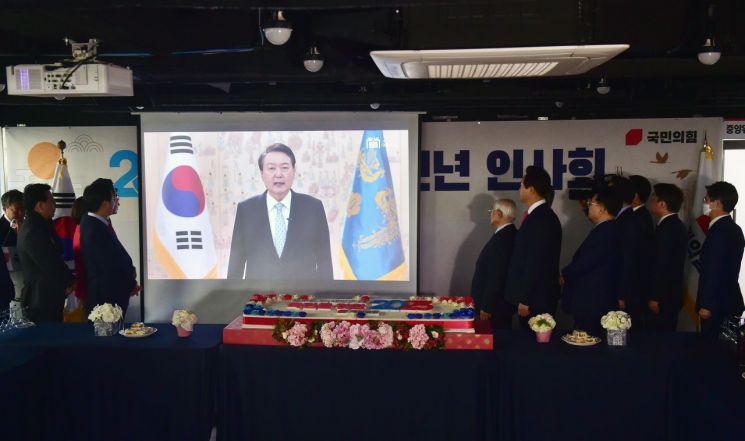
Lee Kyung, the standing deputy spokesperson of the Democratic Party of Korea, issued a statement titled 'The Only President to Skip the First New Year's Press Conference After Inauguration,' saying, "To become the only president since the 1987 direct presidential election system to skip the first New Year's press conference is to regress to the military regime era where the New Year's address was simply read and ended," and criticized, "Even former military-origin President Roh Tae-woo held a New Year's press conference. No president since then has avoided the first New Year's press conference after election."
The Presidential Office evaluates that communication with the public has been sufficiently achieved, citing strategic meetings chaired directly by President Yoon and broadcast live to the public at the end of last year. Internally, there was also analysis that instead of communicating with the public through a press conference format, the time President Yoon spends directly meeting the public is more effective in securing governance momentum and boosting approval ratings.
On this day as well, President Yoon extended words of encouragement to various figures, including researchers working at the Jang Bogo Antarctic Research Station and the Barakah Nuclear Power Plant in the United Arab Emirates (UAE), firefighters who worked hard to rescue lives at major accident sites, and a police officer who became a father of twins on New Year's Day.
After a phone call with Nam Jong-seok, captain of the Buk-myeon Volunteer Fire Brigade at Uljin Fire Station, who worked on-site during the longest wildfire in history in Uljin, Gyeongbuk, last March, President Yoon instructed his aides, "We must provide the world's best safety equipment," and said, "Please carefully ensure that individuals do not have to purchase safety equipment themselves due to the state's failure to provide it promptly."
© The Asia Business Daily(www.asiae.co.kr). All rights reserved.


















