Electricity Rates to Rise by 13 Won per kWh in Q1 Next Year
Energy Public Enterprises Face Limits Due to Deficit Impact
4-Person Household Sees 4,022 Won Rate Increase
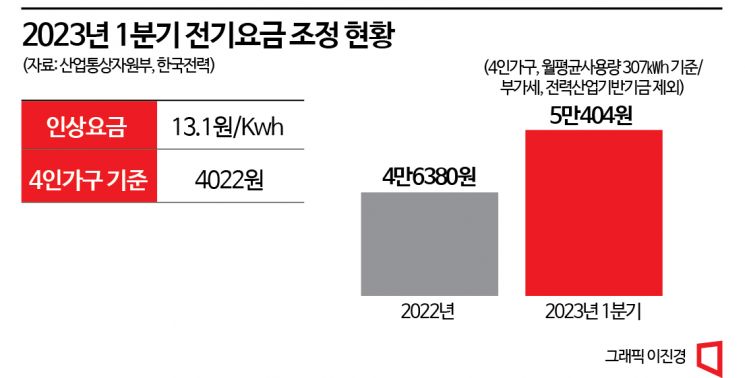
[Asia Economy Sejong=Reporter Dongwoo Lee] The government's decision to significantly raise electricity rates by more than 13 KRW per kWh in the first quarter of next year stems from the judgment that it can no longer overlook Korea Electric Power Corporation's (KEPCO) losses amid the surge in energy prices. Analysts say that the increase is also supported by the negative impact on the trade balance caused by the rise in import costs due to soaring international energy prices.
The government stated regarding next year's electricity rate hike, "The deficits of energy public enterprises such as KEPCO and Korea Gas Corporation are spreading burdens across the entire economy, even adversely affecting the bond market." Although the government has implemented high-intensity self-help measures amounting to 14 trillion KRW and 10 trillion KRW respectively to improve the financial conditions of KEPCO and Korea Gas Corporation, it has acknowledged the limitations of overcoming the financial crisis without reasonable rate increases.
In fact, KEPCO's deficit is expected to reach 21.8 trillion KRW by the third quarter of this year and is projected to increase to 34 trillion KRW by the end of the year. The industry expects the debt ratio to rise from 223.23% last year to 424.9% this year. This is because KEPCO has been selling electricity at a loss of about 60 KRW per kWh throughout the year, resulting in a deficit more than three times higher than last year.
The government attributes KEPCO's worsening management to the previous administration's reduction of low-cost power sources such as nuclear power and the increased proportion of power generation sources vulnerable to fuel cost volatility, such as liquefied natural gas (LNG), which has higher costs. Specifically, LNG prices rose 2.8 times compared to 2021, and bituminous coal prices increased 3.9 times last year, causing power generation costs to skyrocket.
The industry estimates that if electricity rates are raised by 13.1 KRW per kWh in the first quarter of next year, KEPCO will gain an additional profit of approximately 6.55 trillion KRW. In this case, the corporate bonds issued by KEPCO for operational funds are expected to decrease from an average of 2.5 trillion KRW per month to about 830 billion KRW. The government plans to raise electricity rates by around 50 KRW in four installments next year. This is expected to offset KEPCO's deficit of about 30 trillion KRW this year.
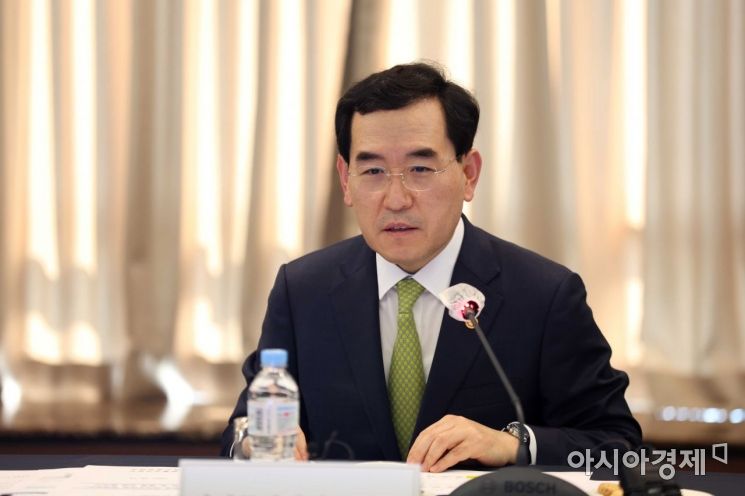 Minister Lee Chang-yang of the Ministry of Trade, Industry and Energy is speaking at the signing ceremony of the win-win agreement for the activation of eco-friendly biofuels and the industry meeting held at the Press Center in Jung-gu, Seoul on the 13th. Photo by Moon Ho-nam munonam@
The problem is that the increase in public utility rates acts as a factor that fuels inflationary pressure. Since consumer prices have risen by more than 5% this year, marking the highest level in 24 years since the foreign exchange crisis, the electricity rate hike could impose additional burdens on the low-income economy.
The government's additional rate hike plan is also a concern. To normalize KEPCO's management, the government is considering a total rate increase of around 50 KRW throughout next year. Although gas rates will be frozen in the first quarter of next year under this plan, an increase ranging from a minimum of 8.4 KRW to a maximum of 10.4 KRW per megajoule (MJ) is likely. The expectation is that electricity rates, which require urgent increases, will be raised first, and gas rates will be raised more substantially starting from the second quarter of next year.
To alleviate the burden on the low-income economy, the government plans to provide energy vouchers and offer focused support to small and medium-sized enterprises (SMEs) and mid-sized companies struggling with energy efficiency management through a three-part package of 'efficiency diagnosis - loans/subsidies - smart management.' In particular, for energy-intensive companies such as root enterprises, the government intends to provide concentrated support for replacing high-efficiency equipment such as transformers, injection molding machines, and pumps through the Energy Efficiency Resource Standard (EERS) program for energy suppliers.
Professor Seunghoon Yoo of the Department of Energy Policy at Seoul National University of Science and Technology said, "The government's phased electricity rate increase plan is an inevitable choice as long as it does not increase the burden on low-income households. However, an additional average increase of about 50 KRW next year will be necessary to normalize KEPCO's management."
© The Asia Business Daily(www.asiae.co.kr). All rights reserved.
![Clutching a Stolen Dior Bag, Saying "I Hate Being Poor but Real"... The Grotesque Con of a "Human Knockoff" [Slate]](https://cwcontent.asiae.co.kr/asiaresize/183/2026021902243444107_1771435474.jpg)

















