Chairman of the Joint Chiefs Highlights Drone Provocation, North Korean Drone Infiltration Occurs 10 Days Later
Joint Air Defense Drill Proposes Measures Addressing Drone Provocation
[Asia Economy Yang Nak-gyu, Military Specialist Reporter] The Joint Chiefs of Staff announced that they will conduct a joint air defense exercise assuming drone provocations. This measure came 10 days after Chairman of the Joint Chiefs of Staff Kim Seung-gyeom visited the Army's 5th Corps headquarters and air defense positions on the 16th and instructed, "North Korea's drone threats are also becoming more sophisticated," and "We will maintain thorough readiness according to operational procedures in case of enemy drone provocations," following another drone intrusion into the skies over Seoul.
On the 28th, the Joint Chiefs of Staff reported follow-up measures such as strengthening practical training and exercises for drone response and promoting early operational deployment of response capabilities during an emergency inquiry at the National Assembly's National Defense Committee.
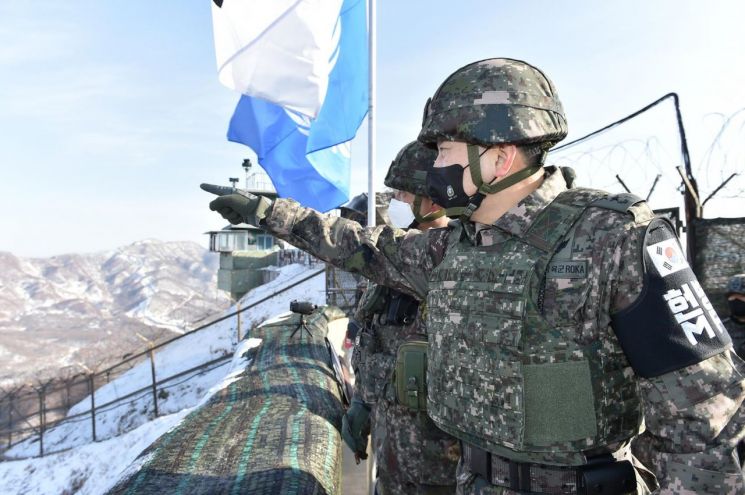
The military held an emergency operational commanders' meeting chaired by Chairman Kim Seung-gyeom the previous day to discuss response measures related to the North Korean drone airspace intrusion incident. According to the Joint Chiefs of Staff, considering the pattern of provocations by North Korean small drones, they decided to strengthen integrated practical training at the Joint Chiefs level. Accordingly, a joint air defense exercise to prepare for North Korean small drone provocations is scheduled for the 29th.
They also decided to establish an optimized operational execution system to prepare for North Korean small drone threats by making the best possible use of current forces. The detection radius of North Korean drone surveillance assets (local air defense radar, low-altitude detection radar, thermal imaging surveillance equipment) will be expanded deep into North Korean territory, and measures for mutual target distribution between surveillance assets and strike assets will also be devised.
This decision was based on the assessment that local air defense radars detected some North Korean drones but ground strike assets (interceptor weapon systems) failed to detect them, resulting in no attempts to shoot them down. They are also exploring ways to integrate and operate Army and Air Force strike assets by region.
In regions operating Air Force KA-1 light attack aircraft, Army Apache helicopters (AH-64), 500MD helicopters, and ground interceptor weapon systems, these will be packaged together for response.
The mid-to-long-term plan is to accelerate the operational deployment of drone response systems. At the strategic and operational levels, they plan to establish drone units reflecting trends in scientific and technological development and warfare patterns, and to shorten the deployment timeline of essential assets such as drone strike assets as much as possible.
Meanwhile, the Joint Chiefs of Staff also reported on the five North Korean drones' airspace intrusion and the military's response measures on the 26th. According to the Joint Chiefs, one North Korean drone was first detected by the 1st Corps local air defense radar at 10:25 a.m., and the situation of intrusion into South Korean airspace continued until 3:20 p.m. After moving south to the northern part of Seoul and then northward, it disappeared from radar.
At 12:57 p.m., the Air Force Operations Command identified four additional drones and tracked them until 3:20 p.m. These four drones moved south toward Ganghwa Island and the West Sea area but later disappeared from detection networks.
The military raised the overall alert posture to level 2, and the Air Force Operations Command issued the 'Durumi' posture, which is the readiness posture for North Korean drone response. 500MD, Surion, Apache, and Cobra helicopters, along with F-15K, F-5, F-16 fighters, and KA-1 light attack aircraft were scrambled.
The Marine Corps conducted six warning broadcasts and five warning shots at guard posts, and a Cobra helicopter fired 100 self-destructing incendiary rounds at a target detected by the TOD over Jumundo Island toward the southwest sea, but failed to shoot it down.
The military launched drones north of the Military Demarcation Line (MDL) and the Northern Limit Line (NLL) in proportional response to North Korea's drone provocations. Additionally, manned and unmanned reconnaissance assets were operated close to the MDL direction. The Joint Chiefs explained that this was the operational route before the September 19 military agreement. During this process, the Joint Chiefs reported that coordination between South Korea and the U.S. was conducted through a phone call between Chairman Kim and Combined Forces Commander Paul LaCamera.
Earlier, President Yoon Suk-yeol received a report on drone response from Defense Minister Lee Jong-seop on the morning of the 27th at the Yongsan Presidential Office before the Cabinet meeting, and reportedly strongly reprimanded, saying, "What on earth have you been doing all this time?" according to a presidential office official.
At this meeting, President Yoon reportedly questioned, "How can there be no place prepared to respond to North Korean drone attacks? Similar incidents have happened several times in the past, so what have you been doing until now?" Following this, the security situation review meeting continued throughout the morning, and attendees including Minister Lee did not attend the Cabinet meeting but instead focused on discussing ways to strengthen readiness.
© The Asia Business Daily(www.asiae.co.kr). All rights reserved.

















