Announcement of the "3rd Basic Plan for National Statistics Development"
[Asia Economy Sejong=Reporter Lee Jun-hyung] The government is developing statistics related to unpaid household labor to establish labor policies. It will also advance national greenhouse gas statistics as part of carbon neutrality efforts.
On the 28th, Statistics Korea announced that it submitted the "3rd Basic Plan for National Statistics Development (2023?2027)" to the National Assembly after review and approval by the National Statistics Committee. The Basic Plan for National Statistics Development is a mid- to long-term roadmap outlining policy goals the government will pursue over the next five years to advance national statistics. According to the Statistics Act, the government must establish a Basic Plan for National Statistics Development every five years. This plan will be applied from next year through 2027.
Through this plan, the government decided to develop 29 new statistics and improve 59 existing ones. This is to provide statistics reflecting social and economic structural changes such as low birth rates and aging, and to strengthen support for data-driven policy making. A Statistics Korea official said, "We will provide timely statistics reflecting changes in the economic and industrial structure through major economic statistics reforms," adding, "We will also develop and improve statistics that can support environmental policies, such as greenhouse gas statistics and green industry status statistics."
Accordingly, Statistics Korea will begin developing the "National Time Transfer Account" from next year. This statistic shows the age-wise distribution of production, consumption, and transfer of unpaid household labor, which is not included in the Gross Domestic Product (GDP). From 2024, Statistics Korea will also develop the Regional Supply and Use Table, a matrix describing the entire regional economy from the perspective of production and consumption of goods and services.
Development of 'Vacant House Statistics'
Statistics showing the status of vacant houses nationwide will also be newly developed. To accurately grasp housing price trends, the Korea Real Estate Board's nationwide housing price trend survey will be improved. From next year, the government will develop comprehensive pension statistics and dementia status surveys to support elderly policy formulation. The dementia status survey is expected to include dementia care costs.
Environmental statistics will also be improved. The government plans to advance the "National Greenhouse Gas Statistics System (GIRS)" starting in 2024 to more accurately calculate national greenhouse gas statistics. Since greenhouse gas statistics must be submitted to the United Nations Framework Convention on Climate Change (UNFCCC) from December 2024, there is a need for a greenhouse gas statistics system reflecting the international guideline, the Enhanced Transparency Framework (ETF). The ETF is a system under which UNFCCC parties transparently report greenhouse gas-related statistics so that anyone can access them.
From 2024, the government will also develop statistics on the status of regional green industries to establish a five-year plan for the development direction of green convergence clusters. Additionally, water management statistics such as Korean hydrological statistics and sewage statistics will be improved.
Integration of Government Statistics Websites
The government’s online statistics portals will be integrated. Previously, the government disclosed statistical data through the National Statistical Portal (KOSIS), e-Nara Indicators, and the Statistical Geographic Information Service (SGIS). However, to enhance user convenience, these public statistical service websites will be consolidated into a single platform.
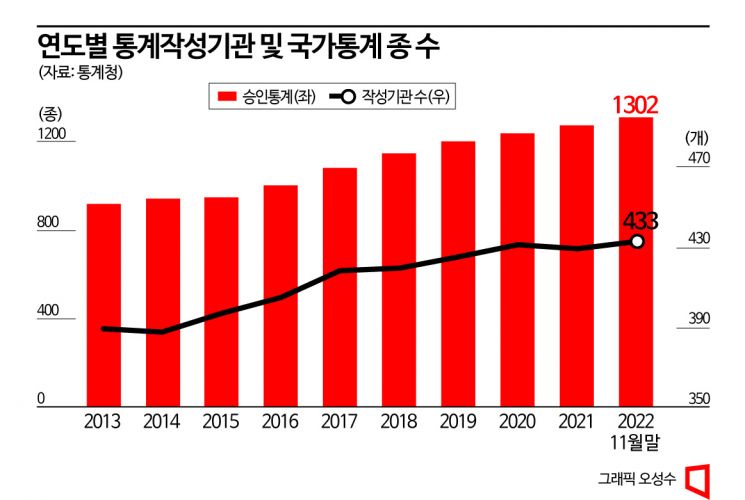
Meanwhile, the current status of national statistics is also included in this Basic Plan. This year, there are 1,302 nationally approved statistics, a 41.2% increase compared to 922 in 2013 when the 1st Basic Plan for National Statistics Development began. This year, there are 333 statistical producing agencies, with an average of three statistics produced per agency.
Han Hoon, Commissioner of Statistics Korea, said, "We have newly established the Basic Plan for National Statistics Development to expand the production and service of national statistics, which are scientific decision-making tools," adding, "We ask for the cooperation and support of central administrative agencies, local governments, and statistical producing agencies to ensure the smooth implementation of the plan over the next five years."
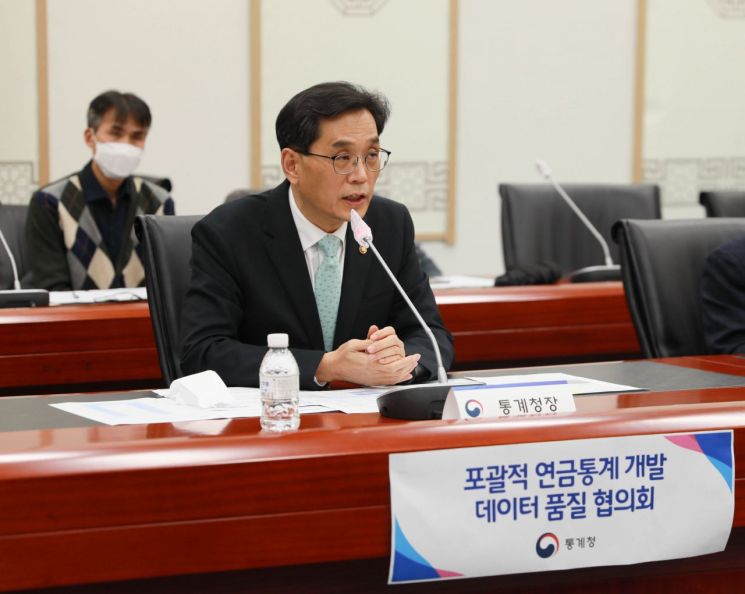 Han Hoon, Commissioner of the Korea National Statistical Office, giving a greeting
 (Seoul=Yonhap News) Han Hoon, Commissioner of the Korea National Statistical Office, is giving a greeting at the '1st Comprehensive Pension Statistics Development Data Quality Council' held at the Statistics Center in Seo-gu, Daejeon on December 6, 2022. [Provided by the Korea National Statistical Office. Resale and DB reproduction prohibited]
Photo by photo@yna.co.kr
(End)
<Copyright(c) Yonhap News Agency, unauthorized reproduction and redistribution prohibited>
© The Asia Business Daily(www.asiae.co.kr). All rights reserved.


















