Number of Tariff-Quota Items Increased from 83 to 101... Support Amount Rises by 1 Trillion Won
Extension of Duty-Free Food Items... Including Chicken and Pork
[Asia Economy Sejong=Reporter Lee Jun-hyung] The government is significantly expanding the list of items subject to tariff quotas to stabilize prices and supply. Some emergency tariff quota items, such as rare gases used in semiconductor processing triggered by supply instability due to the Ukraine crisis, will be converted into regular tariff quota items. The duty-free measures applied to food items such as chicken and pork will be extended for up to six months.
The Ministry of Economy and Finance finalized and announced the "2023 Flexible Tariff Operation Plan" containing these details on the 27th. Earlier that day, the government reviewed and approved the "Amendment to the Regulations on the Application of Tariff Quotas" and the "Amendment to the Regulations on the Application of Adjustment Tariffs" at the Cabinet meeting for next year's flexible tariff operation plan. This flexible tariff operation plan will be applied from January 1 to December 31 of next year.
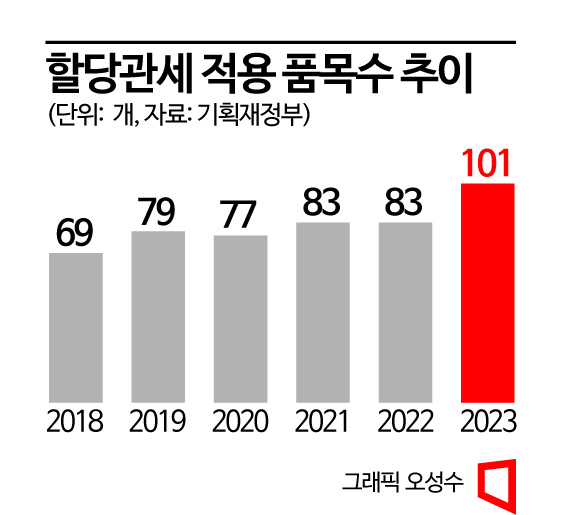
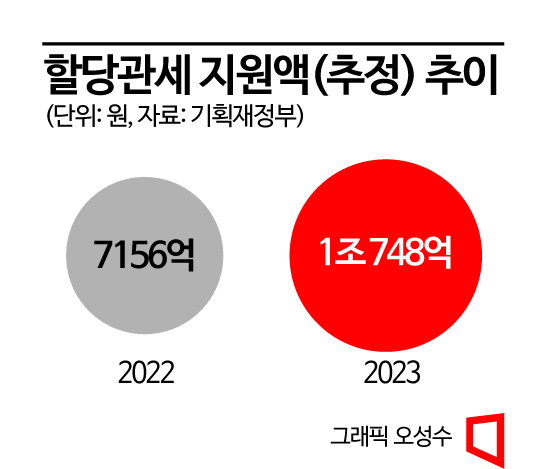
The number of items subject to tariff quotas next year is 101, an increase of 18 from this year's 83. This is the result of the government expanding tariff quota items mainly for agricultural and livestock products such as pork, chicken, and cooking oil to stabilize prices and supply. This is the first time the number of tariff quota items has exceeded 100, marking the largest scale ever. The government's estimated tariff quota support amount will also increase by 359.2 billion KRW, from 715.6 billion KRW this year to 1.0748 trillion KRW next year.
Conversion of Rare Semiconductor Gases to Regular Tariff Quotas
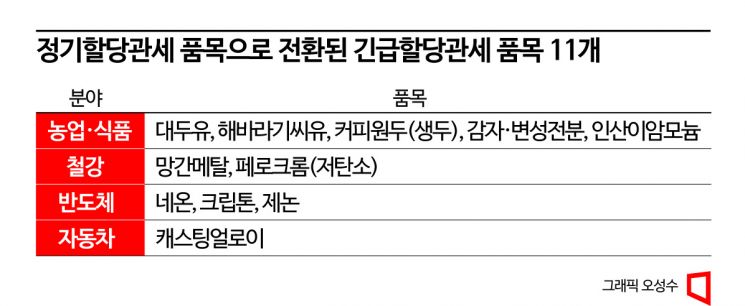
Notably, some emergency tariff quota items have been converted into regular tariff quota items. The government decided to convert 11 items that were subject to emergency tariff quotas this year into regular tariff quota items starting next year. In the agricultural and food sector, five items including soybean oil, sunflower seed oil, coffee beans (green beans), potatoes and modified starch, and ammonium phosphate will be converted to regular tariff quota items. In the steel sector, manganese metal and low-carbon ferrochrome, and in the automotive sector, casting alloys have been selected for conversion to regular tariff quota items.
Three rare gases necessary for semiconductor photolithography and etching processes?neon, krypton, and xenon?will also become regular tariff quota items. Earlier this year in March, immediately after the Ukraine crisis, the government applied emergency tariff quotas to neon, krypton, and xenon, reducing the tariff rate from the existing 5.5% to 0%. This was because the domestic semiconductor industry heavily depends on Russia and Ukraine for supplies of these three items. By converting them into regular tariff quota items, the duty-free application period will be extended compared to before.
Duty-Free Pork Extended Until First Half of Next Year
The emergency tariff quota measures on imported food items have been extended by 2 to 6 months depending on the item. Specifically, for onions, which have a basic tariff rate of 50%, a 10% tariff quota will be applied until February next year. Chicken and mackerel will maintain a 0% tariff until March next year. Duty-free measures for three items?pork, processed egg products, and refined sugar?will be extended until the first half of next year. As a result, chicken, which previously had tariffs of 20-30%, and pork, which was subject to tariffs of 22.5-25%, can both be imported duty-free for the time being.
To alleviate the burden of electricity and heating costs during winter, the government also expanded the reduction of energy tariffs. The government decided to lower the tariff rate on liquefied petroleum gas (LPG), which had a 2% tariff quota, to 0% from next month until March next year. Liquefied natural gas (LNG) will also be duty-free for three months from January to March next year. Typically, the government applies a 2% tariff quota on LNG during the winter heating demand season.
Meanwhile, the government plans to apply adjustment tariffs to 13 agricultural and fishery products and 14 items including naphtha next year. Currently, adjustment tariffs have been temporarily abolished for pollock and naphtha, but adjustment tariffs will be applied from March 1 and July 1 next year, respectively. A Ministry of Economy and Finance official said, "(Adjustment tariffs) will be operated within a reasonable range after carefully reviewing the necessity to prevent domestic market disruption and protect the industrial base."
© The Asia Business Daily(www.asiae.co.kr). All rights reserved.
![Clutching a Stolen Dior Bag, Saying "I Hate Being Poor but Real"... The Grotesque Con of a "Human Knockoff" [Slate]](https://cwcontent.asiae.co.kr/asiaresize/183/2026021902243444107_1771435474.jpg)


















