North Korea's Cruise Missile Engine Could Enable Medium-Altitude UAVs
Possibility of Biochemical Weapon UAVs Raised
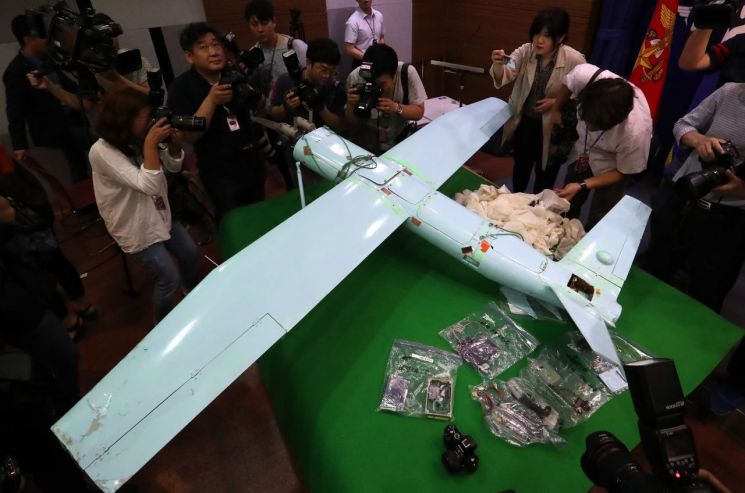
[Asia Economy Yang Nak-gyu, Military Specialist Reporter] As North Korea's drones evolve, there are calls for countermeasures against attacks on our rear areas. This is because it becomes more difficult to defend as North Korea's drones have longer flight ranges and higher altitudes.
According to the military on the 27th, North Korea emphasized the "completion of drones" as one of the five-year defense development plans at the 8th Congress of the Workers' Party in January last year. This means they intend to focus on drone development to offset the inferiority of their air force capabilities.
In fact, North Korean drones have steadily advanced. The flight range of three drones discovered in 2014 was only 180 to 300 km. Later, the drones found in 2017 switched to twin engines. The engines used a mixture of oil and gasoline. Typically, drones use "glow engines," but by modifying to gasoline engines, they increased endurance and flight range. Glow engines use synthetic lubricants such as nitromethane (30%) and methanol (70%) as fuel. These engines produce about half the power of gasoline engines that use gasoline.
There are concerns that the long-range cruise missile engine developed this year could be applied to drones. North Korea claimed in January that two cruise missiles hit target islands 1,800 km away in the East Sea. Applying this engine to drones means it is possible to develop medium-altitude unmanned reconnaissance drones (MUAV) currently being developed domestically. Shin Seung-gi, a research fellow at the Korea Defense Research Institute, said, "If North Korea equips drones with engines over 1,000 pounds like those used in cruise missiles, they would effectively be medium-altitude drones," adding, "Reconnaissance is necessary to strike targets, and after striking, it is necessary to assess the results, so it would be necessary from North Korea's perspective."
Still Insufficient Preparedness Against Drones... Rear Areas Completely Undetectable
On the other hand, the South Korean military's preparedness against drones is still considered insufficient. In 2014, ten Israeli tactical low-altitude radars (RPS-42) were introduced but were only deployed in parts of Seoul, including the Blue House. These can detect small drones under 2 meters within 10 km, but it is known that they failed to detect the recent drones. The local air defense radar system (TPS-880K), whose development was completed in 2017, is expected to take time before deployment to rear areas. Rear areas are completely undetectable, meaning preemptive measures and strike decisions must be made before North Korean drones cross over.
Strike means are also inadequate. The South Korean military uses anti-aircraft weapons such as the 'Biho' self-propelled anti-aircraft gun and the 'Biho Complex' equipped with portable anti-aircraft missiles, as well as Apache and Cobra attack helicopters and KA-1 light attack aircraft for shoot-down operations. However, they failed to shoot down the recent drones. The Defense Acquisition Program Administration has started developing a "Korean-style jammer" capable of neutralizing North Korean drones, but development will be completed in 2026. Shin Jong-woo, Secretary General of the Korea Defense and Security Forum (KODEF), said, "The problem is not so much the lack of defense systems against North Korean drones but the command's accurate and rapid judgment," adding, "This time, the initial response failed, missing the timing for a strike."
There are also claims that North Korean drones could carry biological and chemical weapons, posing a serious threat to South Korean security. According to a report by Voice of America (VOA), military expert Bruce Bennett, senior researcher at the RAND Corporation, estimated that North Korea possesses hundreds of drones that could be used to carry high-performance explosives or biological and chemical weapons.
On the previous day, five North Korean drones crossed the Military Demarcation Line (MDL) and violated the airspace over Seoul, Ganghwa, and Paju for over five hours. In response, our military dispatched fighter jets, helicopters, and light attack aircraft. This is the first time in over five years since June 2017 that North Korean drones have violated South Korean airspace.
© The Asia Business Daily(www.asiae.co.kr). All rights reserved.
![Clutching a Stolen Dior Bag, Saying "I Hate Being Poor but Real"... The Grotesque Con of a "Human Knockoff" [Slate]](https://cwcontent.asiae.co.kr/asiaresize/183/2026021902243444107_1771435474.jpg)
















